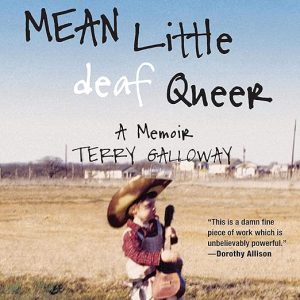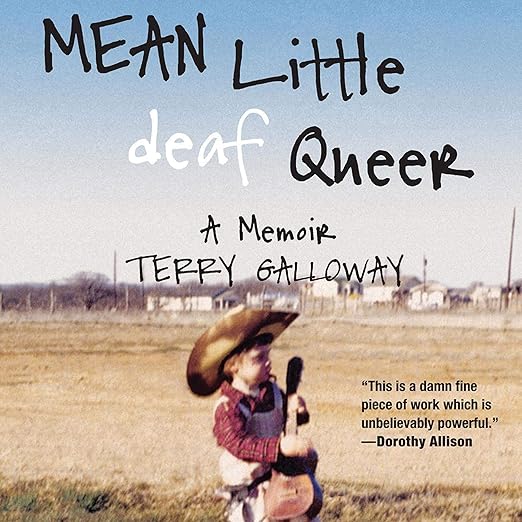
- Read by: Elizabeth Hess reads with a theatrical awareness that suits Galloway's own background in performance, capturing the memoir's dark comedy without undercutting its emotional weight.
- At its heart: Disability and queer identity as overlapping and distinct experiences, theater as survival mechanism, the body as site of institutional damage
- Vibe: Irreverent and affecting in equal measure, with the particular energy of someone who has decided that laughter is the most accurate response to the absurd
- Short version: Terry Galloway's memoir earns its cult status because it refuses to be only one thing, and Elizabeth Hess's narration honors that refusal.
Terry Galloway's Mean Little Deaf Queer begins in 1959, when Galloway turned nine and the voices of everyone she loved began to disappear. An experimental antibiotic given to her mother during pregnancy had damaged her fetal nervous system, and the deafness that followed was not discovered immediately. What makes this audiobook worth discussing in the same breath as the best disability memoirs of the past few decades is that Galloway refuses from the outset to organize her story around either suffering or triumph. She is interested in something more specific and more useful: the experience of living in a body that the world was not designed for, and the theatrical strategies she developed to make that life not just bearable but genuinely her own.
The title alone signals the register: Mean Little Deaf Queer. It is the kind of self-description that claims an insult and turns it into a declaration, and Galloway's whole memoir operates in that mode. She is not asking for sympathy. She is giving you a tour of a life that has been, by turns, bewildering, hilarious, painful, strange, and full of people she loves who are equally strange. The fact that this memoir exists as an audiobook requires a brief acknowledgment of the obvious irony: Galloway's deafness is central to her story, and hearing it read aloud creates a layered experience that the print edition cannot replicate.
The Child Who Fakes Her Own Drowning
Galloway's use of theater as both subject and structural principle is the most distinctive element of the memoir. She has been a theater artist throughout her adult life, and the theatrical mode of performance, of audience relationship, of playing a version of yourself for strategic purposes, runs through her account of everything from her camp-for-crippled-children years to her mental breakdowns to her queer relationships. One reviewer described the memoir as doing something remarkable: "transmuting Terry Galloway's unique, quirky, anguished, sometimes goofy but nevertheless powerful individual narrative into a larger exploration of the way we tell stories to ourselves and to others in order to construct our places in the world."
That is an accurate account of what Galloway is doing, and it is harder than it sounds. Most memoirs that attempt to move from the personal to the universal do so by becoming vague, shedding specificity in favor of applicability. Galloway goes the other direction: she becomes more specific as the book progresses, and the universality emerges from that specificity rather than from abstraction. The character of the "child freak" who fakes her own drowning at camp is not a type; she is Galloway, at nine, doing what she has to do to get through a situation that no adult has prepared her for.
Hess Keeps the Dark Comedy's Timing Intact
Elizabeth Hess is the right narrator for this material. She has a theatrical background that allows her to inhabit Galloway's voice without imitating it, keeping the dark comedy's timing intact while letting the emotional passages land with appropriate weight. The memoir's tonal range is considerable: from the broadly comic to the genuinely distressing, sometimes within the same paragraph. A narrator without Hess's sense of comedic timing would flatten that range into either sentimentality or ironic distance; Hess navigates between those poles with real skill.
At eight hours and seventeen minutes, the runtime is substantial but appropriately paced for memoir. Galloway's chapters are structured around specific events and periods, which gives the audiobook natural resting points without the narrative feeling episodic. The memoir was reviewed alongside work by Dan Savage, Alison Bechdel, and Augusten Burroughs in one reader's account, and that context is useful: Mean Little Deaf Queer belongs in the tradition of queer memoir that uses personal experience to construct larger social observations, rather than simply documenting a life for its own sake.
Deafness, Not Queerness, Is the Analytical Center
One reviewer noted that while Galloway is both deaf and a lesbian, the deafness proves to be the more structurally central element of the memoir's analysis. The queer identity is present and important throughout, but Galloway's extended engagement with how her deafness has shaped her relationship to language, communication, theater, and the performing self is the dominant intellectual concern of the book. Listeners who come primarily for the queer narrative may find the disability analysis given more sustained attention.
The memoir's mental breakdown passages require some preparatory awareness. Galloway does not dramatize these experiences for emotional effect; she reports them with the same candor she brings to everything else, which actually makes them more affecting rather than less. The effect of reading her account of psychiatric hospitalization in the same deadpan register she uses for the camp episodes is not to minimize the distress but to insist that all of these experiences belong to the same life, narrated by the same person, and deserve the same quality of attention.
Shelved Beside Kenny Fries and Raymond Luczak
Readers of disability memoir, queer memoir, and theater-adjacent personal writing will find this audiobook essential. It belongs alongside Kenny Fries's Body, Remember and Raymond Luczak's collected work as a document that takes the intersection of disability and queer identity seriously without treating either as the subordinate element of the other. Listeners who prefer their memoirs strictly chronological or emotionally straightforward will find Galloway's associative structure and tonal range demanding; this is a book that requires you to track irony and grief simultaneously, and it rewards that effort.
Before You Listen
Is there any irony in listening to a deaf memoirist's audiobook, and does the text acknowledge this?
The irony is real and Galloway is a writer precise enough to be aware of such layering. The audiobook does not address the format directly, but listening to a narrative about the loss of hearing and the construction of a theatrical voice is an experience that adds resonance rather than contradiction.
How does this audiobook balance the queer identity content with the disability narrative?
One reviewer and the memoir's own structure confirm that Galloway's deafness is the more structurally dominant element of the analysis, while her queer identity is integrated throughout rather than treated separately. Both are given serious attention, but they are not weighted equally across the memoir's arc.