The Short Version
- Narration: No reviews are attached yet to confirm Kimberley Loomis's specific delivery, but the tour-guide format calls for warm, unhurried clarity over dramatic performance.
- Themes: Louvre history, art theft and restoration, architecture as political symbol
- Mood: brisk, curious, museum-guide energy
- Verdict: A well-organized, fact-dense primer for anyone curious about the Louvre beyond the Mona Lisa, though it is a survey rather than a deep scholarly text.
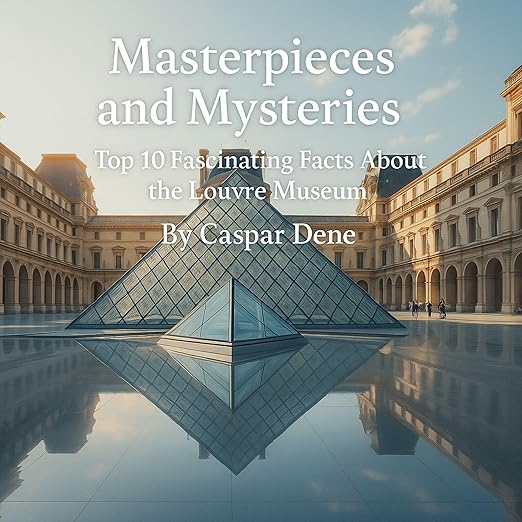
A twelfth-century fortress built to keep invaders out of Paris is not the image most people carry of the Louvre, but that origin story opens this audiobook and sets the tone for everything that follows. Architectural historian Caspar Dene structures the whole two-hour-and-thirty-six-minute runtime around ten specific facts, moving from medieval battlements through royal palace, revolutionary seizure, Napoleonic plunder, wartime evacuation, and finally the glass pyramid that once scandalized the city it now defines. It is less a comprehensive history than a guided tour of the moments when the building itself became the story.
Ten Facts, No Reviews Yet to Judge Loomis
The ten-fact structure is the book's smartest choice: rather than attempting an exhaustive institutional history, Dene picks specific turning points, the 1911 theft of the Mona Lisa, the wartime evacuation of thousands of artworks into châteaux across France, the discovery of the Winged Victory sculpture shattered into pieces before its restoration, and lets each one carry a self-contained narrative. That format suits a shorter audiobook far better than a chronological march through eight centuries would, and it means a listener can absorb the whole thing in a single sitting without losing the thread.
No listener reviews are attached to this listing yet, leaving no outside confirmation of narrator Kimberley Loomis's specific delivery choices. What the material itself demands is clear enough: an engaging, unhurried clarity closer to a knowledgeable museum guide than a lecture hall, since Dene's own prose already leans toward vivid, story-forward description rather than dense academic argument. The book's overall success ultimately rests on whether that guide voice comes through consistently and clearly across all ten segments.
A Thesis Sentence Disguised as a Description
Two of the ten facts extend the story well past Paris itself: the Louvre Abu Dhabi, described in the book as a genuine global sisterhood extension of the original museum, and the Historical Axis, the grand line of monuments running from the Arc de Triomphe through to the modern Grande Arche, both push listeners to think about the Louvre as an ongoing institution rather than a fixed historical relic.
The book's own opening description of the Louvre as a fortress, a palace, a treasure house of revolutions, and a stage for mysteries is doing more work than a simple flourish; each of those four words maps onto one or more of the ten facts that follow, fortress to the twelfth-century stronghold, palace to the monarchy years, treasure house to Napoleon's spoils and the wartime evacuation, stage for mysteries to the Mona Lisa heist and the Winged Victory's shattered discovery. It is a tightly constructed thesis statement disguised as a single descriptive sentence.
Caspar Dene's credential as an architectural historian specifically, rather than a general art historian or museum studies writer, shapes which facts made the final ten: the Pyramid Scandal, the Fortress origins, and the Historical Axis are all fundamentally stories about buildings and city planning, while pure art-historical detail about individual paintings or sculptures stays relatively light. That specialization gives the collection a consistent point of view rather than a scattershot survey of Louvre trivia.
A Scar on Paris Becomes a Beloved Symbol
The Pyramid Scandal section alone justifies the listen: I. M. Pei's now-iconic glass pyramid was, per the book's own framing, once dismissed as 'a scar on Paris' before it became one of the museum's most beloved symbols, a reversal that says as much about how cities process change as it does about architecture. Pairing that story with the Mona Lisa's 1911 theft, which transformed a respected painting into a global celebrity practically overnight, gives the book a real thesis: the Louvre's most famous features often became famous through controversy, not immediate admiration.
The Winged Victory story is another highlight, a sculpture discovered shattered into pieces and reassembled by curators into what is now one of the museum's most striking displays, proof that even the museum's most celebrated objects sometimes arrived through accident and repair rather than a triumphant unveiling. Dene consistently chooses the human decisions behind the art rather than the art alone.
Revolution, Napoleon, and a Wartime Secret
The Revolutionary Change and Napoleon's Spoils sections work as a strong one-two punch: first the palace of kings becomes, during the French Revolution, a museum belonging to the people, transforming art from royal privilege into shared national heritage, and then Napoleon renames the whole institution after himself and fills it with treasures looted across Europe. Placed back to back, the two stories capture how quickly the Louvre's meaning could flip depending on who controlled it.
The Wartime Secret segment, covering how curators and staff secretly evacuated thousands of artworks into châteaux across France during the Second World War, adds real moral stakes to a book that could otherwise stay purely decorative; it is a reminder that preserving the Louvre's collection has, at points in history, required genuine courage and risk rather than simple maintenance.
Fifteen Minutes Per Fact, Built to Repeat
At two hours and thirty-six minutes for ten distinct facts, each segment gets roughly fifteen or sixteen minutes on average, which is enough for a vivid anecdote but not enough for sustained scholarly argument. Listeners wanting exhaustive art history, provenance debates, or curatorial detail should treat this as a starting point rather than a destination; it reads as a popularized entry built first for curious travelers and casual history fans, not specialists.
This is one entry in the Marvels in Stone: Amazing Buildings Around the World series, and the format, ten facts, one landmark, one relatively short runtime, appears designed to repeat across other buildings rather than stand alone as a definitive single work. Listeners who genuinely enjoy this particular approach should expect to look for companion entries covering other famous structures worldwide, rather than assuming this specific title is a one-off release.
Two Hundred Days to See Every Piece
Anyone planning a trip to Paris, or simply curious about the Louvre beyond the crowds gathered at the Mona Lisa, will get real value here, as will general history and art fans who prefer story-driven nonfiction over textbook density and footnotes. The runtime makes it an easy single-sitting listen rather than a long-term commitment.
Listeners planning a Louvre visit specifically will get outsized value from the Labyrinth of Art fact alone, the observation that seeing every piece in the museum would take more than two hundred days at just thirty seconds per work, since it reframes any single visit as a deliberate, curated sampling rather than an attempt at completeness.
A ten-fact, two-and-a-half-hour tour will not satisfy anyone looking for deep scholarly analysis or a comprehensive institutional history of the museum, and with zero listener reviews attached so far, no outside track record yet exists to confirm how the finished audio experience actually lands.