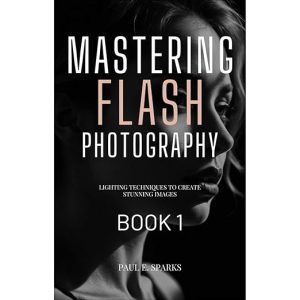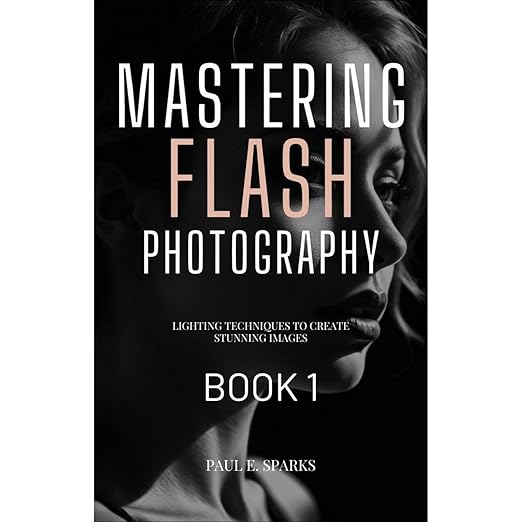
Picture the setup this audiobook asks you to picture: a light placed off to one side of a face, angled so the shadow falls exactly where the photographer wants it. Now do that without seeing a single diagram. Mastering Flash Photography Book 1 is a five-hour survey of built-in units, external flashes, speedlights, ring lights and studio strobes, of TTL against manual, of sync speed and high-speed sync, of gels and fill and balancing a flash against daylight. Virtual Voice carries the reading credit here, meaning synthetic delivery instead of a human performer. The subject is what light looks like. The medium is sound, and the distance between those two facts runs through everything below.
The Five Written Reviews Average Higher Than the Score
A one-star review does the most useful work on this listing, and it deserves reading before the enthusiastic ones. Erica R, writing in June 2024, grants that lighting has fundamentals worth knowing and then lands the objection that decides the purchase: the book has "no images, no diagrams or anything else to serve as guideposts for how to set up and use lighting." That is a structural complaint about a printed book on a visual craft, and it is not a small one. The same account describes the writing as high-level, without depth or substantial examples, compares it unfavorably to a machine-written draft, and reports reaching for Rembrandt lighting only to be told where to put the light and very little else.
Ratings reflect that split precisely. The listing shows 3.2 from thirteen votes, which is low by any standard, while the visible five run 5, 5, 4, 3 and 1, so the written pool actually averages higher than the score, which means most of those thirteen ratings arrived with no explanation and were unimpressed. The honest reading is that people either found this a genuinely useful introduction or found it close to worthless, with very little sitting in between, and which of those you get depends almost entirely on how much you already know before you press play.
Vocabulary Transmits Perfectly When You Just Listen
Five hours and twelve minutes on a single accessory is more attention than most photographers ever give the subject, and the coverage is genuinely broad. The description works through the history of flash technology, the differences between a built-in unit, a speedlight and a studio strobe, a flash unit's components and settings, power levels and zoom, care and maintenance, the TTL and manual modes, what sync speed limits and how HSS gets around it, off-camera triggering, fill technique, and using gels to match or contrast ambient light. Eric Shiers, a photographer of decades' standing, reports learning new things about flash from it and calls it very comprehensive, which is the strongest endorsement on the page and comes from the person best placed to judge whether anything is missing.
That breadth is exactly what a listening format handles well. Vocabulary is the hard part of flash for a beginner, and vocabulary transmits perfectly through sound: learning what TTL stands for and why you might leave it, understanding sync speed before you ever hit the limit, recognizing high-speed sync as a solution to a problem you have already had without knowing its name. An August 2024 review covers the same ground, running from the fundamentals and the nuances of various flash types through TTL and manual modes and out into off-camera work and blending flash with ambient light, and reports feeling prepared for the creative and technical possibilities afterwards. Prepared is the right word. Not competent, prepared.
Every Written Review Predates This Recording
Chronology is the thing to check first. This recording carries a release date of 2 April 2025. The five written accounts are dated June 2024 twice, then July, August and November of the same year, every one of them before this recording existed. They are describing a printed or digital book, which is why the sharpest criticism concerns missing diagrams: in print, a diagram is a reasonable thing to expect. In audio it was never available, so the complaint changes character entirely. What reads as a publishing failure in one format becomes an inherent limit of the other, and a synthetic reader cannot compensate, because it can only read out what the text says, and the text is precisely where the pictures are missing.
Repetition is the other recurring complaint, and it scales badly at this length. Christopher Grimes, giving three stars in November 2024, came looking for tips and techniques and found the author repeating the same explanations of what flashes are used for across different genres of photography. In print you skip a paragraph in two seconds. Across the full running time you sit through it. Two smaller data problems are worth noting while you are here. The description advertises the book as Mastering Flash Photography: Lighting Techniques to Create Stunning Images, a subtitle that appears nowhere in the listing title, and the series listing reads Mastering Flash Photography Books with no number in it, while the number sits inside the title as Book 1.
A Fine Theory Course, a Poor Craft Course
Beginners after vocabulary rather than technique will get something real out of this. Somebody who owns a flash, has never taken it off the camera, and could not define TTL will finish with a map of the territory and a list of things to go away and try. Amy N. describes buying it for a beginner photographer who wanted to understand flash, and reports that the techniques are being put to work, which is a secondhand verdict rather than a first-hand one and is also the clearest statement of the intended audience anywhere on the page. That is who this serves: the person who needs the words before the practice, and who would otherwise spend a year guessing at settings on the back of a camera.
If you already own a speedlight and use it every week, this will feel thin. Working photographers who want lighting recipes, ratios, worked examples and pictures of results will not find them, and that objection stands whichever format you buy. The deeper problem is that a book about a visual skill arrives in a synthesized voice with no visual component at either end, which is a legitimate way to learn the theory and a poor way to learn the craft. Pair it with something you can look at, or treat it as a vocabulary course and go and find your diagrams somewhere else.
Key Details
- At its heart: Speedlights and studio strobes, TTL against manual, the sync limit and how to beat it, gels and balancing flash with daylight.
- Vibe: Systematic, repetitive, and strictly theoretical.
- Short version: A vocabulary course for beginners and close to redundant for anyone who already owns a light stand.
A Few Questions About Mastering Flash Photography Book 1
Who narrates the Mastering Flash Photography Book 1 audiobook?
The credit reads Virtual Voice, so the delivery is synthetic and no human reader is involved. On a technical manual that matters less than it would on fiction, since the material is definitional rather than dramatic, but software also cannot slow down or clarify when the text leaves a step vague.
Does this audiobook include diagrams or example photographs?
No. The printed edition was criticized for lacking them, and in audio the question is settled by the format itself. Expect definitions, settings and procedures delivered entirely in words, and plan on a second source, a video or a workshop for anything you genuinely need to look at.
How much photography knowledge does this audiobook assume?
Very little. It starts from what a flash is and works upward through types of unit, power settings, TTL and manual modes, sync speed and off-camera triggering. If you know your way around aperture and shutter speed you have enough. Anyone already shooting regularly with strobes will find it elementary.