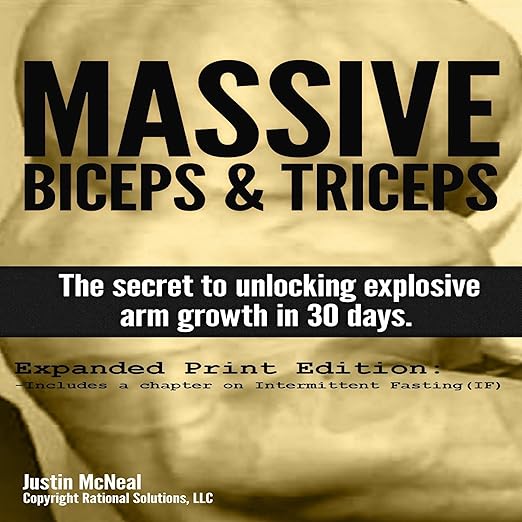
Justin McNeal's Massive Biceps and Triceps opens with a promise that its cover wears openly: ripped, ultra-muscular arms in thirty days, with only two arm sessions per week. That pitch is aimed squarely at the person who has not yet started training and is looking for a reason to begin. This audiobook, narrated by Philip Serkosky and running one hour and twelve minutes, is brief enough that the question is less about whether it covers everything and more about whether what it covers is accurate and useful. Serkosky reads the material with a motivational energy that suits a training guide - direct, forward-leaning, not drowning the listener in caveats. The answer to the accuracy question is partially yes: the fundamental principles underlying arm hypertrophy are sound, even if the specific gains promised in the marketing copy are significantly overstated.
A Closer Look at Massive Biceps and Triceps
The review landscape here is split, and the split reflects something real about the book. Readers with training experience - those who have actually lifted weights consistently for years - found the content shallow or internally inconsistent, with one reviewer questioning whether the author had practical gym experience at all. Beginners, by contrast, found it a useful starting framework. This gap is typical for entry-level fitness content, and it is worth being clear about where this title sits on the spectrum: it is a primer for people who have not yet started structured arm training, not a program for intermediate or advanced lifters. McNeal covers bicep and tricep exercises, the importance of progressive overload without using that term, nutrition basics, and the twice-weekly frequency that allows adequate recovery. These are correct principles, even if the framing overpromises on the timeline and the gains.
What Makes Massive Biceps and Triceps Worth Hearing
Seventy-two minutes is a short enough runtime that the audiobook format functions as a single focused session: a commute, a light cardio session, or a stretch routine can accommodate the entire thing. Serkosky's delivery keeps the energy up without becoming fatiguing, and the structure of moving through exercise selection, frequency, nutrition, and supplementation in sequence means the content lands in a logical order even without visual reference. The primary limitation of the audio format for any training guide applies here: there are no demonstrations. The exercise descriptions rely on verbal cues alone, and some of those cues - one reviewer specifically flagged a wrist-twist instruction that was confusing even with visuals - will be difficult to translate into correct movement without supplementary video. Beginners should plan to cross-reference with a video resource before attempting any exercise they have not already performed with supervision.
Things to Know Before Starting Massive Biceps and Triceps
The thirty-day timeline for half an inch to two inches of new arm circumference is aspirational at best. Natural muscle gain, even under optimal training and nutrition conditions, does not occur at this rate for most individuals. Listeners who approach this as motivation rather than as a literal prediction will get more from it. The twice-weekly arm-specific programming is a genuine framework that can be incorporated into a broader training split, but the book does not address how arm training fits into a full-body program, which is an important omission for anyone doing more than arm isolation work. The supplementation section is brief and general, which is appropriate for an entry-level guide. No specific products are recommended, which is a positive sign in a space prone to promotional content. The overall content is thin enough that experienced lifters will find nothing here that a basic gym orientation or a free online resource would not cover.
Who Justin McNeal Is Writing For
This audiobook suits complete beginners who want a short, accessible introduction to arm training before committing more time to a comprehensive program. The runtime is so short that the cost of a first listen is minimal, and for someone who genuinely does not know where to start, the framework it provides is sound even if it is not deep. Intermediate or advanced lifters will find nothing actionable here. Anyone intending to follow the program should pair it with video demonstrations of the exercises and set realistic expectations about the timeline. The rating of 3.6 across seventeen reviews reflects the experience of both audiences, and both assessments are accurate within their respective frames of reference.
One thing the book does well that its brevity makes easy to overlook is its treatment of recovery as an active part of training rather than simply the absence of training. The emphasis on sleep quality and hydration as performance variables - not afterthoughts but integrated components of a program - reflects current exercise science accurately and is the kind of foundational knowledge that beginners often do not encounter until they have already made preventable mistakes. Serkosky delivers these sections without the dismissive speed that can make recovery discussion feel like fine print; they get the same matter-of-fact authority as the exercise sections. For someone just beginning to think seriously about strength training after a long sedentary period, this kind of attentiveness to the whole system rather than only the visible effort is one of the more durable things the audiobook can offer.
The structure of the audiobook - covering exercises, frequency, nutrition, supplementation, and recovery in sequential chapters - is predictable but functional for the subject matter. Beginners benefit from this kind of sequential framework because it mirrors the order in which information becomes relevant during the initial weeks of a training program. Serkosky moves through these sections at a pace that allows each concept to register without lingering on any single point long enough to become repetitive. The result is a listening experience that functions as a complete orientation in a single session, which is exactly the value proposition a seventy-two-minute training guide should deliver. The limitations are real, but within the stated scope, the audiobook delivers what it promises.
One thing the book does well that its brevity makes easy to overlook is its treatment of recovery as an active part of training rather than simply the absence of training. The emphasis on sleep quality and hydration as performance variables - not afterthoughts but integrated components of a program - reflects current exercise science accurately and is the kind of foundational knowledge that beginners often do not encounter until they have already made preventable mistakes. Serkosky delivers these sections without the dismissive speed that can make recovery discussion feel like fine print; they get the same matter-of-fact authority as the exercise sections. For someone just beginning to think seriously about strength training after a long sedentary period, this kind of attentiveness to the whole system rather than only the visible effort is one of the more durable things the audiobook can offer.