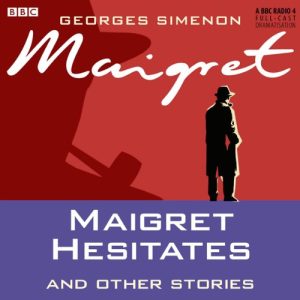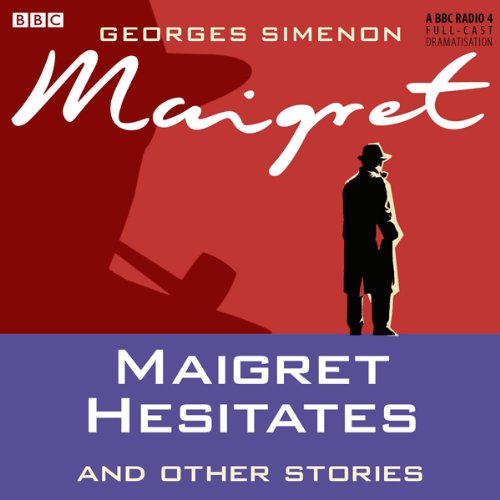
Four radio plays, one detective, and a running conversation with the man who invented him: that is the shape of this audiobook, and calling it an audiobook is already a small stretch. What BBC Digital Audio has published is a set of full-cast dramatizations, specially adapted for radio from Simenon's novels, running two hours and fifty-seven minutes in total. Maurice Denham plays Maigret. Michael Gough plays Georges Simenon. The two of them talk between and around the cases, a device radio can manage and a printed book cannot.
Loitering Is the First Thing Radio Cuts
Maigret Goes to School, Maigret and the Old Lady, Maigret Hesitates and The Patience of Maigret are the four adapted here, and a framing device holds them together. Jules Maigret, whom the description calls the world's best-known French detective, talks to his creator about four intriguing cases, so every play arrives introduced by the man who wrote it. Two of the four take the detective to the seaside: one to help a schoolmaster fight off an unfair charge of murder, one to soothe an elderly widow convinced she is about to be poisoned. An anonymous letter supplies the third, announcing a murder without naming the victim. The fourth brings the death of Manuel Palmari, an old adversary, and with it a chance at his criminal empire.
Arithmetic sets expectations here more honestly than any blurb does. Four novels have been fitted inside one hundred and seventy-seven minutes, leaving roughly forty-four minutes apiece if the four run to similar lengths, which is the standard shape of a radio slot. Simenon's novels are short by the standards of crime fiction and that helps. Even so, a forty-four-minute adaptation keeps the plot and the atmosphere while shedding nearly everything else: the digressions, the meals, the weather, the long passages in which Maigret does nothing but absorb a place. Anyone who loves these books for the loitering should know that loitering is the first thing radio cuts.
Denham Was Already Rumpole's Familiar Voice
Radio suits this detective unusually well, which is presumably why the BBC kept coming back to him. Maigret works by sitting in rooms, listening to people talk and waiting for a wrong note, and the interrogation scene is drama's oldest engine and radio's most natural one: two voices, one room, nothing that needs showing. Simenon's Paris is built out of weather, cafes, staircases and the noise of a city at work, all of which sound design delivers more cheaply than any camera. Adaptation also removes the awkwardness of reading translated third-person narration aloud. Here the characters simply speak, and the prose that would have framed them is gone.
One written response sits beneath this listing, four stars from January 2013, and it repays close reading because it is the only one. It reports that Maurice Denham was already familiar as the voice behind Rumpole of the Bailey, which made it an easy jump to believe him as a slightly down-at-heel and world-weary French detective. That is a genuinely useful piece of casting observation. The same entry then widens out to the BBC's Maigret run as a whole, noting a successor who took the role after Denham's death in 2002, calling the adaptations great diversions, and arguing that taken together they make a decent slice of the dark Paris streets Simenon imagined across more than seventy novels. The praise attaches to a series, in other words, and not to these four plays.
Full-Cast Drama, Credited as One Reader
Credits are where this record misrepresents its own product. The reader field names one person, Maurice Denham, which is how a page describes somebody narrating a book aloud. The description in the same box says full-cast dramatisations, twice, and names Michael Gough as Simenon in its opening line. Somebody is playing the schoolmaster, the widow, Palmari and everyone else across four plots, and none of those actors appears in the credits at all. The displayed title drops the marker too, since the publisher's own product name carries a Dramatised label that has not survived onto this page. A buyer scanning quickly sees a Simenon audiobook read by an actor, and will be surprised, pleasantly or otherwise, by what actually plays.
A single rating stands behind the score. One voter chose four stars, which breaks nothing whatsoever, since a lone click lands on a whole number and four sits among the options. What the figure cannot do is work as a verdict. It is one person's reaction, registered once, with nothing beside it to corroborate or contradict, and no way of telling whether the click was about the plays, the production or the price. Shelving offers no help either. The record is filed under arts and entertainment with a performing arts tag, defensible for a radio production and close to useless for anybody searching by the name Maigret, Simenon or detective fiction.
A Sampler, Not a Season
Drama listeners are the natural audience and will need no persuading. Anybody raised on BBC afternoon plays, or who has worked through the corporation's other crime adaptations, knows the register and will find three hours here well spent. Simenon readers who already know these four novels take the most from it, because compression stops being a loss once you can supply the missing texture yourself. Newcomers can start here perfectly well too. Three hours is an inexpensive way to discover whether a detective who solves cases by paying attention appeals to you at all, before committing to a whole shelf of them.
Purists should be warned rather than reassured. These are adaptations, not readings, and the text Simenon actually wrote is not what plays; if you want the novels, buy the novels. Listeners who dislike full-cast production, with its music, its effects and its scene changes, will meet all three. Anyone hoping for a substantial box set should check the runtime before anything else, because four titles inside three hours is a sampler and not a season. Taken for what it is, though, this is a well-made piece of archive radio, sold on a page that never quite admits what it is selling.