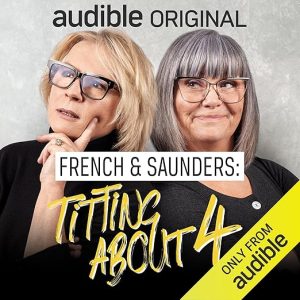
Two comedians, one microphone and a stack of in-studio snacks. That is the entire apparatus, and after three previous runs it is apparently enough. This audiobook collects the fourth series of Titting About, six episodes and three hours and ten minutes of Dawn and Jennifer working through ghost hunting, grooming rituals, unwatchable box sets and unlistenable bird noise, which the copy lists with the air of a menu. What nothing on the page ever does is name the second person in the room, and on a two-hander that is a good deal more than a clerical slip.
Timing Between Two Voices, Credited to One
Podcast episodes sold as an audio release are a specific proposition, and this one is honest about being exactly that. The description calls it their smash hit podcast, names all six episodes, and gives you the actual contents instead of a tagline: a bird cafe in the garden, a dream about compromised toilets, a faux-pas just before an operation, a not-very-convincing conversation with a celebrity ghost, a set of bagpipes, and a Bafta Fellowship accepted, by their own account, purely for access to the free toilets. None of it is constructed. If you want written comedy, sketches, characters or anything with a shape, this is not the format and it never pretends otherwise.
Six episodes means each runs short enough to fit into one sitting, with the last extended and organized by decade. Dawn French is the only name in the narrator field, and on this material the reading is not a reading at all: two people are talking, and what you pay for is the timing between them rather than delivery by either one. That is worth stating plainly, because a credit line naming a single performer implies a solo recording, and nothing in the six episode summaries suggests anything of the kind.
Series Four Gets Called the Best One Yet
Ghost hunting, grooming rituals, franglais and faff: the range is deliberately trivial, and the triviality is the method. The Embarrassment episode moves from reading aloud at school to farting during a massage to falling off a cliff and being too ashamed to ask for help, which is a genuinely well-built escalation and suggests these conversations are shaped even when they sound like they are not. Showbiz gets an attempt at a consistent Yorkshire accent and a martini constructed by Nigel Havers at the Palladium. Paranormal gets a vegetable identified by ESP. The units are tiny and the recall is specific, and specificity is what makes this sort of thing land.
Writing in October 2023, the one person who has left a written verdict here reports listening to the first three seasons, expecting no improvement, and being wrong: series four is called the best yet. The sentence worth pulling out is about craft. Their storytelling, timing and humorous antics appear effortless to the listener, that entry says, but may be rooted in sheer brilliance and fortified by amazing careers. That is a precise thing to have noticed, and it is why this single entry carries more weight than its grade does. Pure comedy gold follows, then the opening of a complaint about the only downside, which the record cuts off mid-word.
Jennifer's Name Is Missing From Every Credit
Byline trouble is the headline defect on this record. The title says French & Saunders. The episode summaries name Dawn and Jennifer in every one of the six, describe them settling in behind the mic together, and build each entry on the two of them talking. The author field names one of them. The narrator field names the same one. A two-hander missing half its cast from both credit lines is not a rounding error, and the consequence is practical: a buyer searching on the second name will not arrive here, and the performer doing half the work carries no credit on the product they are half of.
Series fields are the second problem, and they are simply empty. The title carries Series 4 in brackets, the blurb calls this the fourth series of a smash hit podcast, and the fields store no series name and no number, so nothing links this release to the three runs before it. The rating is the next oddity, and it is arithmetically innocent: 5.0 above a rating count of one breaks no rule, because a lone voter picks a whole number and five is among the choices. What it means is that a single anonymous click and a single written paragraph constitute the entire public record on this release. Note too that the page flags its own contents for strong language and adult material.
The Pleasure Is Recognition, the Risk Is Trust
Comedy-podcast listeners are the address here, and specifically people who already know these two well enough to hear the shorthand. The pleasure is recognition: a pair of performers with long careers behind them, declining to perform, letting a conversation about flossing run as long as it wants to. Anyone who enjoys the chat format, or who has ever found the unedited version funnier than the finished one, gets precisely what they came for. The running time is a generous amount of it, and the decade-by-decade final episode gives the set a shape it does not otherwise have.
Prudishness is the obvious disqualifier: the publisher's own note about strong language and adult content is accurate, and the title is not being coy about the register. Pass on it too if you have never encountered these performers, because none of the six episodes explains who anybody is, and the humor runs entirely on a shared history the recording assumes you already hold. Buyers wanting something scripted and shaped should understand that this is the opposite format, unstructured and unwritten and proud of both. Nothing in those credit fields should stop you buying if you know what you are getting; it should stop you trusting the fields.
- Performance: the credit names one performer for a recording built on two people interrupting each other, so the interplay is what a buyer will notice long before any single delivery.
- What it covers: unscripted friendship, embarrassment as a subject, six episodes of deliberate triviality
- Feel: Loose, filthy, affectionate
- Our call: Worth the money if you already know these two, and useless as an introduction to them.
Is this audiobook a new comedy production or a collection of podcast episodes?
A collection. The copy calls Titting About their smash hit podcast and presents this as its fourth series, six episodes produced by Listen Entertainment. Nothing has been scripted or restaged for release, so what you buy is the conversation as recorded, with the final episode running longer than the other five.
Do I need the earlier series before starting this audiobook?
Not strictly, though it helps a great deal. Each episode takes one topic and works it, so any of the six stands on its own. The record is unhelpful here: its series fields are empty despite the bracketed Series 4 in the title, so nothing points a buyer toward the three earlier runs.
Who is actually speaking on the recording?
Two people, though only one is credited. The narrator field names Dawn French alone, while every episode summary in the copy describes Dawn and Jennifer talking together behind the same microphone. The second half of the title is doing work that both credit fields decline to acknowledge.
How explicit is the content?
The copy attaches its own advisory for strong language and adult content, and the episode list bears it out: farting during a massage, compromised toilets, and a sustained commentary on grooming rituals. The register is adult rather than graphic, but this is not a listen to put on with children in the car.