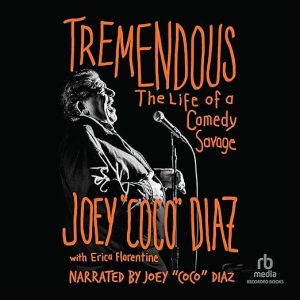
Comedy memoirs usually arrive with a laugh already built into the prose, and this audiobook does not. Six hours and forty-five minutes of Joey Diaz telling his own life turns out to be far less stand-up set than confession, and the publisher copy is honest about that from its opening line: outsider, misfit, criminal, convict, then movie star, family man, comedy legend. Seven nouns, and the ones that hurt come first. I went in braced for the podcast voice and got something with much less padding around the difficult parts, which is either the reason to buy it or the reason to leave it alone, depending entirely on what you wanted from a comedian's book.
A Biography, Not a Book of Funny Anecdotes
Joey Diaz built a public persona out of the anecdote, which is exactly what makes the shape of this one unexpected. It runs in order, from a childhood spent helping his tough-as-nails mother in her bar and holding a gun for the first time at the age of six, through dealing drugs and serving time, to the very late discovery that comedy was the job he had been built for all along. A five-star entry headed Unapologetically Joey names the difference better than the marketing does: it calls the book an account of his life from his earliest memories, the good and the bad, without much in the way of filtering, and then draws the line explicitly, a biography rather than a book of funny anecdotes.
That distinction matters more than it sounds. The stories that made Diaz a household name among podcast listeners are compressed events, shaped for a three-minute telling with a punchline holding the door at the end. Laid end to end across a whole life, the same material has to carry weight the stage version never asked of it: finding his mother's body, addiction, depression, and the stretch of homelessness the copy summarizes as a week sleeping in a piece of playground equipment. Humor is still in there, and plenty of it. It is simply no longer the reason each sentence exists, and a buyer who misses that will feel the difference within the first hour.
Deciding When to Stop Performing the Bit
Diaz reads his own book, and that puts an unusual demand on the file. A comedian narrating a set knows exactly where every laugh sits. A comedian narrating the death of a parent has to decide, sentence by sentence, when to stop performing altogether, and this manuscript makes him make that decision constantly, because it alternates bar-room set pieces with the material the description flags as dark: high-stakes crime, addiction, depression. Test it on the passages about serving time, not on the first twenty minutes, since the first twenty minutes are where any comic sounds most like himself and tell you nothing about how the rest is handled.
An Immigrant Mentality Gives Listeners the Throughline
Existing fans have the plainest reason to buy, and one enthusiastic response states it exactly: the book collects stories he has touched on across his podcast and elsewhere over the years, alongside a good deal he has never covered on a podcast or on a stage. That is a real proposition rather than a marketing one. Material road-tested for a decade gets its context restored, and the chronological spine explains why particular bits land the way they do, which is a pleasure a fan cannot get from the routines themselves.
An immigrant framing carries the more interesting argument, and it belongs to the book rather than to the comedy career. Diaz credits what he calls his immigrant mentality and the work ethic his mother modeled for him, and the copy widens that into a claim about a survival strategy shared by many people who never became famous at all. That framing gives a celebrity memoir something to be about besides celebrity, and it gives somebody who has never heard a minute of the podcast an actual reason to stay past the first hour.
Five Signed Entries Beneath a Total of One
Content is the first caution, and the description does not disguise it: the death of his mother, addiction, depression, serious crime, and language the copy itself calls foul-mouthed. One five-star response establishes its own credentials on exactly this point, saying its writer is no prude and has been around drugs and violence, and then reports being shocked by the honesty all the same. Take that as calibration rather than as complaint. The book is not edgy in the promotional sense; it is unguarded in a way that will be genuinely uncomfortable to have playing with other people in the room.
Numbers on this record refuse to line up. The score reads 4.9 above a rating total of one, and one vote cannot produce that figure by any route: a lone voter picks a whole star from one to five, and rounding a whole number to a single decimal place puts a zero in the tenths column every time. The written column makes the mismatch plainer still, because five signed entries sit beneath that total of one, and every one of the five is a five-star. Whatever the 4.9 is counting, it is not the single vote the counter claims to be reporting.
The File for the Life Underneath the Act
The clean fit is somebody who already knows the voice and wants the chronology underneath it, plus anyone who reads celebrity memoir for the working-class detail rather than the famous names. Podcast regulars get origins for jokes they have been hearing for years. Listeners drawn to recovery writing, immigrant writing or crime writing will find all three braided together instead of taking turns, and the comedy career arrives so late that the book has become something else well before it shows up.
Leave it if what you want is a comedy record. Anyone shopping for a run of bits, or for the loose riffing rhythm of a podcast episode, will meet a structured autobiography told in sequence and deliberately slowed down for the parts that hurt. It is equally wrong for a shared car, a family listen, or a buyer hoping the profanity has been dialed back for the recording, because the profanity is load-bearing here rather than decorative. Fans who want Uncle Joey at his funniest should go to the stage material; this is the file for the life underneath the act.
Good to Know
Does the Tremendous audiobook work as comedy, or is it a memoir first?
Memoir first, by a wide margin. The description lays out a chronology running from a childhood in his mother's bar through crime, incarceration and addiction before comedy enters the story at all. Humor threads through the telling, but the structure is biographical rather than a sequence of routines, and the bleakest chapters are given real room.
How explicit is this audiobook, and who should avoid it?
Very explicit. The publisher copy calls the book foul-mouthed and states outright that it is not for the faint of heart or for prudes, then lists addiction, depression, serious crime and the death of a parent among its subjects. Treat it as adult listening, and not a shared-car choice with children aboard.
Does Joey Diaz reading his own story change what you get?
It changes the register rather than the content. Because the byline and the reader credit name the same person, the delivery carries whatever emphasis the author intended, including the passages he chose not to soften. The trade-off is that a self-read memoir has no second voice available to shift tone when the material turns grim.