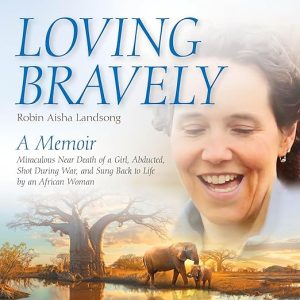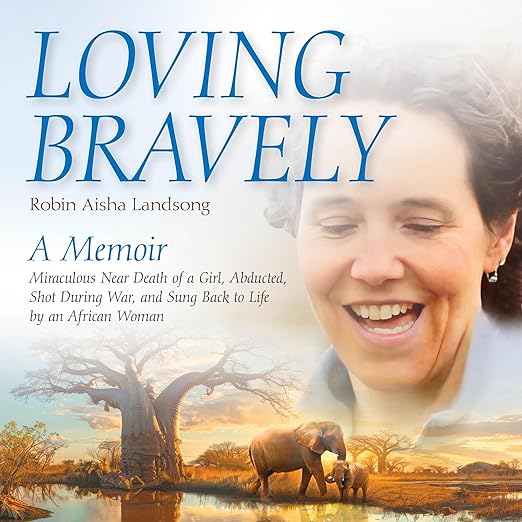
Eight years old, abducted from her own life and abandoned in wartime Rhodesia, Robin Aisha Landsong survived her first night alone in the hollow of a tree, and she tells that story herself on this audiobook with a steadiness that took decades to earn. Loving Bravely narrates the aftermath of a 1977 kidnapping across a civil war zone, a rescue by villagers who had no reason to risk themselves for a stranger's child, and a mother's song that Landsong credits with pulling her back after a soldier's bullet nearly ended her life entirely. Forty years later, she returns to what is now Zimbabwe to find the people who saved her.
Tribal Song Excerpts Only the Audible Edition Has
Landsong narrating her own material is not a neutral production choice here; it is close to the point. Reviewer wlcarr specifically bought both the Kindle and Audible editions because the Audible edition, read by the author, contains what they called 'tribal song' excerpts, 'which I found beautiful and inspiring.' That is an argument for audio over print that few memoirs can genuinely make, since a described song and a heard one carry entirely different weight, and it reframes the audiobook edition as something closer to a distinct artifact than a simple alternate format of the same text.
Reviewers use unusually intense language for this book, and the pattern is worth noting rather than dismissing as blurb inflation. SacGeo Po wrote of feeling 'stunned, moved to my core, and transformed' after finishing it, and that kind of intensity recurs across the audiobook's listener response, suggesting Landsong's delivery of her own trauma and recovery lands with a directness a third-person narrator would likely soften.
A fair technical question follows any memoirist narrating their own worst experiences aloud: can they sustain the performance without either flattening into numbness or tipping into melodrama across a full-length audiobook. Landsong manages that balance across roughly eleven hours, letting silence and pacing do work that a professional narrator, working from a script alone rather than lived memory, would have to manufacture through technique instead. The result sounds less like a performance and more like testimony, which is precisely the register this material calls for.
I Won't Throw Her Away, She Is Human
The book's most quietly devastating moment does not involve the abduction or the shooting. It is a neighbor telling the grandmother sheltering young Robin, 'Don't bother with her, it is too dangerous,' and the grandmother's flat refusal: 'I won't throw her away, she is a living human being.' That exchange, delivered in Landsong's own voice, carries the entire moral architecture of the book in two sentences, more than any synopsis paraphrase could carry on its own.
Colleen Webb described the book as 'a potent medicine journey that the world needs,' language that might read as hyperbole applied to a lesser memoir but tracks with how deliberately Landsong structures the story around indigenous healing practice rather than a purely Western trauma narrative. The Medicine Song that saves her life is treated as literally, spiritually real within the book's own framework, not as folklore color, and listeners willing to meet that framework on its own terms will find the audiobook's second half considerably richer than a purely secular survival story would be.
The title itself rewards a second look. Loving Bravely is not simply a description of Landsong's own courage, it also describes the courage of everyone else in the story: the villagers who sheltered a stranger's child during a civil war, the mother who sang over a body soldiers had already left for dead, the grandmother who refused a neighbor's warning outright. The synopsis frames the book's underlying claim as 'our human capacity to rise from the ashes,' and that capacity, in Landsong's telling, belongs collectively to an entire community rather than to one exceptional survivor alone.
Difficult Listening, Narrated Without Comfort
The opening chapters are genuinely difficult listening. An eight-year-old is abducted, taken across a war zone, and later shot, and Landsong does not narrate around these events for the listener's comfort. This is not gratuitous material; the memoir's whole argument depends on the reader understanding the depth of what was survived, but anyone sensitive to detailed accounts of child abduction and violence should know the intensity going in rather than discover it mid-chapter.
The synopsis itself reads almost like liturgy in places, short poetic lines describing forty years passing in a single sentence, and the audiobook follows that same compressed, impressionistic pacing rather than a conventional chronological memoir structure. Listeners expecting a detailed, blow-by-blow reconstruction with dates, names, and geographic specifics may find the account more meditative and thematic than procedural. That is a deliberate choice suited to the book's spiritual register, but it is worth knowing before pressing play if procedural detail is what you are after.
With just fifty-six ratings behind its 4.8 average, this book has not yet reached a wide audience, worth knowing both as a caveat and as an invitation. The existing reviews run unusually long and personal rather than brief star ratings, suggesting a small but genuinely moved readership rather than an inflated score, but a listener wanting a large, thoroughly established review base to lean on before committing nearly eleven hours will not find that volume here yet.
Healing Testimony First, Survival Thriller a Distant Second
Memoirs of spiritual survival draw a specific readership, and this book fits squarely into that category for listeners who appreciate writers like Malidoma Some, treating African indigenous healing traditions as legitimate frameworks rather than anthropological curiosities. Listeners rebuilding their own relationship to a difficult family or community history, not just trauma survivors specifically, may also find Landsong's return journey to Zimbabwe as resonant as the original events. Anyone drawn to stories of ordinary people risking themselves for a stranger, the villagers who sheltered an abducted child with nothing to gain, will find that thread as central to the book as Landsong's own recovery.
A reader who wants the abduction and shooting treated primarily as a true crime narrative, with investigative detail and legal aftermath, will find Landsong's spiritual and communal framing a different book than the one they came for. This is memoir as healing testimony first, and survival thriller a distant second. Listeners uninterested in first-person spiritual language, in a narrator describing hearing a song 'from the other side of the veil' and meaning it literally rather than metaphorically, should know that register runs through the entire back half of the book rather than surfacing in one isolated passage.
Frequently Asked Questions
Does this audiobook include the actual sung excerpts mentioned in reviews, or just a description of them?
Reviewers confirm the Audible edition contains real sung excerpts described as 'tribal song,' something the print or Kindle edition cannot reproduce, which is a genuine reason to choose the audiobook specifically.
How graphic is the depiction of violence in this audiobook?
The abduction, assault, and later shooting are described directly rather than softened, so listeners sensitive to detailed accounts of violence against a child should be aware going in.
Does this audiobook require any familiarity with Zimbabwean or Rhodesian history to follow?
No prior background is required. The book centers on personal and spiritual experience rather than political or military history, though it is set against the real 1977 Rhodesian civil war.