In Brief
- Read by: Adam Verner's measured, unhurried pacing lets a genuinely sprawling structure settle once the book finds its rhythm.
- At its heart: cross-genre musical cross-pollination, 1970s New York City decay and creativity, scenes as living communities
- Vibe: Dense but rewarding, encyclopedic in the best sense
- Short version: Rewarding for serious music history listeners willing to push through a disorienting opening stretch, less so for casual browsers.
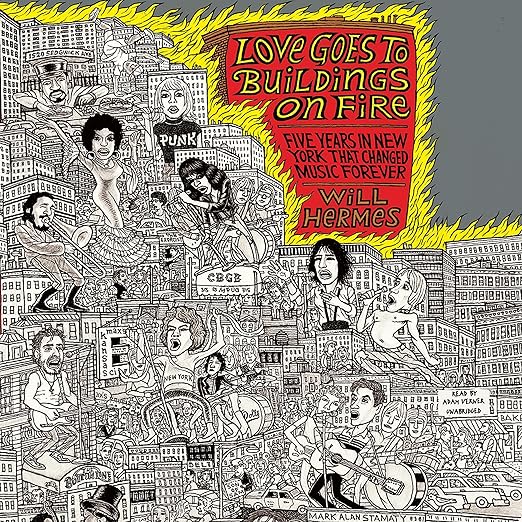
New York City in 1973 was broke, dangerous, and according to Will Hermes the single best possible place on earth to make music, and Love Goes to Buildings on Fire spends thirteen hours proving that second half of the claim. Structuring a book around five years and six different, simultaneously erupting scenes, punk, salsa, disco, hip-hop, loft jazz, and downtown minimalist composition, is a genuine formal challenge, and Hermes solves it by refusing to pick a lane, moving month by month through parallel storylines rather than giving each genre its own separate chapter. That structural bravado is also this audiobook's biggest early hurdle. More than one reviewer flags how disorienting the constant subject-jumping feels in the opening hours, and I felt the same disorientation myself before the pattern clicked, once the cross-pollination between scenes started to feel like the actual point rather than a structural tic.
Moving Readers From Greenwich Village to the Bronx
Hermes earns the sprawl through personal authority: the synopsis notes he was 'there,' 'venturing from his native Queens to the small, dark rooms where the revolution was taking place,' and that first-person proximity shows in details too specific to have been assembled from archives alone. This is not a book written by an outside historian reverse-engineering a scene from old magazine clippings. It reads like the work of someone who remembers which door led backstage.
The loft jazz and downtown minimalist composition threads, the two scenes probably least familiar to a general listener compared to punk or hip-hop, get treated with the same seriousness as their more famous neighbors, and that even-handedness is one of the book's real achievements. Musicians reinventing composition itself in Lower Manhattan lofts sit structurally alongside CBGB's three-chord urgency, and Hermes never signals that one scene matters more than another simply because it became more commercially famous decades later.
The geography itself becomes a structural device. Hermes moves the reader physically, from post-Dylan Greenwich Village folk clubs to the arson-scarred South Bronx where salsa and hip-hop were both taking shape, to Lower Manhattan lofts reinventing jazz and classical composition, to CBGB and the Gallery downtown. Willie Colón renting Yankee Stadium to bring salsa to a mass audience sits in the same book as Grandmaster Flash turning two turntables into an instrument, and Hermes trusts the reader to feel the connective tissue between a stadium concert and a bedroom mixing session rather than spelling it out.
CBGB Was Built for Country and Bluegrass
CBGB itself, the club Hermes returns to repeatedly, opened on the Bowery in 1973 under owner Hilly Kristal, initially intended for country, bluegrass, and blues, the letters in its name, before Television, the Ramones, Patti Smith, and Talking Heads redirected it entirely toward the sound that would define American punk. That founding mismatch between what the club was built for and what it actually became is a small, real detail that captures the book's larger argument: none of these scenes emerged according to plan, they emerged from cheap rent, physical proximity, and musicians willing to use a room built for something else entirely.
The book's title itself is a direct riff on 'Love, Building on Fire,' Talking Heads' own 1977 debut single, which is a fitting choice: it signals upfront that Hermes sees the era's musical explosion and the city's literal decay, arson, blackouts, fiscal near-collapse, as two expressions of the same underlying energy rather than an ironic contrast between art and ruin.
Disco Gets Treated as Serious Art Here
Disco gets a similarly fair hearing, treated here as a serious creative movement rather than the punchline it became in later decades of popular memory. Hermes places it in direct conversation with the same downtown scene producing punk and loft jazz at the same historical moment, which is a genuinely useful corrective for any listener who absorbed the backlash against disco as received wisdom rather than understanding its actual creative and cultural origins.
Adam Verner narrates, and his track record with long-form conceptual nonfiction, measured pacing that lets an argument settle before the next one arrives, serves this material well once the book finds its rhythm. Thirteen hours of cross-cutting between scenes and subgenres could easily turn shapeless in a lesser narrator's hands, but Verner's even, unhurried delivery gives each new thread enough weight to register before the next one starts, which matters more here than in most music histories given how many names move through the text.
One reviewer's specific origin story for picking this up is worth repeating: they bought it while recovering from a herniated disc, on the strength of a recommendation inside a Nick Hornby book, and reported that Hornby's warning, that readers might 'buy a bunch of music as a result,' proved accurate. That same reviewer calls Hermes' knowledge 'encyclopedic,' and a third describes the book as 'an extremely thorough look into five key years in the history of music in NYC,' recommending it specifically to 'music fans or New Yorkers who want to understand such a key time.'
A Poor Choice for Increased-Speed Listening
The sheer number of named musicians, producers, club owners, and scene figures also means this is a poor choice for listening at increased speed, even for listeners who normally prefer a faster clip; names and relationships arrive quickly enough at normal pacing that pushing it risks losing track of who connects to whom across the book's five-year span.
At thirteen hours with a genuinely large cast of musicians, producers, and scene figures moving in and out of focus, this is not a casual background listen, at least not at first. Give it real attention for the opening stretch specifically; the payoff for sticking with the structural jumps is a much richer sense of how these scenes actually influenced each other than a genre-by-genre approach could ever deliver, but that payoff arrives gradually rather than immediately.
Build Your Own Playlist While You Listen
Because so much of the book's pleasure depends on hearing what Hermes is describing, a companion playlist pulled together from the artists and songs named chapter by chapter turns this from a good listen into a genuinely immersive one. It is not built into the audiobook itself, so building one alongside your listening, even loosely, adds real value the narration alone cannot fully replicate.
Punk Purists Should Look Elsewhere Instead
Recommended strongly for music history obsessives, anyone who has read the classic punk oral histories built from firsthand testimony and wants the wider-lens version connecting punk to salsa to hip-hop to minimalism in one continuous story. New Yorkers and former New Yorkers with any nostalgia for the city's broke, dangerous, creatively electric 1970s will find this especially rewarding.
Skip it if you want a tightly focused single-genre history, punk purists hoping for thirteen hours on CBGB alone should look elsewhere, or if cross-cutting, multi-thread nonfiction structure tends to frustrate rather than reward your patience as a listener.
Common Questions
Does this audiobook require musical knowledge of 1970s New York genres to follow?
No prior expertise is required, though building a companion playlist alongside the listening experience adds real value the narration alone cannot fully replicate.
Why does this audiobook jump between so many different music scenes?
Will Hermes structures the book chronologically rather than by genre, moving month by month through 1973 to 1977 so listeners hear how punk, salsa, disco, hip-hop, and jazz influenced each other in real time.