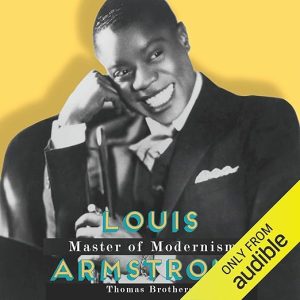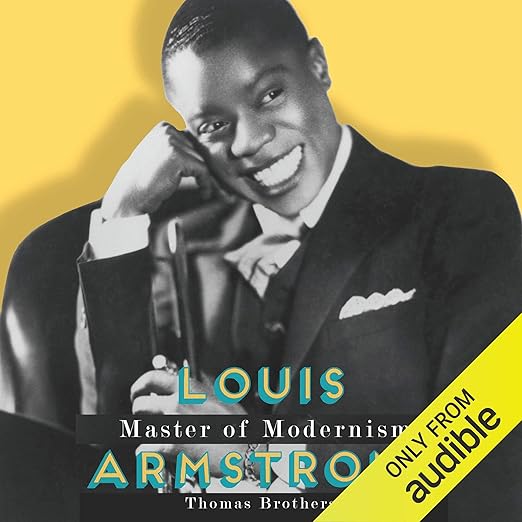
Music scholarship that doubles as cultural history is genuinely difficult to write, and Thomas Brothers manages it across nearly 19 hours in this audiobook. Louis Armstrong, Master of Modernism picks up where Brothers's earlier Louis Armstrong's New Orleans left off, following the trumpeter into his most creatively fertile years in the 1920s and early 1930s. Andy Caploe's narration carries the full weight of that ambition. This is not a greatest-hits biography. Brothers is after something harder: an account of how Armstrong's genius operated within and against a society shaped by racial violence, economic exploitation, and cultural appropriation, through negotiations Armstrong himself could not have named that way.
Caploe's voice has an academic quality that suits the material, measured and authoritative without being dry. He conveys Brothers's analytical framework clearly, and when the prose opens up into scene-setting or direct quotation from Armstrong's contemporaries, he modulates accordingly. For a book this long and this dense, the narration needs to be trustworthy above all else, and Caploe delivers that trustworthiness across the full run without flagging.
One Artist, Two Modern Musical Styles
One reviewer singled out Brothers's ability to avoid both the panegyric trap and the flat biography format, noting that jazz writing too often defaults to either fanciful genius-worship or dry documentation. Brothers does neither. He is a musicologist who takes the music seriously as music, not merely as cultural artifact, and he is also a historian who refuses to separate the sound from the conditions that produced it. The result is a book that can analyze a single improvised phrase from a 1927 recording session and then trace its social implications across an entire chapter covering Chicago's South Side club circuit.
The period Brothers covers produced not one but two modern musical styles from a single artist, a claim that sounds like hyperbole until Brothers lays out the evidence. Armstrong's Hot Five and Hot Seven recordings, made in Chicago between 1925 and 1928, redefined what individual virtuosity could sound like in a collective music. Then his shift toward popular song and entertainment in the early 1930s defined a second idiom entirely. Brothers navigates this dual arc without flattening either into a simple narrative of rise or fall, and Caploe's narration gives each phase its own tonal weight so that the audiobook feels like two interconnected stories rather than a single unbroken arc.
Quickness and Sureness as Real Intelligence
The audiobook format works better for this material than you might initially expect. Brothers's prose is dense but not impenetrable, and Caploe's pacing gives the listener time to absorb each analytical move before the next arrives. The chapters on Armstrong's relationships with Joe King Oliver, his manager Tommy Rockwell, and his various band configurations are particularly strong on audio, because Brothers reconstructs dialogue and scene with enough vividness that they feel inhabited rather than archived. You are in the recording studios and the backstage dressing rooms alongside Armstrong in a way that a dryer academic text cannot achieve.
The racial history woven throughout is handled without either sanitizing the violence or reducing Armstrong to a victim of it. Brothers documents in careful, specific detail the constant improvisation Armstrong had to perform off the bandstand: navigating white club owners, corrupt booking agents, hostile local authorities in dozens of cities and towns, and the unwritten rules of a touring circuit where a Black musician could not count on food, lodging, or safety across state lines. Armstrong's strategies for managing this environment, what Brothers calls his quickness and sureness, come across as a form of intelligence as sophisticated as anything he did with a trumpet in front of a microphone.
This Audiobook Has No Musical Clips
Brothers's methodology becomes most visible in the passages where he reads specific recordings against the social conditions under which they were made. These are the sections where the book earns its subtitle. Armstrong was not just modernizing jazz in isolation; he was doing it inside a specific set of constraints and pressures, and those constraints shaped what he reached for in the music. When Brothers links a particular harmonic choice or rhythmic innovation to what Armstrong was navigating at the moment of recording, the music stops being abstract genius and becomes a specific human response to specific circumstances. This is the most illuminating argument the audiobook makes, and it rewards patient listeners who are willing to sit with the complexity.
Listeners who already know Armstrong's recordings will get considerably more out of these passages. It helps substantially to have heard the Hot Fives and Sevens, West End Blues, and Heebie Jeebies before you encounter Brothers's analysis of them. The audiobook does not play audio clips, which is the format's one significant limitation here. But Brothers describes musical moments with enough technical precision and contextual richness that even listeners without deep jazz knowledge can follow the argument and sense what is at stake in each musical decision.
Skip It if Armstrong's Music Is Unfamiliar
Serious jazz listeners who want more than a life story will find Brothers's framework genuinely illuminating about the relationship between individual genius and social conditions. This audiobook also rewards anyone interested in American cultural history of the 1920s and 1930s, the Great Migration, or the mechanics of racial capitalism in the entertainment industry. At nearly 19 hours, this is a book that demands patient listeners who are willing to stay with the complexity of Brothers's argument rather than looking for a quick summary of Armstrong's achievements.
Skip it if you are looking for a breezy musical biography or an introduction to jazz history aimed at listeners coming in cold. Brothers writes for people who are already curious and willing to work. If Armstrong's music is entirely unfamiliar to you, spending some time with the recordings first, particularly the 1927 and 1928 Hot Five and Hot Seven sessions, will make the musical analysis in this audiobook land with the full force Brothers intends.
Before You Press Play
- Narrator: Andy Caploe brings measured authority to Thomas Brothers's dense musicological argument, sustaining nearly 19 hours without losing clarity or momentum.
- Subjects: Jazz innovation under racial constraint, Armstrong's dual modernisms, the business and violence of the touring circuit
- Tone: Rigorous and revelatory, with vivid scene-setting punctuating the scholarship
- Bottom line: A serious, rewarding audiobook for jazz listeners and cultural historians who want to understand Armstrong's genius as inseparable from the society that shaped and resisted it.
Does this audiobook require prior knowledge of jazz or Louis Armstrong's catalog to follow the argument?
Some musical familiarity helps, particularly with Armstrong's Hot Five and Hot Seven recordings from the 1920s. Brothers analyzes specific musical choices in detail, and listeners who already know the recordings will get significantly more from those passages. The cultural and racial history sections are fully accessible regardless of musical background.
Does the audiobook address Armstrong's personal relationships and private life or stay focused on music and history?
Brothers integrates the personal and professional throughout. Armstrong's marriages, his relationship with Tommy Rockwell, and his friendships within the Chicago scene all appear, but always in service of understanding how those relationships shaped his musical decisions and his navigation of a racially hostile industry.