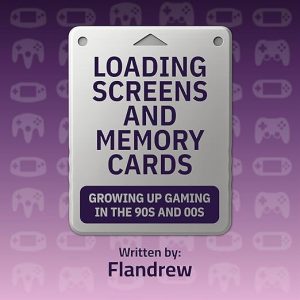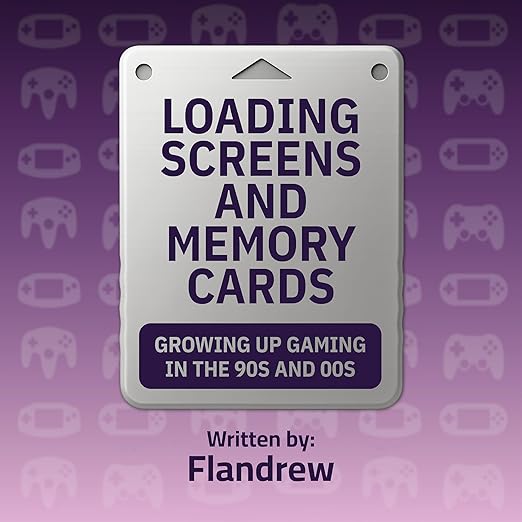
Loading Screens and Memory Cards opens with a detail that immediately earns trust: Flandrew describes the specific quality of light from a CRT screen in a dark room, that particular blue-gray luminescence that felt like its own kind of weather. This audiobook, written and narrated by Flandrew of YouTube classic gaming fame, makes its strongest choices in the first ten minutes, and the decision to self-narrate is the most important of them. His voice carries the exact register of someone who has spent years explaining why old games matter without ever sounding like he needs to convince you.
What Games Produced in the People Who Played
The book is structured as a series of set pieces from the golden era of gaming roughly the PlayStation 2 and GameCube generation, with excursions into the cartridge years before it and the digital transition that followed. Flandrew does not write chronological gaming history. He writes about specific phenomenological experiences: the ritual of blowing on a cartridge, the social infrastructure of the schoolyard cheat code economy, the existential weight of choosing which game to buy when you only had birthday money for one. These are scenes, not bullet points, and they hold up across three and a half hours because Flandrew understands that the subject is not the games themselves but what those games produced in the people who played them.
One reviewer describes it as listening to one of his videos on a grander scale, which is accurate as both description and praise. The difference between a video essay and a book, for Flandrew, seems to be scope rather than form. He takes more time with each memory here, follows tangents longer, and connects experiences across years rather than across the runtime of a single game. The result is something closer to a cultural memoir than a gaming guide, and that is the right call. Nobody who picks up a book called Loading Screens and Memory Cards needs to be told how the PlayStation 2 worked.
Flandrew Remembers Instead of Performing Recall
The self-narration is what makes the audiobook format the right format for this project. Flandrew's audience already knows his voice from YouTube, but more importantly, his delivery has the kind of conversational specificity that does not translate to a professional narrator reading someone else's memories. When he describes the particular social dynamics of birthday party split-screen gaming, the embarrassment and exhilaration of it, he does so with the vocal quality of someone genuinely remembering rather than performing recall. That distinction matters more than production polish.
The audiobook runs just over three and a half hours, which is the right length for what it is. Nostalgia projects that run too long collapse under their own sentiment. This one knows when to end a section and let the memory sit. A reviewer who received it as an early Christmas gift notes enjoying it alongside a younger sibling who games on modern systems, and that cross-generational appeal is real: the book functions as documentation of a gaming culture that genuinely no longer exists in the same form, and curiosity does not require having lived through it.
Console-Specific Memories, Mostly a Boy's Experience
The book does not attempt to be comprehensive gaming history, and readers who approach it looking for coverage of specific titles or platforms will find gaps. The focus is on the PlayStation 2 era and the GameCube years, with the N64 and earlier consoles appearing as context rather than subject. If your gaming childhood was primarily PC-based or if your primary console was a different platform, some of the specific resonances may land differently. The emotional architecture is still intact, but the particular artifacts Flandrew uses as anchors are console-specific.
The writing also leans toward a male experience of gaming culture from this era, the social rituals of sleepovers and schoolyards as they existed for boys in particular. This is not a limitation the book tries to hide, and Flandrew does not claim universal coverage. It is worth knowing going in.
What Flandrew gets right that many nostalgia projects miss is the specificity of waiting. The book's title announces this: loading screens and memory cards are both about pause, about the gap between wanting and having. Loading screens asked you to be patient for a world that was materializing. Memory cards asked you to trust that your progress was real and preserved. Neither of those experiences exists in the same form today, and Flandrew writes about them with the precision of someone who understands that the feeling of waiting for a game to load was a distinct and unrepeatable phenomenology, not just an inconvenience that technology has since resolved.
The YouTube audience that Flandrew brings to this audiobook is already trained to engage with his specific mode of retrospective analysis, the combination of affection and critical intelligence that distinguishes good gaming criticism from simple nostalgia performance. The book extends that mode into a format where his voice can work at longer length than any video allows, and the result justifies the extension. Not every content creator who moves to long-form writing or audio finds that the shift works. Flandrew does.
A Book About Memory and What Games Meant
This audiobook is unambiguously for people who grew up gaming in the 90s and early 00s and who have some attachment to that specific cultural moment. Flandrew's YouTube audience will find everything they love about his work expanded and deepened. Listeners who missed the era but are curious about gaming as a generational experience will get genuine documentary value. Anyone looking for game reviews, platform comparisons, or practical gaming content should look elsewhere: this is a book about memory and what games meant, not what they were.
The Short Version
- Narrator: Flandrew self-narrates with the warm, conversational cadence of his YouTube channel, making this feel like a long-form video essay you listen to rather than a conventional memoir.
- Subjects: Gaming nostalgia, generational identity through technology, the lost ritual of waiting
- Tone: Warm and funny, like a conversation with a friend who remembers exactly the same things you do
- Bottom line: For anyone who grew up gaming in the 90s and 00s, this audiobook is the rare nostalgia project that captures feeling rather than just fact.
Frequently Asked Questions
Do you need to be a fan of Flandrew's YouTube channel to enjoy the audiobook version of Loading Screens and Memory Cards?
No prior familiarity is required. The book stands alone as a gaming memoir. That said, existing fans of his YouTube channel will recognize the voice and cadence immediately and will likely find the longer format satisfying as an extension of what they already enjoy.
Is this audiobook suitable for someone who did not grow up gaming in the 90s and 00s?
It works as a cultural document for non-gamers or younger listeners curious about gaming as a generational phenomenon. The emotional core of the book, about specific technologies shaping specific kinds of childhood, is broadly legible even without personal nostalgia for the PS2 era.
At three and a half hours, is Loading Screens and Memory Cards substantial enough to justify the audiobook purchase?
The runtime reflects the book's scope rather than any padding or lack of it. At under four hours it works well as a single listening session and does not overstay its welcome. Compared to longer nostalgia memoirs that stretch a narrower emotional range across many more hours, the concision is an asset.