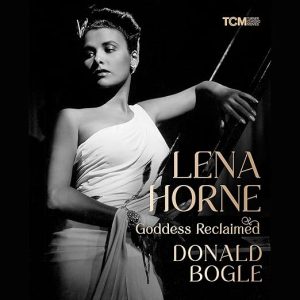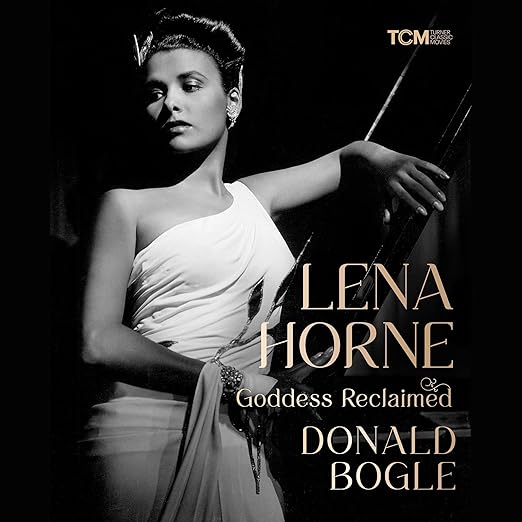
How do you write the life of a film star whose scenes were built to be removed? Lena Horne became the first Black performer to receive the full glamour treatment at MGM, the treatment the studio had previously reserved for Garbo, Harlow, Lana Turner and Ava Gardner. She also found that her roles were usually musical numbers, staged so they could be lifted out of a print without damaging the plot, for audiences that objected to her presence. Donald Bogle, the author of Hollywood Black, spends ten hours and twelve minutes on that contradiction, and he narrates the audiobook himself.
The Book Is Actually Titled Goddess Reclaimed
First, a note on what you are buying. This listing gives the title as a name, but the book itself is Lena Horne: Goddess Reclaimed, and both the subtitle and the reclamation inside it are load-bearing. Bogle's project is not a neutral chronicle. It is an argument that a performer who was made into a symbol, then held at arm's length by the industry that made her, has been undervalued in the standard histories, and that the record can still be corrected.
Interviews, Press Accounts, and Studio Archives Combine
The research base is stated plainly and it is the right one for a subject this mediated. Bogle works from "interviews, press accounts, studio archives, and decades of research", which is the combination you need when a star's public record was manufactured by a publicity department and her private record was guarded. The result covers her activism alongside her career without sorting the two into separate compartments, because in Horne's case they were never separate to begin with.
One reviewer maps the coverage usefully, running through the Harlem club years, a difficult contract at MGM, a marriage to Lennie Hayton kept secret, the Broadway one-woman show, and the civil rights work. That comment then breaks off mid-word as it starts on the length of her career, so its full assessment is not visible. Another calls the book "another remarkable piece of scholarship" by a chronicler well known to film audiences. The third runs to two sentences of straightforward praise and no detail.
Years of Turner Classic Movies Appearances, Now Narrating
Self-narration is the right call here, and not only for authenticity. Bogle is described in the publisher's copy as a leading authority on Black cinema history, and one reviewer notes "his many appearances on Turner Classic Movies", which at minimum tells you he has spent years discussing this material out loud for an audience. A biography this dependent on interpretation benefits from hearing the interpreter. The emphasis inside a contested sentence belongs to the author rather than to a reader's guess at his intention.
The central argument is genuinely uncomfortable and Bogle does not soften it. Horne received the star treatment and the indignities simultaneously, and the mechanism of the indignity was built into the way she was filmed. A performer whose numbers are detachable is a performer the studio has quietly decided to make optional. Grasping that single production decision explains most of her screen career, and it explains why the filmography looks so much thinner than the fame.
The compensations are here too, and they make the better half of the story. The nightclub work, the television, and above all the one-woman Broadway show that finally gave her a stage no studio could edit. Bogle also gives the disappointments their proper weight, professional and personal, and the copy is honest that some of them turned bitter. A biography that only celebrated would have been a lesser book and a worse tribute.
Photographs Do Not Survive the Audio Conversion
The photographs are the obvious casualty. The print edition is illustrated throughout, some images published for the first time, and the publisher's copy treats them as a headline feature. None of that survives a conversion to audio on its own. Before buying, it is worth checking whether the edition ships with a companion document, because a biography whose selling point includes previously unpublished images is a biography where the pictures formed part of the argument.
Density is the second issue. A book built from studio archives and press accounts carries a heavy load of names, dates, film titles and contract details, and ten hours of that by ear asks more of you than the same material on a page you can flick back through. Anyone unfamiliar with the studio system of the 1940s will want to look things up along the way. That is a fair cost, but it remains a cost.
The review pool is small and partly cut off. Thirty-seven ratings makes a modest base, consistent with a recent release rather than a verdict on the work, and two of the three written comments break off before they finish their thought. Nobody in the pool discusses the reading. What can honestly be said about the audio comes down to the fact that the person who did the research is the person doing the talking.
Reclaiming a Goddess Means Naming Who Took Her
Classic film obsessives form the core audience, particularly anyone who has watched a 1940s MGM musical and wondered why Horne appears for one number and then vanishes. Readers of Black cultural history get a heavily sourced account of a career sitting at the intersection of the studio system and the civil rights movement. Anyone who came to Horne through the Broadway show or the late-career recordings will find the whole shape of the life laid out here.
Pass on the audio if the photographs are what drew you, and buy the illustrated print edition instead. Pass on it too if you want a brisk life story, because this is scholarship and scholarship at length. Casual listeners looking for anecdote and glamour will find plenty of both, wrapped inside a research apparatus that never hurries itself along for their benefit.
The subtitle carries the whole project. Reclaiming a goddess implies that somebody took her, and Bogle spends the running time naming who, how and at what cost. As a corrective it convinces. As a listen it asks for attention rather than offering ease, which is the honest trade with any biography built this thoroughly.
Frequently Asked Questions
Does the audiobook include the photographs from the print edition?
The publisher's copy makes the illustrations a headline feature, including images published for the first time, and audio cannot carry them by itself. Check whether your edition ships with a companion document before buying. If the pictures are the reason you want the book, the illustrated print version is the safer purchase of the two.
Is it a problem that Donald Bogle narrates his own audiobook?
Not here. Bogle is presented as a leading authority on Black cinema history and one reviewer notes his many television appearances discussing this material. For an interpretive biography, hearing the author place his own emphasis is an advantage. No listener comment assesses the delivery, so sample it if a scholarly rather than theatrical register would bother you.
Do I need to know 1940s Hollywood to follow it?
Not to follow it, but background helps. The book moves through studio contracts, MGM production practices and a filmography most listeners will not know well. Bogle explains what matters as he goes. Anyone entirely new to the studio system should expect to pause and look up a film or two along the way.
How much of the book covers Lena Horne's civil rights work?
A substantial part. The copy names her activism alongside her career, and one reviewer lists her involvement in the civil rights movement among the book's major threads. Bogle treats the politics and the performing as one story rather than two, which is the point of the reclamation argument running through the whole biography.