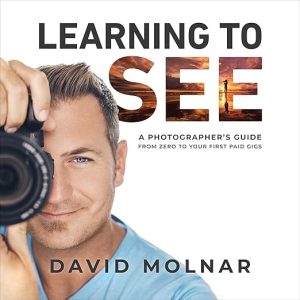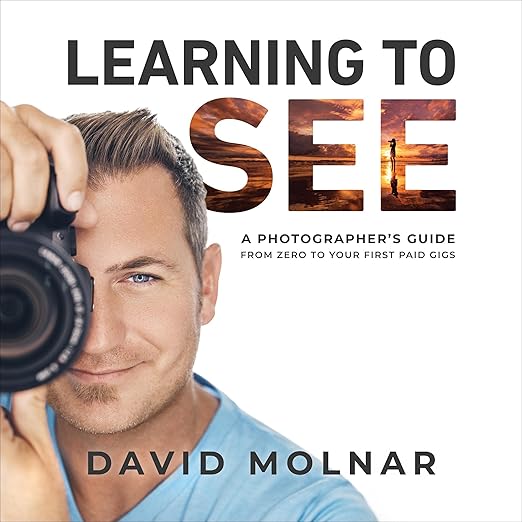
David Molnar was never supposed to be a professional photographer, by his own account, until a head-on collision changed that trajectory entirely. This audiobook opens with that crash and the long recovery that followed, learning to walk again, and traces how photography became both an escape and a genuine form of therapy during that period. What follows across four hours and fifty-two minutes is part memoir and part instructional guide: a five-step path Molnar developed through roughly a decade of trial and error before his work eventually reached a mass commercial audience across print, advertising, and product packaging alike. He wrote the book, by his own framing, as the mentor he wishes he had found twenty years earlier.
Millions of Pepsi and Mountain Dew Cans Later
The recovery narrative that opens the book does real structural work beyond simple backstory. Molnar frames photography explicitly as both escape and therapy during his recovery from the collision, learning to walk again, and that framing recontextualizes the five-step method he teaches later as something developed under genuine personal stakes rather than assembled purely as a marketable teaching framework after the fact. There was, by his account, no clear professional path into photography available to him, no equivalent of a bar exam or licensing structure, which meant the decade of trial and error he describes was navigated without a map, a detail that gives the later instructional chapters more earned weight than a more conventionally credentialed teacher's guide would carry.
The specific evidence of Molnar's eventual success is worth noting because it is unusually concrete for a self-published-feeling instructional memoir: work seen by hundreds of millions of people across The New York Times, People Magazine, USA Today, billboard campaigns, album covers, and, in one of the book's more memorable specific details, millions of Pepsi and Mountain Dew cans. That level of specific, verifiable commercial reach lends real credibility to the five-step framework that follows, since it is coming from someone whose photography demonstrably reached a mass commercial audience rather than a niche instructor whose credentials rest largely on self-description.
Molnar's observation that photography has no bar exam is a sharper point than it first appears. Unlike law, medicine, or accounting, creative professions rarely offer a clear, externally validated marker of when someone is actually ready to charge for their work, which leaves aspiring photographers navigating a much murkier path toward professional legitimacy than more credentialed fields provide. That absence of structure is exactly what Molnar's five-step framework tries to substitute for, an informal but concrete set of markers in place of a licensing exam that does not exist. Listeners from other unlicensed creative fields, writing, design, music production, may find the underlying problem just as familiar as photography-specific listeners will.
Molnar's Own Voice Makes the Mentorship Land
Reviewer Allison Steinberg's description of the book captures its central appeal precisely: genuine photography know-how delivered in an informal, almost conversational voice layered over what is, underneath the friendly tone, fairly formal instructional content. Molnar narrating his own material is essential to that effect landing the way it does; a hired narrator reading his five-step framework aloud would deliver information, but would not replicate the specific sense of a mentor talking a listener through hard-won lessons in real time. That mentorship framing runs through the entire book, Molnar structures the guidance explicitly as the resource he wished existed when he was starting out, and hearing that intention in his own voice adds a sincerity that print alone would not carry as effectively.
Reviewer Ali described finishing the print book in a single day and half-joking about feeling like personal friends with Molnar by the end, which speaks to how effectively the conversational register builds intimacy across a relatively short text. That same quality should translate well to audio, arguably even better, since hearing Molnar's actual voice deliver material already designed to sound like a one-on-one mentoring conversation closes the gap between reader and author further than the page can. For listeners who respond well to that kind of personal, direct-address teaching style rather than a more clinical or textbook approach to skill instruction, this format plays directly to the book's existing strengths.
Fifteen Video Lessons That Audio Cannot Replicate
This is about as clear a case as you will find of a book whose full value cannot be captured in audio alone, and it is worth knowing that going in. The listing advertises fifteen video chapter lessons as part of the package, and photography instruction leans heavily on visual demonstration, composition examples, lighting setups, framing choices, that a purely audio narration simply cannot replicate no matter how well Molnar describes them verbally. Listeners who purchase expecting the complete multimedia experience the print or digital edition offers should understand that the audiobook necessarily delivers only the spoken portion of that package, the memoir narrative and the conceptual framework translate cleanly to audio, but the video demonstrations that presumably accompany technical lessons will not be part of what you hear.
A companion PDF is also available alongside the audio in your library, which likely carries some of the more visual or reference-heavy material that benefits from being seen rather than only heard. This is a compact listen relative to many instructional or memoir titles, well under five hours total, which works in its favor for the storytelling half of the book but means the actual photography instruction is necessarily more of a conceptual overview than a comprehensive technical course. Listeners wanting exhaustive, camera-settings-level instruction should treat this as a starting framework rather than a complete technical education.
For Anyone Turning a Hobby Into Paid Work
Aspiring and hobbyist photographers looking for mentorship-style guidance and encouragement rather than a dry technical manual are the clearest audience here, and Molnar's own conversational narration delivers exactly the kind of accessible, direct-address teaching that reviewer Allison Steinberg praised. Listeners drawn to memoirs of reinvention through adversity, a near-fatal accident redirecting an entire life's trajectory, will also find real value in the recovery narrative even setting the photography instruction aside. Anyone considering turning photography from a hobby into paid work specifically, the exact audience the book's own framing targets, gets a realistic, hard-won account of that transition rather than an idealized version of it.
Skip the audio-only edition if the fifteen video chapter lessons are the main reason you were considering this title, since none of that visual instructional content transfers to narration, and prioritize the companion PDF and video package instead if hands-on technical learning is your primary goal. Listeners wanting comprehensive, camera-settings-level technical instruction rather than a conceptual five-step framework paired with memoir should also look toward a more purely technical photography course. For listeners primarily drawn to the mentorship voice and the reinvention story, though, David Molnar's own narration makes this a genuinely warm, worthwhile listen.
In Brief
- Narrator: David Molnar's self-narration delivers a genuinely conversational, mentor-style register throughout.
- Subjects: Reinvention after injury, photography as therapy, self-taught professional mastery.
- Tone: Warm, encouraging, and personally candid.
- Bottom line: A worthwhile listen for aspiring photographers, though the audio edition cannot replicate the listing's 15 video lessons.
Good to Know
Is this audiobook narrated by David Molnar himself?
Yes, and his own conversational delivery is central to the mentorship tone reviewers consistently describe.
How long is this audiobook and is it mostly memoir or mostly instruction?
It runs four hours and fifty-two minutes and blends both, opening with Molnar's recovery-driven origin story before moving into his instructional framework.