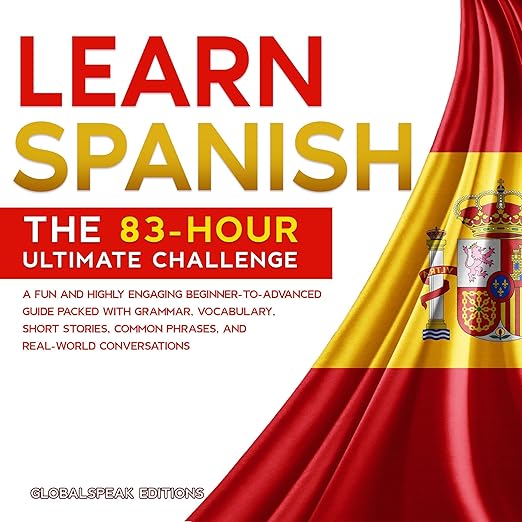
Eighty-four hours of Spanish instruction in audiobook form is a genuinely ambitious undertaking. The premise of Learn Spanish by GlobalSpeak Editions is appealing: a single audiobook resource that takes a learner from first vocabulary through advanced conversational fluency, narrated by Paula Pereira and a second voice, with grammar, short stories, and real-world dialogues woven through the entire runtime. On paper, and in the synopsis, this sounds like exactly the kind of comprehensive audio learning resource that would deserve serious attention from anyone committed to learning Spanish through listening. The listener reviews, however, describe a different experience, and honesty about that gap is the most useful thing this review can offer.
The structural promise of the audiobook is sound in its design. Beginning to advanced grammar explained through relatable examples. Vocabulary in practical contexts covering travel, business, and daily life. Short stories calibrated for different learner levels. Dialogues that reflect authentic Spanish interactions rather than the stilted constructions that plague many language textbooks. These are the right components for a language-learning audiobook, and if executed well, an 84-hour resource of this kind would be genuinely valuable in the market. The format also suits the stated goal of learning while driving, exercising, or otherwise occupying your hands. Auditory language learning has real science behind it, and a resource designed to leverage that approach has inherent merit as a concept even before the execution is evaluated.
Instructor's English Pronunciation Undermines the Spanish Lessons
The practical problem documented by multiple reviewers is the narration itself. Listeners who have invested time into this audiobook describe significant English pronunciation difficulties from the instructor, which creates a compounding problem: if you cannot clearly parse the English explanations, you cannot correctly apply the Spanish instruction. One reviewer described the experience as spending listening time trying to understand the English rather than learning the Spanish, which is the opposite of the intended effect. A second reviewer raised concerns about grammatical errors in the English portions, which undermines confidence in the accuracy of the Spanish content that follows. A third found the Kindle companion book listed only one chapter despite the audiobook having eight, suggesting production quality issues that extend beyond narration alone.
These are not aesthetic criticisms. For a language-learning audiobook, clarity of instruction is load-bearing in the most literal sense. The learning model depends on a listener hearing correct pronunciation modeled, understanding the English explanation scaffolding around it, and then reproducing the target language. If the English scaffolding is unclear, the entire learning structure is compromised. This is particularly damaging for absolute beginners, who have no prior Spanish knowledge to fill in gaps left by unclear instruction and must rely entirely on what the audiobook provides.
Paula Pereira's Dual Voices Aid Conversation Practice
A fair assessment requires acknowledging what this audiobook attempts and where it might still deliver value. The 84-hour runtime reflects a genuine attempt at comprehensive coverage, and the modular structure, which allows learners to progress at their own pace with lessons as short as 30 minutes, is a real feature that suits busy schedules. For listeners who have already established some Spanish foundation through other methods and want additional audio exposure, some components of this resource may prove useful even where the instruction is imperfect. Immersive listening, even imperfect immersive listening, builds pattern recognition over time for learners who can self-correct against what they already know.
The dual-narrator format also provides something genuine: alternating male and female voices create more realistic conversational exposure than a single-narrator audiobook can. Natural conversational flow between two voices, when it works, is one of the most effective audio learning structures available. The question, given the reviewer feedback, is whether the execution matches the format's potential. For listeners curious about the approach, sampling the early lessons before committing to the full runtime is the most prudent path forward.
Verified Reviews Warn Against Inflated Star Ratings
The rating on this audiobook across verified purchase reviews averages significantly lower than the inflated figures that one reviewer specifically warned may appear on some platforms. That reviewer explicitly cautioned that a high star rating visible elsewhere appeared to be publisher-placed rather than from genuine learners who completed the program. Given the specific, detailed nature of the critical reviews from confirmed listeners, that warning deserves significant weight when making a purchase decision.
Experienced language learners who want supplementary listening material and can self-correct against other resources may extract some value from this audiobook. Absolute beginners looking for a primary resource should approach with significant caution, and should verify the specific lessons they intend to use before committing. The synopsis's promise of expertly crafted content has not been consistently verified by listeners who completed substantial portions of the program, and 84 hours is a very long commitment to make without confidence in the underlying quality.
Beginners Should Look Elsewhere for a First Course
Intermediate to advanced Spanish learners seeking supplementary audio exposure may find portions of this 84-hour audiobook useful, particularly the story sections and conversational dialogues where the pronunciation standard of Spanish itself rather than the English explanations is the primary content. Those who already have enough foundation to self-correct and evaluate quality independently are better positioned to use it selectively and extract genuine value.
Beginners looking for a primary Spanish-learning audiobook should investigate alternatives with more consistent listener validation before committing to this resource. The instructional model is sound, and the ambition of the project is genuine, but the narration quality concerns documented by verified listeners represent a serious practical limitation that matters most for those who can least afford to receive unclear instruction when building a new language from scratch.
Frequently Asked Questions
Is the Learn Spanish audiobook by GlobalSpeak Editions suitable for complete beginners?
Based on verified listener reviews, beginners should exercise caution. Multiple reviewers document significant English pronunciation problems from the narrator that make the instructional scaffolding difficult to follow, which is a serious limitation for learners who have no prior Spanish foundation to draw on.
Is it worth trying a sample of the Learn Spanish audiobook before purchasing?
Yes, strongly recommended. Given the narration quality concerns documented by multiple verified listeners, sampling the first lesson to assess whether the English explanations are clear enough for your learning style is the most practical approach before committing to an 84-hour resource.