At a Glance
- Performance: Valentino Blanco narrates clearly alongside native Spanish speakers, creating the bilingual contrast that makes the cognate method click in real time.
- What it covers: cognate-based vocabulary building, interactive listen-respond-repeat method, practical everyday Spanish
- Feel: Energetic and purposeful
- Our call: A well-designed thirty-hour audio course that genuinely exploits the format's strengths rather than simply reading a textbook aloud.
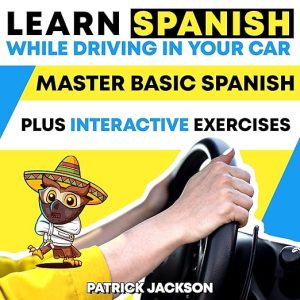
Patrick Jackson's Spanish language audiobook is built on a premise that any experienced linguist would recognize: Spanish and English share thousands of cognates, and most English-speaking beginners are sitting on a vocabulary they do not realize they have. Learn Spanish While Driving in Your Car: Master Basic Spanish Plus Interactive Exercises, narrated by Valentino Blanco with native Spanish speakers throughout, makes that insight the structural foundation of its thirty hours and eleven minutes of audio. This is not a passive listening course. It is designed to interrupt you, prompt you, and make you respond out loud, which is either the program's most valuable feature or its most demanding one depending on how and where you typically listen.
The audiobook format is genuinely well-matched to this kind of language material. Acquisition research consistently shows that production matters as much as comprehension, and the listen-respond-repeat method Jackson builds into the program means listeners are actively using the language rather than just absorbing it. The course explicitly frames otherwise dead time as productive Spanish practice: driving, commuting, exercising, walking. At thirty hours, there is enough material to sustain a serious listening course over several months at a realistic pace, and the structured progression means the vocabulary builds systematically rather than accumulating randomly without a framework to connect it.
Blanco Bridges English Instruction and Native Spanish
The cognate framework is what makes this program distinct from standard audio language courses. Rather than beginning with memorized lists of everyday vocabulary, Jackson shows listeners how to recognize and deploy words they already know, then teaches the patterns that unlock even more vocabulary through systematic transfer. The jump from recognizing a word to using it confidently in a sentence is usually where language courses lose momentum, and Jackson addresses that gap directly by building sentence construction into the interactive exercises from early in the program.
Blanco's narration bridges the English instruction and the Spanish practice cleanly, and the inclusion of native speakers for the Spanish content specifically is a meaningful commitment that distinguishes this from programs using a single voice for both languages. Hearing Spanish pronounced by native speakers from the beginning establishes proper rhythm and accent rather than the flattened approximations that non-native narrators sometimes produce. At thirty hours, the production investment in native speaker voices pays off in terms of the quality of the Spanish a learner develops through the program.
The accompanying PDF, available in the Audible library alongside the audio, adds a visual component for learners who want to reinforce what they hear with text. That kind of multimedia support is sensible for a course of this length, and Jackson notes it explicitly. For listeners who process visually as well as aurally, having the reference material available without purchasing a separate book is a practical advantage that makes the audio program genuinely comprehensive.
Honest About Not Promising Fluency in Thirty Days
The case for this audiobook over alternatives in the language learning category is its density of actual practice time combined with the format flexibility it provides. Unlike podcast-based language programs, which tend to offer passive listening with occasional prompts, this course builds the interaction into its structure in ways that require genuine engagement. The listen-respond-repeat method creates something closer to a distributed drilling session than a lecture, and the research basis for that approach in language acquisition is solid and well-established.
The course earns its 4.9 rating from fifty reviews partly through its practical design and partly through honest framing of what it actually is. Jackson does not promise fluency in thirty days. He promises a practical, efficient way to build foundational Spanish using vocabulary you already have, guided by native speakers who bring the language to life. The progress a learner makes depends on their engagement with the interactive components, but the tools are genuinely there and the course respects the learner's intelligence throughout.
Open Offices Are the Wrong Place for This
The interactive design creates one listening constraint that matters: this is not an audiobook you can have on in the background while doing something else that requires your verbal attention. The prompts asking you to translate, respond, or repeat out loud require genuine participation, and passive listening will significantly reduce retention. That is by design, but it does mean the course is less flexible than a standard audio program in situations where you cannot actually speak out loud. A listener in an open-plan office or a shared vehicle will find the format awkward in ways that a podcast-style course would not be.
The course focuses on vocabulary acquisition and natural sentence building rather than explicit grammar explanation. Learners who want systematic grammar instruction alongside vocabulary work will want to supplement with a written resource that covers the structure of the language. The audio format handles the communicative and pronunciation dimensions of Spanish very well, but the logical architecture of how Spanish grammar functions is better absorbed with visual support than through audio alone.
Made for Commuters Who Can Speak Aloud
This audiobook is ideal for English-speaking beginners or false beginners who commute or have regular windows of alone-time where they can respond aloud. The course is particularly well-suited for people who have tried traditional classroom Spanish and stalled on vocabulary memorization, since the cognate approach reframes what they already know. Skip it if you need systematic grammar instruction, if you primarily listen in shared spaces where speaking aloud is impractical, or if you are already at an intermediate level seeking more advanced practice material rather than foundational vocabulary expansion.
Questions Listeners Ask
Does this Spanish audiobook actually require you to speak out loud, or can it be followed passively?
The course is explicitly designed for active participation. The listen-respond-repeat method includes prompts that ask you to translate, respond, and repeat aloud throughout. You can listen passively, but the course's purpose is to build production skills, and passive listening will significantly reduce what you retain compared to full engagement.
How does the cognate approach in this audiobook differ from standard vocabulary-list methods used in language courses?
Instead of memorizing unrelated word lists, Jackson teaches listeners to recognize the patterns that connect Spanish and English vocabulary, then builds from those patterns into sentence construction. The idea is that most English speakers already know far more Spanish words than they realize, and the course is designed to unlock that existing knowledge rather than replace it.
Can the accompanying PDF be accessed through the audiobook purchase, and is it necessary for following the course?
The PDF is included with the Audible purchase and accessible in your library alongside the audio. It is supplementary rather than required; the course functions completely through audio. Learners who process visually will benefit from having it available, but those who prefer pure audio learning can follow the course without it.