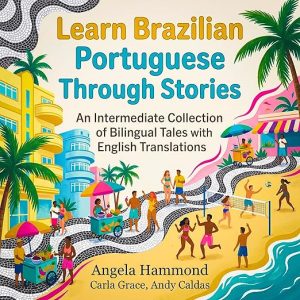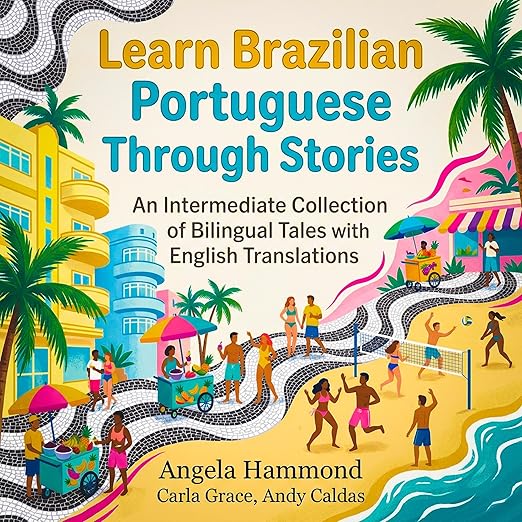
The Learn Brazilian Portuguese Through Stories audiobook makes a structural choice that immediately signals what kind of language-learning resource it wants to be: each story is presented in Portuguese first, then in English translation, then in Portuguese again. That triple-pass design respects the way listening comprehension actually develops. You encounter the language in context, you confirm your understanding through the translation, and then you re-enter the Portuguese with that comprehension now active. For intermediate learners who have cleared the basics but find themselves stalling at the point where passive knowledge needs to become active fluency, that rhythm is genuinely useful.
Author Angela Hammond has built the collection around a specific learner profile: native English speakers at roughly CEFR B1 who want to build listening fluency rather than memorize vocabulary lists. The stories themselves are placed in familiar, contemporary environments: cafes, gyms, airports, apartment buildings, job interviews. The deliberate ordinariness of the settings is a feature, not a limitation. Because the plots stay simple and culturally neutral, nothing pulls focus away from the language itself. You are not trying to follow a complex narrative while also decoding grammar; the narrative exists to provide the grammar a plausible home.
Short Stories Calibrated for Repeated Replay
At 3 hours and 56 minutes, this is a collection you can work through across several focused sessions rather than consuming as a single sitting. The stories typically run 200 to 300 words in Portuguese each, making them short enough to replay multiple times without patience running out. That replay value matters: the way listening fluency develops requires repeated exposure to the same material, not just forward progress through new content. Hammond has accounted for this by keeping the individual stories short and the collection substantial enough to offer variety. The vocabulary throughout stays at high-frequency practical Portuguese, with idiomatic expressions introduced sparingly and always within a context that makes their meaning deducible. That calibration is harder to achieve than it looks. Too many intermediate resources either stay too safe to challenge or push into complexity that requires dictionary lookups to follow.
Grace Keeps the Real Brazilian Cadence Intact
Carla Grace's narration is the component that makes or breaks a resource like this, and it holds up well. Brazilian Portuguese has a specific rhythm, an intonation pattern, and a vowel reduction in casual speech that differs substantially from European Portuguese. A narrator who smoothed those features out in an effort to sound clearer would undermine the resource's purpose. Grace does not do that. She narrates the Portuguese passages with natural Brazilian cadence rather than textbook articulation, which means the listening material trains your ear for actual spoken Brazilian rather than an idealized classroom version. The English translation sections are read cleanly and at a pace that allows comprehension to settle before the Portuguese returns.
This audiobook suits listeners who travel between Portuguese study sessions and everyday life. The commuting, gym, and focused-study use cases described in the product notes match the format well. Because no single story is longer than a few minutes, it fits into fragmented time without losing coherence. Learners who want to consolidate grammar through structured reading and discussion will find it more useful alongside other resources; the stories are not designed to teach grammar explicitly, but to let you encounter it in natural use. No written companion is required, which is a genuine advantage for pure audio learners who do not want to juggle a book alongside the recording.
Spaced Replay Improves Comprehension on Return
This resource is clearly labeled for intermediate learners, and that designation is accurate. Complete beginners will find the Portuguese passages difficult to follow even after hearing the English translation, because the audio assumes you already know what present tense conjugations look like and how basic sentence structures work. The stories let you hear those structures functioning naturally, not teach them from scratch. If you are at beginner level, this is not the right starting point. Sequential resources like foundation grammar courses build the base that this kind of story immersion then activates. Listeners also need to be clear that this is Brazilian Portuguese specifically, not European Portuguese. The phonology, some vocabulary, and several grammatical conventions differ enough that the wrong regional variant creates confusion rather than progress. Check your target dialect before investing time here.
One additional practical note for listeners working through this collection: the replay design rewards spaced repetition. Rather than progressing through every story in sequence and moving on, learners who return to earlier stories after completing several later ones will find that their comprehension of the initial material has improved noticeably. That improvement is the proof of concept for this kind of structured listening. Fluency is not built by encountering language once and moving forward. It is built by the accumulation of encounters with the same language in slightly different contexts, which is what Hammond's story format, combined with deliberate replay, is designed to produce.
For Learners Tired of Mentally Translating Everything
The ideal listener has completed a foundation Portuguese course and can understand basic conversational exchanges but wants their listening comprehension to feel less effortful. If you find yourself needing to mentally translate every sentence before you can process the meaning, this collection is pitched at exactly the right level to start shifting that pattern. It works well alongside formal study as supplementary listening material. Listeners at advanced B2 or above may find the language level less challenging than they need and would benefit from moving to authentic Brazilian media or longer-form intermediate texts. For its target audience, it is a well-made, thoughtfully sequenced resource that respects the learner's time and intelligence.
The Short Version
- Performance: Carla Grace reads the Portuguese passages with authentic Brazilian rhythm and clear enunciation, which is exactly what an intermediate learner needs from a narrator in this format.
- What it covers: Everyday Brazilian life, intermediate language scaffolding, listening fluency
- Feel: Methodical and reassuring
- Our call: A well-designed intermediate listening resource for CEFR B1 Portuguese learners who want structured immersion without classroom pressure.