In Brief
- Performance: Hara Garoufalia-Middle carries the narrator credit, though the description places a second teacher and two students in the same recorded lesson.
- What it covers: Spoken-first language learning, no memorization, learning from other students' mistakes, bounded and honest goals.
- Feel: Calm, patient, participatory.
- Our call: A solid spoken-Greek foundation for beginners who will actually answer out loud, and no help at all with the alphabet.
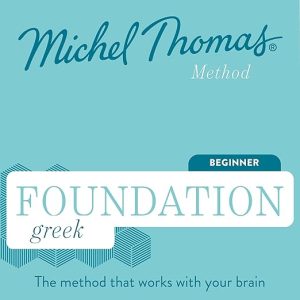
Ten hours of spoken Greek, with no books, no homework, and nothing to memorize, is the entire proposition of this audiobook. Foundation Greek is the full beginner course in the Michel Thomas Method, and the listing credits Michel Thomas as author with Hara Garoufalia-Middle as narrator. The description is more forthcoming about what you actually get: a recorded lesson with two teachers and two students already in the room, into which you are inserted as a third student expected to answer out loud.
Speaking Aloud Is the Real Prerequisite Here
The method is old enough to have outlived every trend that tried to replace it. Thomas spent decades breaking languages into what the description calls building blocks, introduced in a sequence designed so the learner constructs sentences rather than repeating them. His stated principle is quoted directly on the page: 'What you understand, you know; and what you know, you don't forget.' Stress, in this framework, is the enemy of retention, which is why nothing is ever tested.
This is one of the few categories where audio is the original medium rather than an adaptation of a book, and that changes how you should approach it. A novel tolerates half-attention. This does not. The course only functions if you answer aloud in the pauses, pause the playback when your answer is slower than the students', and resist the urge to let a correct response from someone else stand in for your own attempt. A quiet room and a willingness to talk to yourself are the real prerequisites, which rules out a surprising number of the situations people buy language audio for in the first place.
A Small Classroom Behind One Narrator Credit
Credits on this listing deserve a plain explanation, because the page compresses them. Michel Thomas is named as author, and the method carries his name, but the description states that the teachers you will actually hear are Hara Garoufalia-Middle and Howard Middle, working alongside two students. Only one of those four voices appears in the narrator slot. A buyer expecting a single reader is instead getting a small classroom, which is the format working as designed rather than a mistake.
Hearing Real Mistakes Corrected Builds Confidence Fast
The third-student design is the genuinely clever part. Two real learners work through the material ahead of you, and their errors are left in the recording rather than edited out, so a beginner hears mistakes being made and corrected in real time instead of encountering only polished model sentences. The description promises simple constructed phrases within the first hour, which is realistic for this method precisely because nothing is being memorized. Hearing other beginners hesitate also removes the loneliest part of studying alone, where every stumble feels like personal failure rather than the ordinary shape of learning.
Time economics are worth understanding before you buy. The recording runs ten hours and five minutes, but the description estimates twenty to thirty hours to complete the course, and both numbers are honest. The gap is the work: pausing, thinking, answering, and repeating sections that did not land. Anyone treating the runtime as the study time will finish having heard a course rather than having taken one.
What the method promises is deliberately bounded, and Thomas is quoted saying so: 'I am the architect who builds the house. It's up to you to decorate it.' The stated goal is understanding and confidence in basic Greek with proper pronunciation, not fluency. That honesty is rarer than it should be in language products, and it makes the ten hours easier to judge, since you know in advance which ceiling you are buying.
The Pull Quote Is Actually About German
One pull quote at the top of the description does not survive scrutiny. It is credited to David Sedaris in the New Yorker and framed as praise for learning Greek with this method, but the punchline inside the quotation is 'Hey, Ich kann do dis,' which is German. The endorsement is real and it is about the method; it simply belongs to a different language in the same series and has been carried across to this listing. Read it as a comment on the approach, not on the Greek course.
Overlap between products in this range needs checking before purchase. The description states outright that the first hour of this course is identical to the Start Greek taster, so anyone who tried that sample is buying nine new hours rather than ten. Beyond this course sit an Intermediate level and a separate two-hour Review course, which means Foundation is one step in a ladder rather than a complete package.
The page carries no ratings and no written responses at all, so nothing here is corroborated by anyone who has taken the course in this edition. The copyright lines add useful context: the material dates from 1999 and the recordings from 2009 and 2019, published by Hodder and Stoughton, while the listing shows a February 2026 release. This is an established course reissued rather than a new production, and a publisher line reading simply as the method's own name does nothing to make that clear.
Built for Speaking, Not for Reading Greek
Absolute beginners are the intended audience, particularly travelers who want usable spoken Greek before a trip and adults who have bounced off grammar tables, flashcard apps, or the guilt cycle of streak-based learning. Anyone who learns by talking rather than by writing will find the format suits them immediately, and the absence of homework removes the most common reason people abandon a language course in week three.
The practical requirements are modest but real: somewhere you can speak aloud without embarrassment, a way to pause easily, and the willingness to answer before the recorded students do. A PDF accompanies the purchase for those who want something on screen. Listeners who commute in company, or who plan to run this while doing anything requiring concentration, should think about where the speaking part will actually happen.
Reading Greek is the significant gap. Nothing in the description points to the alphabet being taught, and the method is explicitly built on listening and speaking without writing, so a learner will finish able to say a great deal and still unable to decode a street sign. Pair this with a script resource if literacy matters to you. Owners of the Start Greek taster should also factor that duplicated first hour into the decision.
Does this audiobook teach the Greek alphabet?
Nothing in the description indicates it does. The whole method operates in sound rather than in script, with no writing and no memorizing involved at any stage. If reading signs, menus, and place names matters to you, plan on a separate alphabet resource alongside this one.
Who is actually teaching on the recording?
The description names two Michel Thomas Method teachers, Hara Garoufalia-Middle and Howard Middle, plus two students whose lesson you join as a third participant. On the page, Michel Thomas holds the author credit and only Garoufalia-Middle appears as narrator, so the voices you hear outnumber the credits on display.
Having tried Start Greek, is this audiobook still worth buying?
Partly. The description states that this course's first hour is the same material as the Start Greek taster, so you would be paying for roughly nine new hours. That is still the bulk of the course, and Foundation is the intended next step, but it is worth knowing the overlap exists before you buy.