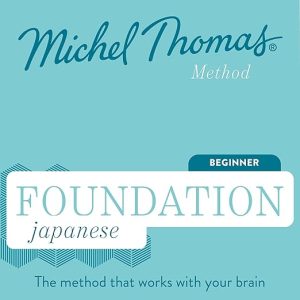
Japanese represents one of the steepest climbs available to an English-speaking language learner, and the question that matters most before committing to any course is whether the method is honest about what it can realistically deliver. Foundation Japanese (Michel Thomas Method) - Full course, authored and narrated by Helen Gilhooly, is unusually clear-eyed on this point: the method will not make you fluent, but it will give you a genuine spoken foundation from which all subsequent learning becomes easier and faster. That honesty about scope is one of the things that distinguishes this audiobook from language products that promise more than the format can provide.
Gilhooly's course runs to 10 hours and 42 minutes and is designed to be completed over 20 to 30 hours of active listening, factoring in the pausing and responding the method requires. It follows the same core structure as Michel Thomas's French courses: Gilhooly works with two students in a live lesson, you join as the third, and the construction of Japanese proceeds incrementally from the simplest possible elements through increasingly complex sentence structures. The first hour, which is the same as the Start Japanese taster course, gives you an immediate sense of whether the approach suits your learning style.
Building Japanese Sentences Before You Hear Them
The Michel Thomas Method's central insight - that you reconstruct the language yourself rather than receiving it pre-assembled - is particularly valuable for Japanese because the structural gap between Japanese and English is so wide. Many learners struggle with Japanese precisely because they try to impose English word order and logical structure on a language that works differently at a fundamental level. Gilhooly introduces Japanese grammar from scratch, without assuming any English analogy, which allows the learner to build an internal model of the language that is actually accurate rather than a translated approximation.
David Sedaris, quoted in the synopsis from his experience with the German method, described the thrill as actually figuring it out on your own, engaging with another language rather than parroting it. That observation maps precisely onto what the Japanese course does. The pause-and-respond format requires you to construct sentences before you hear them, which means you are processing the language rather than tracking it. The difference in how the knowledge settles is real.
Gilhooly's Patient Corrections Build Real Pronunciation
Gilhooly's narration and teaching style are ideally suited to the format. She is patient without being slow, encouraging without being patronising, and her error corrections are handled in exactly the way the Thomas method intends: as opportunities to understand why the correct construction works, not as failures to be noted. For a learner building confidence in a challenging new language, that quality of response is more valuable than it might initially appear.
The pronunciation guidance embedded throughout is particularly well-handled. Japanese phonology is more accessible for English speakers than many learners expect, and Gilhooly introduces it in a way that normalises the sounds without overloading the learner with phonetic theory. By the end of the course, basic Japanese pronunciation is established firmly enough that the learner can use it in real conversation without constant self-correction.
Production from the Start, Then Consolidation
The audio-only format is not a limitation for this course - it is the delivery mechanism the method was designed for. Japanese, like any language, is primarily oral. You learn to speak by speaking, and you learn to understand by listening. The Foundation Japanese audiobook situates you in a learning environment where production is required from the start, which accelerates the process of making Japanese feel usable rather than merely studied.
The 10-hour-42-minute package includes a 2-hour Review course in addition to the main Foundation content, which gives learners a dedicated consolidation session after completing the primary material. For a language as structurally complex as Japanese, that review component is genuinely useful rather than supplementary padding.
No Hiragana, Katakana, or Kanji in This Course
The course does not cover Japanese writing systems. No hiragana, katakana, or kanji is addressed in the audio material. Learners who intend to read or write Japanese, or who plan to interact with the written language in any meaningful way, will need separate resources for that dimension. The course is explicitly oral and aural in its scope, and the Foundation level sets a realistic expectation: you will be able to speak and understand basic Japanese, but you will not be able to read a menu or a train sign.
A PDF companion is included with the purchase, which provides a written reference for the audio material. It does not introduce writing systems but gives learners who want a visual anchor for what they cover in the sessions a useful reference document.
Built for Learners Who Skip Grammar Textbooks
This audiobook is built for learners who have no prior Japanese and want to begin building spoken confidence through an audio-immersion method rather than a grammar-textbook approach. It is particularly well-suited to learners who find rote memorisation frustrating and who respond better to understanding a language's logic than to drilling lists of vocabulary and rules.
Learners who need reading and writing from the start, or who are preparing for formal Japanese examinations, will need to combine this course with additional resources. As a spoken foundation for a genuinely challenging language, delivered through one of the most carefully designed audio-teaching methods available, it is a serious and honest starting point.