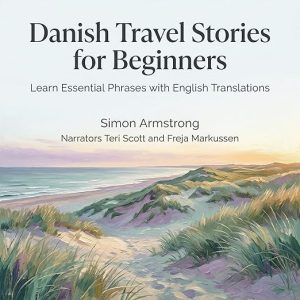
Danish Travel Stories for Beginners sets out its method on the very first track and does not deviate from it across four hours and thirteen minutes of material. Simon Armstrong's audiobook, narrated by Teri Scott, applies a three-pass structure to 21 short travel-focused stories: Danish first, then English translation, then Danish again. The premise is that by the time you hear the story a second time in Danish, the meaning is embedded enough that your brain can focus on the language itself rather than working to decode it. It is an unglamorous approach, and it works.
The stories themselves cover the terrain any traveller to Denmark would actually encounter: booking accommodation, ordering food, navigating transport, handling simple conversations, shopping, and visiting attractions. They are not trying to be literature. They are functional scenarios populated with vocabulary that matters in real situations. That narrowness of purpose is a feature, not a limitation. Armstrong has made deliberate choices about what to include and what to leave out, and the result is a course that stays focused on its actual job throughout.
Scott's Pacing Lets Meaning Land First
The three-step structure deserves more credit than it might initially receive. Language learning audiobooks frequently err in one of two directions: either they assume too much and leave beginners confused, or they over-explain to the point of condescension. Danish Travel Stories for Beginners avoids both problems by giving the listener the meaning before they need it. You hear Danish, you get the full translation, and then you hear the Danish again with comprehension already in place. The second Danish pass is a genuinely different experience from the first, and that gap between the two passes is where learning actually happens.
Teri Scott's narration is well-calibrated for this format. She reads the Danish material at a pace that is deliberate without being artificially slow - fast enough to sound natural, careful enough that a beginner can follow along. The transition between the Danish and English passes is clean and unhurried. Over twenty-one stories and four hours, this consistency matters considerably. A narrator who rushed or varied their pace unpredictably would undermine the structure that makes the method work.
The choice of travel scenarios also reflects good judgment about where Danish learners need the most practical support. Booking a hotel or navigating a train station are precisely the moments when a beginner feels most exposed and most in need of a few phrases that actually land. By situating the vocabulary in complete narrative contexts rather than isolated phrase lists, Armstrong gives the learner something stickier than a conventional phrase book delivers.
Self-Contained Audio, No Textbook Required
The core argument for this audiobook over other beginner Danish resources is the format itself. If you learn better by listening than by reading, and if your goal is travel comprehension rather than academic proficiency, the story-and-translation structure is genuinely efficient. You can work through several stories on a single commute, replay individual tracks when a particular scenario needs reinforcement, and measure your own progress by noticing how much more you understand on each second Danish pass than you did the first time you heard the material.
The 4-hour-13-minute runtime is also meaningful in practical terms. This is a course you can complete across a couple of weeks of regular listening, which is the right scale for a beginner building confidence before a trip. It does not promise fluency - it promises a working familiarity with Danish in practical travel situations, and that is a promise the material is structured to keep.
The lack of any textbook component is worth noting as a genuine advantage for audio-first learners. You do not need to be at a desk, looking at a screen, or following a printed transcript. The course is entirely self-contained as an audio product, which means it is available whenever you have a spare half-hour, wherever you happen to be.
Replayable by Design, Silent on Grammar
This course does not address reading or writing in Danish, and it does not attempt to deliver a systematic grammar explanation. Learners who want a structured overview of Danish grammar alongside their listening practice will need a supplementary resource. The method works through immersion and repetition rather than explicit rule-teaching, which suits some learners very well and suits others less.
The travel-scenario constraint also means that vocabulary outside of tourist contexts is not covered. If you have goals beyond basic travel communication - workplace Danish, academic Danish, or simply a broader everyday vocabulary - the course will serve as a useful starting point but not a complete foundation.
Listeners who find they need to pause frequently to process what they have heard should not interpret that as a failure of the method. The design assumes replaying tracks and working at your own pace. The course is replayable by intent, and the three-pass structure means revisiting any individual story several times is entirely consistent with how the material was designed to be used.
Trip Preparation for Complete Danish Beginners
This audiobook is best suited to English speakers with no previous Danish who are preparing for a trip to Denmark, or to anyone who finds audio-immersion methods more effective than grammar-textbook approaches. It will also appeal to language learners who have tried Pimsleur or similar audio-first courses and want a complementary resource that emphasises reading comprehension over production.
It is not the right choice for learners who need explicit grammar instruction, systematic vocabulary lists, or reading and writing practice alongside their audio work. For those learners, a structured course combining audio with a textbook will serve better. For focused, practical, audio-only preparation for Danish travel, this is a well-constructed option.
Good to Know
How does the three-pass structure in this audiobook actually build Danish comprehension?
Each of the 21 stories is presented in Danish first, then in full English translation, then in Danish again. The effect is that by the second Danish pass, meaning is already established and your brain can focus on the sounds, rhythm, and vocabulary of the language rather than struggling to decode it. That second pass is where the learning consolidates.
Is this audiobook useful if you have already done some beginner Danish study?
Yes. The material targets the beginner-to-low-intermediate range, so if you have done some prior study, you will likely find the stories reinforce rather than repeat what you know. The travel vocabulary and real-situation framing make it a practical complement to grammar-based courses, even for learners with a small amount of existing Danish.
Can this audiobook work as a standalone preparation for a trip to Denmark?
As a standalone audio resource for travel preparation, it covers the most common practical scenarios well - accommodation, food, transport, shopping, and basic conversation. It will not give you conversational fluency, but it will give you enough familiarity with Danish sounds and travel vocabulary to navigate basic tourist situations with more confidence.
Does the narrator Teri Scott read the Danish at a natural speed or is it slowed down for beginners?
Teri Scott reads the Danish at a deliberate but natural pace - careful enough for beginners to follow, but not so artificially slow that it sounds unlike real Danish. This is a sensible calibration for a beginner course, and it means the material remains useful even as your comprehension improves and you want to experience language at closer to normal conversational speed.