The Short Version
- At its heart: Hidden origins of everyday conventions, measurement and money as inventions, the mind's blind spots
- Vibe: Genial and curious, an unhurried stream of small revelations
- Short version: Good value as broad, episodic curiosity fuel, provided synthetic narration and an unreviewed listing do not deter you.
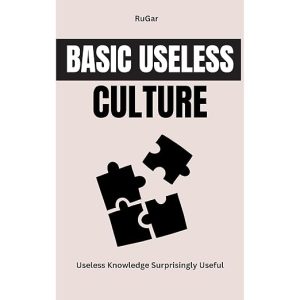
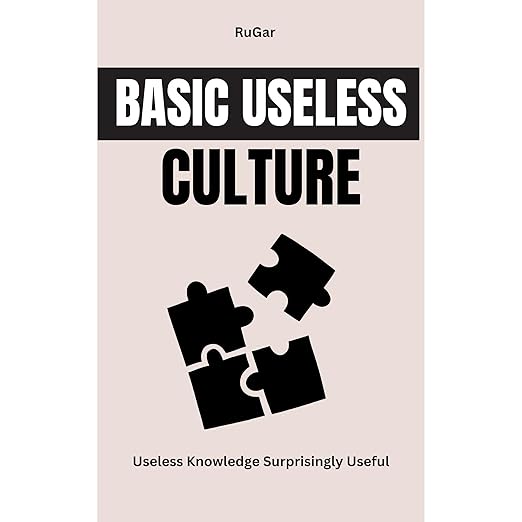
Independently published, synthetically voiced and thirteen hours long, this audiobook is an unusual proposition before a single fact arrives. Basic Useless Culture gathers up the questions most people stop asking somewhere around the age of nine: why the alphabet looks the way it does, why clocks divide time into sixty seconds, why maps lie, why the body still carries parts that no longer do anything. Ruben Garcia's wager is that none of this is trivia, and that the throwaway details are quietly load-bearing.
Connecting Fields Instead of Going Deep
Its organizing move is consistent enough to describe in one sentence: take something nobody looks at twice, follow it back to the decision that produced it, and show that the decision is still shaping behavior. Ancient alphabets and Roman numerals lead into how letters became instruments of science. Sixty-second minutes lead into time as something humans learned to measure and then to control. The origins of money lead into money as an invisible organizing force. Each chapter is a small excavation with the same shape.
That consistency is the book's strength and its ceiling at once. Once you have heard three chapters you can predict the fourth, and the promise printed at the end of the description, that once you see it you cannot unsee it, is really a promise about one trick repeated across dozens of subjects. The trick is a good one. Thirteen hours and twelve minutes is a long time to watch it performed without variation.
Range is the other double-edged property. Science, history, psychology and philosophy all appear, sometimes inside a single chapter, and a book that reaches from the physics of the universe to the glitches of the human mind cannot go deep on either. What it can do is connect them, and the connective work is where Garcia is most interesting: the argument that measurement, notation and money are the same kind of invention, a human agreement that hardened until it looked like nature.
Episodic Chapters Built for Weeks of Listening
Episodic nonfiction is close to ideal in audio, and this is thoroughly episodic. Chapters stand alone, nothing later depends on remembering an earlier argument in detail, and losing three minutes to a distraction costs you nothing structurally. That is a genuine format advantage over a linear history or a technical book where a missed definition wrecks the following hour. You can pick this up mid-chapter for a month and still get the value out of it.
Subject matter also survives being heard rather than seen better than you would expect. Questions about why maps lie or why the brain believes things about itself that are not so are conceptual rather than visual; the distortion of a projection can be described in words, and the description is the point. Nothing here needs a chart to land, which is not something you could say about most books that promise to explain the physical world.
All that ground for the price of a single title is also, frankly, a lot of material. The breadth that limits the depth is the same breadth that makes this a reasonable choice when you want something in your ears for several weeks and do not want to commit to one subject. Curiosity here is the organizing principle rather than expertise, and no shame attaches to that as a design.
Synthesis Handles Prose but Not Proper Nouns
Start with the voice, because it decides everything else. The credited reader is Virtual Voice, which means synthetic speech generated from the text rather than a human performance. No actor is attached to this recording. For a long book dense with numerals, dates, unit names and historical terms, that is a real consideration: synthesis handles ordinary prose competently and handles unusual proper nouns and abbreviations unpredictably, and nobody has been paid to notice when it goes wrong.
Reception data is entirely absent as well. No rating has been filed, no review has been posted, and the release date is March 2026. Every judgment available to a prospective buyer comes from the description and the running time, mine included. That is not a criticism of the book; it is a statement about how much weight the usual signals can carry here, which is none.
Metadata carries one problem worth flagging, because it changes what you think you are buying. The listing displays the title as Basic Useless Culture, while the description gives it in full as Basic Useless Culture: Useless Knowledge Surprisingly Useful. The subtitle is the part that explains the premise, and dropping it leaves a title that reads like a joke rather than a thesis. Independent publication shows elsewhere too, in copy that repeats its central promise several times before the book starts.
Gentler Than Most Nonfiction Audio Entry Points
Generalists are the audience, and specifically the kind of generalist who enjoys the moment when an arbitrary convention turns out to have a traceable origin. If you have ever wondered why the week has the length it has, or found yourself irritated that nobody could tell you why a particular measurement exists, this is built for you. It also suits shared listening with older children, since the questions are ones they still ask out loud.
Long routine tasks are the natural setting. Chapter independence means the book tolerates interruption, and the tone stays even rather than escalating, so it works as company rather than demanding a seat. Anyone who keeps a nonfiction title running through housework, gardening or a long stretch of manual work will find this format kinder than something demanding sustained concentration.
Newcomers to nonfiction audio may find this a gentler entry point than most. No prior knowledge is assumed anywhere, no chapter rests on a technical foundation laid earlier, and the vocabulary stays ordinary even when the subject turns to physics. Anyone who has bounced off denser science or history titles because the opening hour demanded too much can start here without that risk, then use whichever chapters catch them as a map toward heavier reading later.
Nobody looking for depth on any single topic should start here, and anyone sensitive to synthetic narration should audition a sample before committing to it at this length. The absence of any reviewer feedback at all means the usual safety net is gone: you cannot check whether the science holds, whether the historical claims are sound, or whether the voice mangles the terminology. That is a bet, and it should be made knowingly rather than by accident.
Who narrates the Basic Useless Culture audiobook?
The credit reads Virtual Voice, meaning machine-generated speech rather than a recorded human performance. No actor is named anywhere on the listing. Anyone who finds automated reading distracting over long stretches should sample it first, because this is a substantial commitment to a voice you may end up disliking.
Does the audiobook need a PDF or any visual material to follow?
Nothing on the listing mentions a companion document, and the subject matter mostly does not require one. Alphabets, calendars, maps and money are handled as concepts rather than as diagrams. A listener who wants to see a projection distortion or a numeral system laid out will have to look it up separately.
Why does the title on the listing differ from the one in the description?
The page displays the short form, while the description carries the full version, adding a subtitle promising that useless knowledge turns out to be surprisingly useful. That subtitle holds the actual premise, so dropping it makes the book sound like a joke rather than an argument. Same title, shortened for display.
Are there any ratings or reviews to judge it by?
None at all. Both the rating counter and the review section sit empty, and the title appeared in March 2026 from an independent publisher. Every judgment available right now rests on the publisher copy and the length alone, which makes early buyers the first real testers of this one.