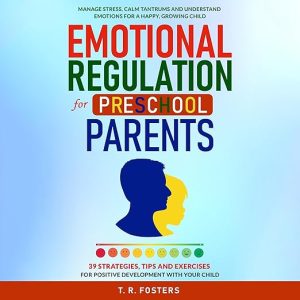
Picture the scene: it is 7:15 in the morning, you have a meeting in forty minutes, and your four-year-old has dissolved into a full-body protest because the toast was cut in the wrong direction. You know on some level that this is developmentally normal. You know that your child is not doing this to you deliberately. What you may not know is what to do with the wave of frustration moving through your own nervous system right now, before you can think about helping your child. This audiobook, Emotional Regulation for Preschool Parents, begins from exactly that kind of ordinary crisis and builds a practical framework for surviving it without losing your own composure in the process. Jack Nolan narrates this entry in the Positive Parenting series with a calm, unhurried tone that itself models the approach the book advocates throughout its 4 hours and 40 minutes.
Nolan's Even Delivery Anchors the Reframe
Author T.R. Fosters is writing for a specific and underserved audience: caregivers of children in the preschool years, roughly ages two through five, a developmental window when emotional storms are frequent, intense, and largely disconnected from rational intervention. The premise is not that parents should focus primarily on managing their child's emotions but that the parent's own emotional regulation is the prior condition for everything else. You cannot guide a dysregulated child back to calm if you are not anchored yourself, and most parenting resources spend far more time on the child's behavior than on the parent's internal state.
At 4 hours and 40 minutes, this is a tight, purposeful listen. Fosters does not pad the runtime with anecdote for its own sake. The book is structured around practical principles that build logically from the neuroscience of co-regulation, how a child's nervous system learns to calm through proximity to a regulated adult, through to concrete scripting and response strategies for the meltdown scenarios that preschool parents encounter with predictable frequency.
Jack Nolan's narration is well-matched to the material. His even, reassuring delivery keeps the audiobook from feeling either clinical or preachy, and he handles the more emotionally resonant passages with appropriate steadiness. For parents who are themselves exhausted and stretched thin, a narrator who does not add urgency or intensity to the listening experience is the right choice.
Thirty-Second Techniques for the Grocery Store Meltdown
The core insight that makes this audiobook valuable is the reframe it offers around parental responsibility. Most parenting content in the emotional regulation space focuses outward: what to do when your child melts down, how to teach feelings vocabulary, how to implement age-appropriate consequence structures. Fosters pivots from that frame and asks instead what is happening in the parent's nervous system during those moments, and what practices can keep that system regulated enough to respond rather than react.
This is practically useful material, and it is presented with the kind of specificity that makes it actually applicable under pressure. Fosters covers breathing and grounding techniques specifically calibrated for parents who have thirty seconds, not thirty minutes, to recover before re-engaging with a distressed child. These are not the mindfulness techniques designed for a quiet morning practice; they are techniques designed for use in the middle of a grocery store, a car ride, or the 7:15 a.m. kitchen standoff described above.
Repair Over Guilt, Within a Coherent Series
The book also addresses the guilt cycle many parents enter after losing their composure, offering a repair framework that treats relationship rupture and repair as a normal and even valuable part of healthy parenting rather than as evidence of failure. This section is particularly well-handled, grounding the repair conversation in research on secure attachment rather than generic reassurance.
As part of the broader Positive Parenting series, this audiobook sits within a coherent framework of attachment-informed approaches to child development, and listeners familiar with that framework will recognize the continuity. The series context enriches the material without making it inaccessible to newcomers.
Calibrated for Two-to-Five, Less for Trauma History
Because this book is part of a series, some foundational Positive Parenting concepts appear without full explanation, with an implicit assumption that listeners are either familiar with earlier entries or already comfortable with the attachment-informed parenting framework. Parents coming to this book without that background will still find it useful, but they may benefit from supplementary reading on co-regulation basics to fully contextualize what Fosters is building on.
The book is also specifically calibrated for the preschool window. Parents of children above age five or below eighteen months will find some of the developmental framing less directly applicable to their specific situation. The core strategies transfer to adjacent age ranges with some adaptation, but the specific scenarios and scripts are written with the two-to-five-year-old in mind.
At under five hours, some listeners will wish for more depth in certain areas, particularly the sections on parenting through your own trauma history and on the ways that a parent's unprocessed emotional responses to their own childhood shape their reactions to their child's distress. These themes are introduced and acknowledged but not fully developed within the available runtime.
Caregivers Whose Own Reactions Are Part of the Pattern
This audiobook is designed for parents, caregivers, and early childhood educators who are actively navigating the preschool years and find that conventional behavior management approaches are not holding under pressure. It is particularly well-suited to parents who have already noticed that their own reactions during their child's emotional storms are part of the pattern they want to change, not just a neutral backdrop to the child's behavior.
The Positive Parenting series context means this works best as part of a broader reading program rather than as a fully isolated resource, but it stands on its own well enough that prior series familiarity is not required to get real value from it. If the 7:15 a.m. toast scenario described in this review is a recurring event in your household, this audiobook has something concrete and immediately actionable to offer you.
Do I need to have listened to earlier books in the Positive Parenting series first?
Not strictly, but some foundational concepts appear without full explanation. Prior familiarity with attachment-informed parenting will help you get more from this audiobook's framework.
Is this audiobook relevant for parents of toddlers or older children, or only preschool age?
The strategies transfer to adjacent ages with some adaptation, but the developmental framing and specific scenarios are calibrated for the preschool window, roughly ages two through five.
What makes this audiobook different from other parenting books on emotional regulation?
Most parenting audiobooks focus on managing the child's emotions. This one reframes the challenge, treating the parent's own nervous system regulation as the prior condition for everything else.
How long is this audiobook and is the runtime sufficient to cover the topic?
At 4 hours and 40 minutes, the book is tight and purposeful. Some areas, particularly trauma-informed parenting history, are introduced but not fully developed. It works best alongside supplementary reading.