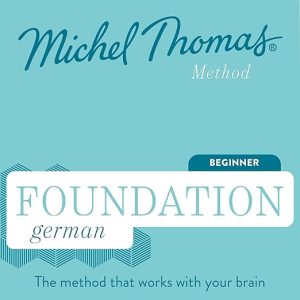
Language courses sit oddly inside the audiobook format, because that format was never designed for anything that expects you to talk back. Michel Thomas built his entire method on exactly that expectation. Foundation German asks you to stop, think and answer aloud at intervals throughout, which makes it less a recording you consume than a class you attend at whatever hour you decide to attend it.
Building Blocks Assembled the Way Brains Accept
Michel Thomas spent more than fifty years, by the description's account, breaking languages down into what he called building blocks and reassembling them in the order a brain accepts without strain. No books, no homework, nothing to memorize. The claim quoted in the copy is his own: what you understand, you know, and what you know, you do not forget. Whether that holds for you is the only test that matters, and the first hour settles it one way or the other, which is more than most language products can promise.
Learning From Two Students' Real-Time Errors
Two students sit in the recorded lesson alongside him, and this is the structural detail that separates the course from every other audio language product. You learn from their successes and, more usefully, from their errors. When one of them stumbles over a construction, the correction happens in real time and reaches you as a listener rather than as a person being marked wrong, which removes most of the self-consciousness that stalls adult learners before they start. Somebody else has already made the mistake for you.
You become the third student. That framing is not decoration, it dictates how the whole recording is paced: deliberate gaps where an answer is expected, and a structure that builds each new sentence out of pieces handed to you twenty minutes earlier. Within the first hour the copy promises you will assemble simple phrases yourself, without writing anything down, without drilling a list, and without the pressure that usually accompanies being asked a question.
Thomas Promises Nine Hours, Delivers Thirty
What the course sets out to deliver is deliberately bounded, and the honesty about that is worth something. Fluency is explicitly not the goal. The stated aim is a strong foundation and a working knowledge with proper pronunciation, arrived at faster than other methods manage, from which a learner can expand afterward. Thomas puts it as building the house and leaving the decorating to you, which is a fair account of what a course of this shape can genuinely accomplish.
Because Thomas is both the credited author and the credited voice, the reading is not a performance of a text; it is the text. No interpretive layer sits between a script and a listener, since nothing was written down to begin with. The pauses, the pacing, the pressure of a question left hanging in the air: all of it is pedagogy rather than delivery, and all of it belongs to the teacher instead of to a reader engaged afterward to speak his words. The distinction matters when you are judging what a credit line is telling you.
Nine hours and twelve minutes of running time will not correspond to nine hours of your life. The copy states plainly that most learners take twenty to thirty hours to finish, because the method demands stopping, repeating and answering, and that ratio is a design decision rather than an inefficiency. Budget accordingly. A course consumed at listening speed, with the gaps skipped over, is a course that will not do what it promises.
Hour One Repeats the Start German Taster
Zero written responses appear on this page, and no rating counter appears either. That is unusual for a title with this much history behind it, and it means the description and the sample are the only things you can weigh before buying. The method has a long public record; this particular listing has none at all, and those two facts should not be allowed to substitute for one another when you are deciding.
One hour of the nine will not be new to everyone. The copy notes directly that the opening hour of this course is identical to the Start German taster, so anyone who has worked through that already will be repeating it here before reaching anything fresh. That is fair disclosure. It also sits in a parenthetical near the end of a very long description, which is precisely where a buyer is least likely to find it.
Rights information on this page tells a more complicated story than the publisher line does. The publisher is given as Michel Thomas, while the copy's own copyright block credits Thomas Keymaster Languages LLC with the material in 1999 and Hodder and Stoughton with the recordings in 2008 and 2019. A March 2026 date on the listing is therefore a release date for this edition, not a production date, and what you are buying is an established course rather than a new one.
Four More Stages Wait Beyond This One
Absolute beginners are the target, and the fit is close to exact. If you have never studied German, or studied it at school and retained almost nothing, this is built for the position you are in. The same applies to anyone who has bounced off app-based learning, because the premise here is that you reason your way toward answers rather than drilling cards until they stick, and reasoning is what survives a gap of several weeks.
The method will frustrate anyone who needs to see a language written down. No books and no homework is the selling point, and it is equally the constraint: you finish able to pronounce and construct, having never read a word of German on a page. Learners working toward exams, reading knowledge or a written qualification need something else running alongside this, and should plan for that from the beginning rather than discovering it at hour eight.
Fifty years of refinement stand behind this, and it shows in the sequencing more than anywhere else, where each new element arrives only once the previous one carries weight. Treat it as an opening rather than a complete solution, because the copy lays out four further stages after this one and expects you to want them. Taken properly, with the gaps honored, it does what almost no other format manages: it has a beginner speaking before they have written anything at all.
- Performance: Michel Thomas is credited as his own voice, which here means the teacher rather than a reader, with two students answering alongside him.
- What it covers: Beginner German, spoken-first learning, building-block grammar, learning without books or memorization.
- Feel: Calm, patient and unhurried, closer to a private class than to a recording.
- Our call: The strongest audio-only route into spoken German for a true beginner, provided you actually pause when asked.
Does the Foundation German audiobook come with any written material?
Yes. The description states that an accompanying PDF appears in your library alongside the audio when you buy the title. It is a supplement rather than a workbook, since the method itself deliberately excludes reading and writing from the learning process, and nothing in the course requires you to open it.
What comes after the Foundation German audiobook?
The publisher sets out a five-stage order: Foundation, then Language Builder, then Intermediate, then Vocabulary, then Insider's. A separate two-hour Review course is also mentioned for consolidating what this one covers. Foundation is the entry point, so budget for more than one purchase if you intend to keep going.
Who endorses the Michel Thomas Method in the description?
The copy opens with a New Yorker quote attributed to the humorist and author David Sedaris, describing the thrill of figuring German out rather than parroting it. Worth noting that the endorsement is of the method in general rather than of this specific recording, which carries no reviews of its own.