At a Glance
- Narration: Cobie Adkins-De Jong's teaching voice is engaged and patient, maintaining the low-pressure classroom atmosphere the Michel Thomas Method depends on across the full twelve hours.
- Themes: Stress-free acquisition, language reconstruction over memorization, adult learning psychology
- Mood: Focused and quietly energizing
- Verdict: One of the most effective audiobook-format language courses available for Dutch beginners, built on a proven method that respects how the brain actually learns.
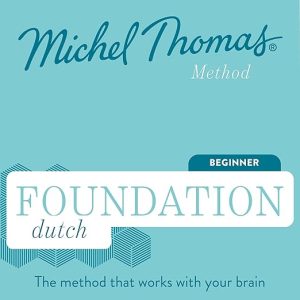
Michel Thomas built one of the most distinctive language learning systems of the twentieth century, and the audiobook Foundation Dutch (Michel Thomas Method) - Full course remains one of the clearest expressions of what made his approach so different from the classroom and the textbook. The method's central claim is simple and radical: learning fails not because students lack ability but because teachers create the conditions for stress, and stress blocks acquisition. Remove the stress, structure the material so learners reconstruct the language themselves rather than memorizing it, and fluency begins to feel like something happening to you rather than something you are forcing. Cobie Adkins-De Jong, one of the course's two teachers alongside Els Van Geyte, is central to how that experience lands in practice, and her teaching voice carries the patient, engaged quality the method depends on.
The twelve-hour full course combines what was previously available as the Foundation and Intermediate programs. It follows the established Michel Thomas format: the listener joins a live classroom session as a third student, learning alongside two course participants whose successes and mistakes are equally instructive. Dutch, as a target language for English speakers, is a strategically well-chosen entry point. Its vocabulary overlaps significantly with English in ways that the method explicitly teaches you to notice and exploit rather than treating the languages as entirely separate systems. By the end of the first hour, listeners are constructing their own sentences without having been asked to memorize anything, which is the moment the method's underlying logic becomes undeniable rather than just theoretically appealing.
The New Yorker piece quoted in the book's promotional material, written by humorist David Sedaris, describes the experience of learning Dutch with the method as thrilling because you feel like you are actually figuring it out yourself rather than parroting back information. That description is accurate. The instructional psychology behind the method draws on how the brain prefers to build retrievable knowledge through active reconstruction rather than passive repetition, and the audio format is the ideal delivery medium for this approach because it forces listening rather than reading-ahead and rewards focused concentration over multitasking.
What the course delivers across twelve hours is a strong working foundation in Dutch: sentence construction, pronunciation, and the kind of structural vocabulary that lets you begin to express what you want to say rather than only what you have been taught. It does not promise fluency and explicitly does not aim for it. Thomas's framework for this is the architect metaphor: he builds the house, and you decorate it. The Foundation course is the house. Everything that follows, including further conversation practice, reading, and exposure, builds on what has been structurally embedded through the method. That clarity of scope is one of the course's genuine assets. It does not overstate what it delivers, which means the actual outcome reliably exceeds the expectation it sets.
Twelve Hours Split Into Two-to-Three-Hour Sessions
The twelve-hour runtime is best approached across multiple sessions of two to three hours each, pausing and replaying where concentration lapses rather than pushing through. The method is deliberately low-pressure, but it demands genuine cognitive engagement rather than passive listening. Adkins-De Jong and Van Geyte's teaching partnership creates a dynamic where the different student responses in the classroom model demonstrate that there is no single right way through the material, which alleviates performance anxiety and keeps motivation steady across the full course. Hearing other learners struggle and recover normalizes the process in a way that solo study cannot replicate.
A downloadable PDF review booklet accompanies the audio, which provides reference material for the structures introduced across the lessons. This is useful as a supplement but is not required for the audio itself to work. The course also notes that the first hour overlaps with the Start Dutch taster course, which is relevant for listeners who sampled that format before committing to the full program. For those listeners, the familiar opening material provides a useful review and confidence boost before the course moves into new territory.
Dutch-English Cognates Scaffold Complex Sentences Fast
The method works by introducing language building blocks sequentially, in a way that allows each new element to combine with everything introduced before it. Watch how quickly the complexity of what you can construct grows across the first three or four hours. The early sessions may feel deceptively simple, and some listeners are surprised to find themselves constructing nuanced conditional sentences and questions within the first half of the course. That acceleration is the system working as designed, not a trick or shortcut. The moments where you pause the audio and construct a sentence independently before hearing the students attempt it in the recording are the moments where the method's underlying logic becomes most tangible and where the long-term retention advantage of reconstruction over memorization first becomes perceptible.
Pay particular attention to how the course handles the points of overlap between Dutch and English. Thomas was deliberate about starting from what learners already know and extending it systematically, and Dutch-English cognates are used consistently as scaffolding for entirely new constructions. This keeps the early progress feeling rapid without sacrificing genuine depth, and it is the mechanism that makes the method feel so different from traditional vocabulary-first language instruction.
Built for Adults Who Fear Classroom Correction
This audiobook course is ideal for adults with no prior Dutch experience who want a genuine grammatical foundation in the language rather than a phrase-list or survival vocabulary. It is specifically designed for learners who cannot commit to structured classroom study but can give focused listening attention in shorter sessions during commutes, exercise, or quiet time at home. Those who have struggled with traditional language learning methods due to test anxiety, memorization-heavy approaches, or the pressure of classroom correction will find the Michel Thomas Method's structure actively designed to work around those obstacles. After completing the full twelve hours, the recommended next step is the Intermediate course, which assumes the Foundation material as its starting point and continues building from the structural base the Foundation program establishes.
Before You Listen
Can I use this audiobook course if I have already done some Dutch study, or is it only for complete beginners?
The Foundation course is designed for beginners, but the method's approach to building from structural components rather than memorized phrases makes it useful for intermediate learners who want to reinforce their grammatical foundation. Those with strong existing knowledge may move through the early sections quickly.
Does the audiobook course require me to read or write Dutch to complete it?
No. The Michel Thomas Method explicitly excludes writing and reading from its learning model. The entire course is designed around listening and speaking, and the absence of written exercises is a deliberate feature of how the method removes the stress associated with traditional language learning.
How long will it take to complete this audiobook and what Dutch level will I reach?
The full course is twelve hours. At a pace of two to three hours per session with appropriate pausing and replay, most learners complete it across five to six listening sessions. By the end, you will have a working foundation in Dutch sentence construction and pronunciation, equivalent to a solid beginner or basic intermediate level.
Is the accompanying PDF necessary, or can I get full value from the audiobook alone?
The audio course is complete without the PDF. The downloadable review booklet is a supplement for reference and consolidation rather than an essential component of the learning experience. The method is designed to function entirely through the audio format.