At a Glance
- Narration: Cobie Adkins-De Jong provides authentic Dutch pronunciation models throughout, essential for the phonetically demanding intermediate level, while the live classroom format with student responses creates an interactive listening dynamic.
- Themes: Intermediate Dutch language acquisition, building-block sentence construction, oral production over memorization
- Mood: Active and intellectually engaging, more participatory workout than passive language lesson
- Verdict: A highly effective audio course for intermediate Dutch learners willing to participate actively, best used as a continuation of the Michel Thomas Foundation Dutch program.
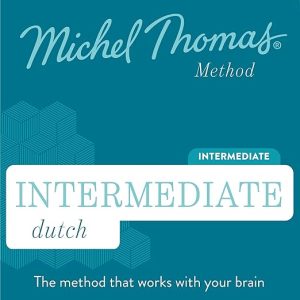
Dutch learners at the intermediate stage face a particular challenge that absolute beginners do not: they already know enough to recognize what they are getting wrong but not yet enough to correct it naturally. The intermediate plateau is where language courses lose students by the thousands, and it is exactly where the Michel Thomas Method stakes its reputation. This audiobook course, narrated by Cobie Adkins-De Jong and running just under seven hours, extends the foundational Thomas approach into intermediate Dutch territory with the same no-books, no-homework, no-memorization framework that Stephen Fry once called a unique and brilliant way of teaching languages.
Michel Thomas spent five decades decoding languages into their component building blocks, a term he used deliberately. Rather than presenting a language as a system of rules to memorize and apply, the method identifies the smallest structural units that, once internalized, allow learners to generate novel sentences on their own. The Dutch course uses that architecture throughout, introducing elements sequentially so that each new concept builds on what the learner has already constructed, never requiring isolated memorization of vocabulary lists or grammar tables.
Adkins-De Jong Models the Guttural Dutch G
The method's genius, and its most unnerving quality for learners trained on traditional language education, is that it does not feel like studying. The course was designed around Thomas's original classroom technique: a teacher working with two students, recorded live, with the students' responses, hesitations, and corrections left in the audio. Listening to an intermediate-level student work through a Dutch construction in real time, make an error, hear the correction, and then rebuild the sentence correctly activates the learner's own mental participation in a way that passive instruction does not. You find yourself thinking ahead to the answer before the student on the recording responds, which is exactly what the method wants.
Cobie Adkins-De Jong's role in the audio is critical. As the Dutch-native component of the teaching pair, she provides the authentic pronunciation models that the course depends on, and her delivery is natural rather than artificially clipped. Intermediate Dutch phonetics are not trivial: the guttural G, the long and short vowel distinctions, and the specific rhythm of Dutch compound words require accurate models to internalize correctly. Adkins-De Jong provides them with fluency that gives the course real phonetic authority alongside its structural framework.
Four Hours of Core, Plus an Hour Review
The audio-only format is not a limitation here. It is the point. Thomas built the method specifically around auditory learning because he believed, based on decades of observation, that the ear processes language in ways the visual brain does not. Writing a language activates different cognitive pathways than speaking it, and Thomas was interested specifically in speaking. The intermediate course continues to emphasize oral production, asking learners to construct sentences aloud rather than silently compose them, which is cognitively harder and linguistically more useful.
At seven hours, the course is structured around roughly four hours of core instruction with an additional hour of review material. The design assumes that you will pause and respond throughout, which means your actual engagement time is longer than the runtime suggests. Thomas courses are not passive listening. They are interactive, requiring you to build answers in Dutch before hearing the expected response. That interactivity makes the course considerably more valuable per runtime hour than a lecture-format language audiobook, and it makes revisiting sections genuinely productive rather than merely repetitive. A PDF companion is included with the Audible purchase for reference.
This Intermediate Course Assumes Foundation Dutch Already
The Thomas method's emphasis on natural acquisition means it does not provide systematic grammar tables or vocabulary lists. Learners who need visual reference materials to feel secure in their progress will find the audio-only structure unsatisfying at the intermediate level, where the complexity of verb conjugations, modal particle usage, and sentence inversion rules is significant. The PDF companion helps bridge this gap but is not a comprehensive grammar reference. Listeners who use this course alongside a Dutch grammar reference will get considerably more out of the structural explanations than those who rely on audio alone.
This is an intermediate course, not a beginner one. Learners who have not completed the Michel Thomas Foundation Dutch course or an equivalent beginner program should not start here. The intermediate level assumes prior knowledge of basic Dutch sentence construction, common verb forms, and core vocabulary. Starting in the middle of the method without that foundation will leave you lost within the first thirty minutes. If you are at the beginner stage, the Foundation Dutch course is the right entry point, with this intermediate course as the natural continuation.
Professionals and Partners Building Real Conversational Fluency
This audiobook course is for Dutch language learners who have moved beyond absolute beginner level and want to expand their expressive range through a method that emphasizes speaking over writing and natural construction over rote memorization. It is particularly effective for learners who have previously used the Michel Thomas Foundation Dutch course and want to continue building on that architectural framework. Professionals, travelers, and learners with Dutch-speaking family or partners who want to improve conversational fluency rather than written proficiency will find the oral production emphasis well-matched to their actual needs.
Skip it if you are a complete beginner, if you require systematic visual grammar references to feel structurally grounded, or if your goal is formal written Dutch for academic or professional certification purposes. The Thomas method produces confident speakers with genuine structural understanding, but it does not produce writers or readers, and it does not map cleanly to standardized Dutch proficiency exams. For its specific goal, conversational intermediate Dutch acquired through listening and speaking, this is one of the most effective audio courses available.
Questions Listeners Ask
Does this audiobook require you to have completed the Michel Thomas Foundation Dutch course first?
Yes. This is an intermediate-level course that assumes prior knowledge of basic Dutch sentence construction, common verb forms, and core vocabulary. Starting here without that foundation will leave you lost quickly. The Foundation Dutch course is the intended entry point, and this course continues directly from that framework.
Is this audiobook a passive listening course, or do you need to actively participate?
Active participation is built into the method's design. The course asks you to pause and construct Dutch sentences aloud before hearing the expected response. This interactive structure is what makes the Thomas method effective, and treating it as passive background listening largely eliminates its value. Plan to engage fully, including speaking aloud, during your listening sessions.
How is the Michel Thomas Method different from other language learning audiobooks?
Rather than presenting vocabulary lists and grammar rules for memorization, Thomas decoded languages into structural building blocks introduced sequentially. The course is recorded live with a teacher and two students, with real responses and corrections left in the audio. Hearing a peer work through constructions and make errors activates the learner's own mental participation in ways that lecture-format courses do not.
Does the audiobook come with any written materials to supplement the audio?
Yes. A PDF companion is included with the Audible purchase for reference. However, the Thomas method does not rely on grammar tables or vocabulary lists, so the PDF is supplementary rather than essential. Learners who want systematic written grammar reference alongside the audio should consult a dedicated Dutch grammar guide as well.