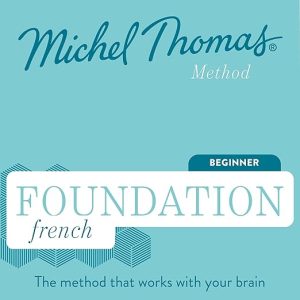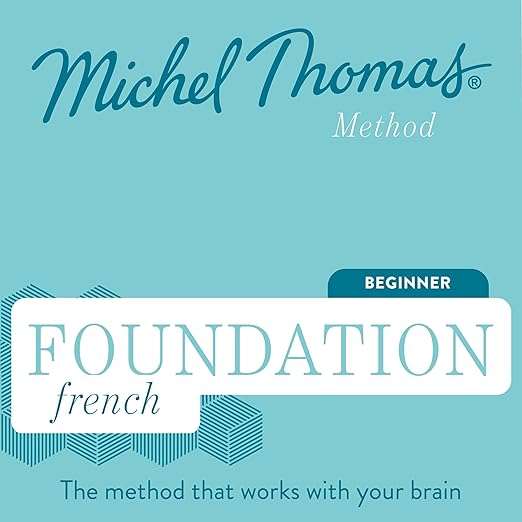
The endorsement at the top of this audiobook's description praises the Michel Thomas method for teaching French, quotes a New Yorker piece by David Sedaris, and then delivers its punchline in German. The line reads Hey, Ich kann do dis. That is a joke about a German course, pasted onto a French one, and it is not a slip confined to this page: the same endorsement, with the same German payoff, appears on other language courses in this range under other language names. Somebody has been running find and replace across a catalog.
Borrowed praise is not something this method needs. Michel Thomas built these courses on a single principle, stated in the description in his own words: what you understand, you know, and what you know, you do not forget. Instead of vocabulary lists, you are handed the components of the language in an order designed so that each one lets you build sentences with everything that came before. Within the first hour you are constructing phrases rather than repeating them, which is the difference the whole system rests on.
This format is unusual and worth understanding before you buy. You are not listening to a presenter. You are sitting in on a recorded lesson with a teacher and two students, and the course is built so that you become the third student, answering aloud in the pauses left for you. You learn as much from the two students getting things wrong as from them getting things right, because their mistakes are the ones you were about to make. Neither student is an actor: they hesitate, guess wrong, and get corrected in real time.
That design makes for a strange, rather intimate listen. Nobody edits out hesitation. The teacher corrects, rephrases, and returns to a point until the room has it, and the pacing belongs to the class rather than to a script. Nine and a half hours of that is closer to attending a course than to consuming a recording, and it is the reason the method has survived decades of newer, shinier competition.
Nothing Tested, Nothing Graded, Nothing Memorized
The strongest argument is the one the copy makes plainly: no books, no homework, no memorizing. For anyone who has abandoned a language app after a fortnight of streaks and flashcards, the absence of maintenance is genuinely liberating. Thomas breaks French into its essential parts and reassembles it in front of you, so the work happens through thinking rather than through drilling, and nothing is asked of you between sessions.
Speed to speech is the second argument. The publisher is careful about what it promises: this will not make you fluent, and it says so. What it claims is that you will speak, with proper pronunciation, faster than by any other route, and that you will finish with a working foundation you can build on. Thomas puts it as building the house and leaving the decorating to you, which is an honest description of what a foundation course can do. That modesty is rare in language marketing, and it is a large part of why the method keeps its reputation.
For a listener, the stress removal is the underrated part. The whole structure is designed around the observation that anxiety blocks learning, so nothing is tested, nothing is graded, and no one is going to ask you to write anything down. If previous attempts at French collapsed under the weight of conjugation tables, this is a different experience entirely. No one keeps score, and no phrase is drilled back at you for its own sake.
Nine Hours on Paper, Thirty Hours in Practice
Running time here is misleading, and the description admits it if you read carefully. The recording lasts nine hours and thirty-six minutes, while the course is expected to take somewhere between twenty and thirty hours to complete. The gap is you: pausing, answering aloud, repeating, and going back. This is the rare audio product you cannot use while driving or washing up, which sits awkwardly beside copy inviting you to reclaim your pockets of free time and learn anywhere. Read the figure on the page as the length of the tape rather than the length of the course.
Check what you already own, too. The description states that the first hour of this course is identical to the Start French taster, so anyone who sampled the method that way is paying again for material they have heard. The word Full in the title means the complete Foundation level, not the complete method: after this comes Language Builder, then Intermediate, then Vocabulary, then Insider's. Budget accordingly if you intend to go the distance.
Then the listing itself. The copyright line dates the recording to 2000 with a further date of 2019, while the release shown is February 2026, so this is a reissue rather than anything new. The publisher credit names Michel Thomas, though the recording copyright is held by Hodder and Stoughton. And a course sold on the promise of no books arrives with an accompanying PDF. None of that is disqualifying, but a buyer deserves to know the vintage of what they are getting. A reissue is not a problem in itself, and a method that worked in 2000 has not stopped working since.
Judged as a Foundation, It Still Builds Sentences
This suits absolute beginners and lapsed learners who want to speak rather than to read, and who can commit to sitting down with it properly. It suits people who found conventional teaching stressful, people who learn by reasoning rather than by repetition, and anyone preparing for a trip who wants working sentences instead of memorized phrases. Nobody has rated or reviewed it here, so the method's long reputation is all a first-time buyer has to go on.
Anyone who needs reading and writing should look elsewhere, since the course deliberately excludes both, and anyone chasing vocabulary volume will be frustrated, because Thomas trades breadth for structure by design. It will also frustrate anyone who wants passive listening, and anyone who dislikes hearing other students hesitate, since those two voices are a permanent feature rather than an occasional interruption.
Judged as a foundation, this remains one of the few language courses that leaves you able to build a sentence you have never heard. Just do not expect the German joke in the description to have anything to do with it.
Before You Listen
How long does the course actually take, compared with the audiobook's running time?
The recording runs a little over nine and a half hours, but the publisher expects twenty to thirty hours to complete it. The difference is the time you spend paused, answering aloud and repeating. Plan for sessions at a desk or on a walk rather than background listening.
Does the audiobook overlap with Start French?
Yes, and the description admits it. The first hour here is the same material as the Start French taster course. Anyone who tried the method through that sampler will be re-buying that hour, though everything after it is new and the full Foundation level continues well beyond.