Before You Press Play
- Performance: Mirron Willis brings documentary authority to Biltmore's history - his measured delivery suits the subject's blend of architectural grandeur and business narrative without tilting into either reverence or dry recitation.
- What it covers: Historic preservation against sustained financial pressure, family stewardship across generations, Gilded Age legacy in the modern economy
- Feel: Richly detailed and genuinely admiring without losing critical perspective on the economic realities
- Our call: Howard Covington's account of Biltmore Estate's survival under William Cecil is the definitive audio document of one of America's most improbable preservation success stories - the business drama is as compelling as the architecture.
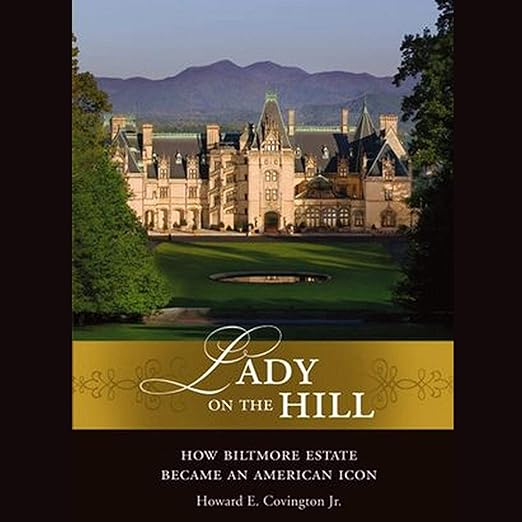
Biltmore Estate near Asheville, North Carolina, is the largest private residence in the United States by any measure, and by any reasonable economic logic it should not still exist as a functioning, financially self-sustaining destination in the 21st century. The arc from George Vanderbilt's original commission of Richard Morris Hunt and Frederick Law Olmsted through the Cecil family's stewardship - and specifically through William Cecil's transformation of an inheritable liability into a viable enterprise - is what Howard E. Covington traces in Lady on the Hill. This audiobook, narrated by Mirron Willis, is the kind of institutional biography that could easily become a corporate hagiography but mostly avoids that fate through Covington's journalistic commitment to specificity and Willis's measured, unsentimental delivery throughout its 8-hour-and-31-minute runtime.
Willis Navigates a Page-Turner About a House
The book's core subject is preservation under financial pressure, and Covington treats the business decisions as seriously as the architectural history. Hunt's original design and Olmsted's landscape work are placed in their historical context - two dominant practitioners of their era executing a Gilded Age vision of European estate grandeur transplanted to the southern Appalachian mountains - but the book's more distinctive contribution is its account of how that vision survived into an era when operating costs for an 8,000-acre estate with a 175,000-square-foot house were catastrophic relative to available resources. The endorsements gathered in the synopsis from Richard Moe of the National Trust for Historic Preservation, from members of the Rockefeller family, and from Gary Walters, Chief Usher of the White House, are not standard back-cover decoration; they reflect genuine industry recognition of what William Cecil accomplished over decades. Covington treats this recognition as a starting point for inquiry rather than as a conclusion, which is what keeps the narrative honest and useful.
Willis's narration navigates the dual register of Lady on the Hill with consistent skill. The architectural and historical passages require a different kind of authority than the business narrative sections, and Willis modulates between them without jarring transitions. One reviewer described the book as a page-turner about a house, which captures the dynamic accurately: the subject is a static architectural object, but the narrative surrounding it is anything but. The succession of financial crises, entrepreneurial decisions, and institutional negotiations that Cecil navigated to maintain Biltmore's self-sufficiency has genuine dramatic shape, and Covington and Willis sustain that shape across the full runtime without sacrificing the historical detail that is the book's primary offering.
Opening to Visitors in 1930 Changed Everything
The Vanderbilt family history Covington weaves through the preservation account adds biographical depth that extends the audiobook's interest well beyond architecture enthusiasts. The story of how Cornelia Vanderbilt, her husband John Cecil, and their sons William and George inherited not just the estate but the problem of determining whether it had a future - and of how William Cecil specifically approached that problem with a combination of genuine reverence and unsentimental entrepreneurship - is treated with the same rigor as the Hunt-and-Olmsted chapters. The decision to open Biltmore to paying visitors in 1930, then controversial among preservation purists, emerges as the foundational choice that made everything else possible. Covington neither celebrates this as visionary genius nor criticizes it as compromise; he traces its consequences through the specific decisions and results of the decades that followed.
The PDF companion available for download with the audiobook purchase extends the visual documentation of the estate's architecture, grounds, and interiors. The audio account stands independently - Willis's descriptions of the house's rooms, the gardens' scale, and the estate's physical geography are specific enough to build a mental picture - but the visual companion rewards the combination for listeners who want to put faces to the spaces being described. A reviewer who visited Biltmore before discovering the book described wanting to learn more after leaving and finding the audiobook more than equal to that impulse.
Solvency as a Precondition for Preservation
The book's implicit argument about the relationship between economic self-sufficiency and preservation is its most transferable contribution. Covington develops the position through Biltmore's specific history: that a house incapable of paying for itself will not be preserved regardless of its architectural significance, and that the decisions required to generate that capacity are not compromises of preservation values but preconditions for them. This argument has relevance for anyone interested in how American historic sites navigate the tension between the museum model and the living-enterprise model. Covington does not make it as an explicit thesis but demonstrates it through the case. Listeners interested in institutional history, cultural tourism, family business succession, and the economics of historic preservation will find the audiobook substantive on all of these dimensions.
The argument Covington develops implicitly through the Biltmore case - that economic self-sufficiency is not a compromise of preservation values but a precondition for them - has genuine relevance beyond this single estate. Houses and institutions that cannot pay for themselves will not be preserved regardless of their architectural significance, and the decisions required to generate sustainability are not betrayals of the original vision but extensions of its core requirement: that the thing actually survive. Willis's delivery gives this argument the same authority as the biographical and architectural sections.
Nasaw and Larson Fans Will Feel Rewarded
Lady on the Hill is for listeners who visited Biltmore and want a deeper account of what they saw, and equally for those who have never been there but are interested in American architectural history, Gilded Age biography, or the business challenge of sustaining a historic property in the modern economy. Willis's narration and Covington's research make the 8-hour runtime feel proportionate to what the book provides. Listeners who found David Nasaw's The Patriarch or Erik Larson's Devil in the White City compelling will find adjacent historical territory here treated with comparable seriousness. The audiobook rewards investment from multiple starting points and is unlikely to disappoint listeners who approach it from any of them.
Frequently Asked Questions
How much of this audiobook covers the Vanderbilt family broadly versus focusing specifically on Biltmore and the Cecil stewardship?
Covington's focus is specifically on the Cecil family's stewardship of Biltmore rather than the wider Vanderbilt dynasty. George Vanderbilt's original vision and the circumstances of the estate's construction receive treatment, but the book's center of gravity is William Cecil's effort to secure long-term viability, which unfolded across the latter half of the 20th century and into the early 21st.
Does the audiobook require familiarity with architectural history to appreciate the Biltmore content?
No. Covington writes for a general audience and provides enough context around Hunt's architectural approach and Olmsted's landscape design philosophy that listeners without prior architectural knowledge will follow the significance of both. The PDF companion available with the audiobook purchase provides visual material for specific architectural details that words alone cannot fully render.