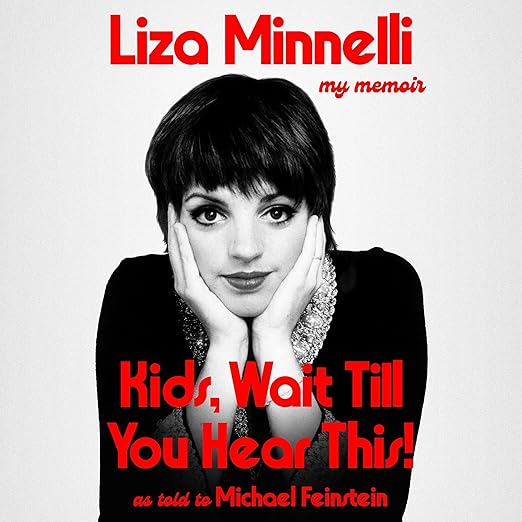
Liza Minnelli decided at age sixteen that sympathy was her mother's business. This audiobook, running nearly eighteen hours of the EGOT icon narrating her own life story, tests that resolution at every turn. The result is one of the more remarkable celebrity memoirs I have encountered in recent years, not because of the famous names that populate its pages, but because of the specific quality of honesty Minnelli brings to the parts of her story that other performers in her position would almost certainly have softened or omitted entirely.
The context required to fully appreciate what is happening in Kids, Wait Till You Hear This! is substantial. Vincente Minnelli and Judy Garland were not just famous parents; they were cultural monuments. Growing up as their only child meant inheriting a public identity before you had constructed a private one. The book's title is itself a performance instinct, the impulse to lead with delight, to make the telling a gift to whoever is listening. Minnelli explains that she learned to give people joy rather than sympathy. Listening to her narrate the moments when that practice reached its limits, and then passed them, is quietly devastating in ways that no print reading could reproduce.
An Inherited Condition, Managed Not Cured
What separates this memoir from the category of celebrity autobiography is the degree to which Minnelli names the mechanisms of her own suffering rather than simply narrating the events surrounding them. She discusses Substance Use Disorder not as a past misfortune but as an inherited condition, something passed down through her mother's branch of the family that she has had to manage, not cure, across decades of public life. The honesty about broken marriages, multiple miscarriages, hospitalizations, and chronic anxiety arrives without the hedging that typically softens these accounts in the celebrity memoir genre. One reader noted that Minnelli is the only one who can say what really happened to her mother, and that it was worse than it seemed. That is accurate, and the book gives that history the space and specificity it requires.
Cabaret, Fosse, Halston, and HIV Activism
The performance that built the public Liza Minnelli is also here in abundance. The stories about Cabaret, about Bob Fosse, about the relationship with Halston, about performing at Carnegie Hall at nineteen, these carry the energy of someone who still lights up at the memory of doing work she loved. The book does not make the mistake of treating the artistic life as separate from the personal cost; it holds them together throughout, refusing the clean narrative of suffering redeemed by success that celebrity memoirs often reach for.
Minnelli's human rights activism, particularly around HIV and AIDS at a time when that work was neither safe nor commercially expedient, is given real attention here. This is not the book of someone who has spent decades carefully managing a legacy. It reads, and sounds, like someone who has finally decided that the truth is more valuable than the protection of any particular version of herself.
Minnelli's Voice Carries Every Story's Weight
The case for the audiobook format here is essentially unanswerable. Minnelli's voice is not merely famous; it is the instrument through which every story in this book gains its full weight. When she describes the early years, you hear the girl she was before the icon solidified. When she discusses addiction and recovery, the vocal texture carries something no printed page could deliver. At nearly eighty, her voice still has that extraordinary combination of strength and fragility that made her singular as a performer. The self-narration across seventeen hours and fifty-five minutes is an act of endurance and generosity that rewards the listener who gives it proper attention.
The readers who responded most enthusiastically describe this as going far beyond another celebrity memoir, calling it a glimpse beyond the velvet rope with a depth of heart far beyond other would-be authors. That enthusiasm is warranted. Minnelli's access to her own life is total, she was in every room for all of it, and she has reached the stage where she seems genuinely uninterested in protecting her image at the expense of the truth.
Speaking Across From Lorna Luft's Own Memoir
The rating count at fifty reviews is a relatively modest sample size for a memoir of this cultural significance, and the audiobook edition has not yet reached the broad audience it deserves. Listeners who come to this expecting primarily showbiz anecdotes and golden-era Hollywood glamour will find those elements present, but the memoir's center of gravity is more personal and more demanding than that framing implies. The duration also deserves mention: eighteen hours is a substantial commitment, and some sections dealing with specific professional periods carry more narrative momentum than others. But the memoir's overall architecture, built around the question of how someone survives the intersection of extraordinary talent, impossible parentage, and genuine suffering, never loses its hold on the listener.
Listeners who have also encountered Lorna Luft's memoir Me and My Shadows will find that the two books speak to each other across their separate perspectives on the same family history. Minnelli's version adds dimensions that a sibling account, however well-rendered, simply cannot provide.
Heavier Than a Brisk Celebrity Memoir
Anyone who has admired Minnelli's work on stage or screen will find this essential context for everything she created. Listeners interested in the mechanics of addiction and recovery in the context of extreme public pressure will find it valuable and unusually specific. Those interested in mid-twentieth-century American cultural history will find the inside account of that era's entertainment world richly detailed. Listeners expecting a brisk, celebrity-gossip-driven autobiography may find the emotional demands heavier than they anticipated. The self-narration format makes this ideal for dedicated listening sessions rather than background play; this is a memoir that earns, and deserves, your full attention.
- Performance: Liza Minnelli narrates her own memoir across nearly eighteen hours, and the result is extraordinary, her voice carries every register of the story, from showbiz glamour to raw grief, with unmistakable authenticity.
- What it covers: artistic identity, addiction and recovery, the weight of iconic parentage
- Feel: Intimate, candid, and finally unguarded
- Our call: For anyone who has ever wondered what it actually cost Liza Minnelli to become Liza Minnelli, this autobiography delivers the honest answer in her own voice.