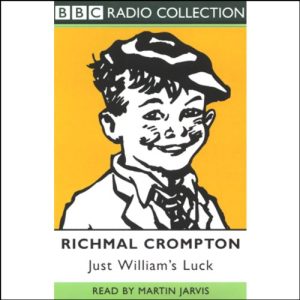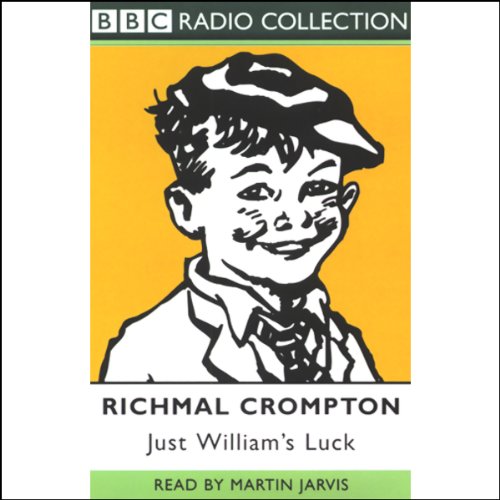
Two hours and forty-nine minutes is the number to look at first, because the publisher calls this a full-length novel and never uses the words abridged or unabridged anywhere on the page. Martin Jarvis reads it for BBC Audio, and the copy promises the whole gang, which on a Richmal Crompton book means William, the Outlaws, several put-upon adults and at least one visiting film star. What you are buying is a comic performance rather than a plain reading, and this particular audiobook has a history that the listing itself only hints at.
Sixpence for Small Wrongs, a Shilling for Big
Plot, as ever, is a matter of glorious escalation. William and the Outlaws found the Knights of the Square Table and go into business righting wrongs at fixed rates, small wrongs sixpence, big wrongs one shilling, with the proceeds earmarked for their intended careers as tramps. The fundraising drifts into a scheme to marry off their older brothers. William, in pursuit of a match for his own brother, courts a visiting film star, to the considerable annoyance of the girlfriend already in place. A midnight haunting follows, aimed at clearing a large house on a hill for the happy couple the boys have decided upon.
Crompton's method is visible in every one of those turns. The boys reason impeccably from premises no adult would accept, act on the conclusions with total commitment, and leave a trail of consequences they are constitutionally unable to perceive. It works on children because the schemes are thrilling and on adults because the schemes are catastrophic, and both readings run at the same time without either canceling the other.
The Word Children Appears Nowhere on This Page
Nowhere does this listing say who the book is for. Children is a word that appears in neither the title nor the description, while the category is entertainment and performing arts, where no parent hunting for a family listen is going to look. That is a shelving error rather than a defect in the audio, but it does mean parents will find this by accident if at all.
They Wore Out the Original Tapes
Quoting the Independent, the publisher calls Jarvis's recordings of the Just William stories works of genius, and the phrasing repays attention: the praise is for the body of recordings rather than for this title specifically. Even so, it is the only assessment of the reading anywhere on the page, and two of the five buyers add something better than a blurb. One describes replacing a lost copy with real gratitude, noting that the children in that household listened so often that "they knew lots of it by heart and we wore out the original tapes". Another calls it "lovely to listen to, makes me happy and helps me sleep".
Read that first response alongside the small print and something clicks. The musical theme is credited with a 1995 copyright, and the listing itself dates from 2005. Between the date on the music and a reviewer describing worn-out tapes, this is plainly a re-release of a recording that circulated on cassette long before it appeared as a download. That is a point in its favor rather than against it. Performances that families played to destruction tend to be the good ones, and a generation of children knowing the lines by heart is a stronger endorsement than sixteen ratings. A named pianist is credited with both composing and performing that theme, which is more production detail than most listings bother to publish and a hint that this was assembled as a piece of radio rather than as a plain reading.
Listen for the Seams
Back to the length, because it is the one thing that could genuinely disappoint. A full-length Crompton novel read at ordinary pace would run considerably longer than this, and nothing on the page states whether the text has been cut for the recording. It may simply be a short novel. It may be a trimmed reading of a longer one. A buyer cannot tell, and on a title where the pleasure lies in the accumulation of small disasters, knowing whether any of them were removed is not a trivial question. Ask the publisher, or listen for the seams.
A Novel Where Fans Expected Short Stories
Dissent on this page is worth reading properly as well. A three-star buyer wrote, typing errors and all, "I was expecting moreofthe William Brown stories,nothis views on life. Notquite as good as thre stories". Strip the missing spaces and the complaint is precise and useful: most of the Just William canon is short stories, this volume is a novel, and somebody who came for the familiar rhythm of a self-contained escapade every fifteen minutes will notice the difference. Another reviewer names the other caution plainly, that it is "old fashioned it definitely is" and that "some details jar, not always totally pc". Books written this long ago carry the assumptions of their moment, and a listener will meet them without a footnote to soften the landing.
Some of the period detail simply needs translating, and a modern child will need help with it. A tariff of sixpence for small wrongs and a shilling for big ones means nothing at all without pre-decimal currency in your head. The boys are saving up in order to become tramps, an ambition that only reads as glamorous if you grew up on a particular kind of storybook. None of this spoils anything, but a parent listening alongside will be doing a certain amount of live commentary, and sixteen scores is a slim foundation on which to have been warned about that.
A Recording That Survives Repetition
Grown-up readers who met these stories as children are the core audience, together with anyone raising a child at the age where organized anarchy is the funniest thing imaginable. Under three hours makes this a genuine family car-trip listen rather than a project, and the buyer who wore out the tapes is the proof of concept: this is a recording that survives repetition, which is an underrated and specific virtue.
Comic performance as a form is the other reason to buy. One voice covering a gang of boys and the assorted adults they torment is a particular skill, and the publisher is selling that skill as much as the text.
The classic short-story format is not what you get, and the dissenting reader is right that a novel is a different shape. Handing period attitudes to a child unaccompanied, with nobody to explain them, is the other thing to weigh before pressing play. Certainty about completeness is the last hurdle, and on that question this page says nothing at all.
Has this Just William's Luck audiobook been abridged?
Nothing on the page answers that, and it remains the one real gap here. A full-length novel is what the description promises, while the recording runs under three hours, which is short for a complete Crompton story read at normal pace. The book may simply be a brief one. Confirm with the publisher if completeness matters.
Is this audiobook suitable for children?
In substance yes, and one reviewer's children listened to it repeatedly. The description never says so, though, and the listing is filed under entertainment and performing arts rather than anywhere a parent would browse. One reviewer also warns that some details jar and that the writing is not always politically correct by current standards.