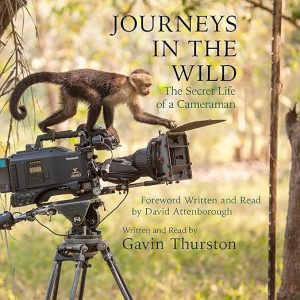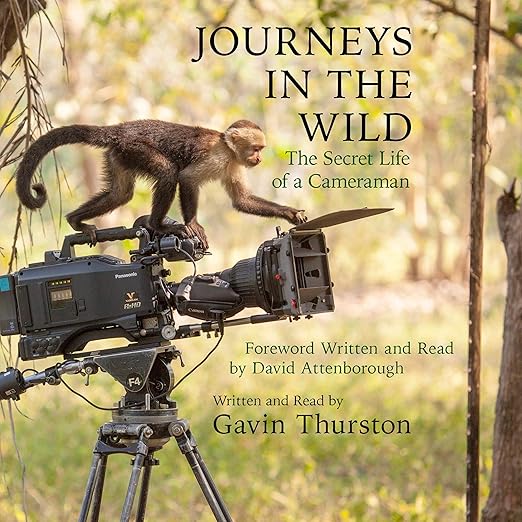
Silverback gorillas, grey whales, capuchin monkeys, prides of lions, even mosquitoes: Gavin Thurston has spent more than thirty years pointing a camera at all of them, often from inside a hide so cramped he couldn't stand up for hours at a stretch. This audiobook collects the stories behind that career, the Blue Planet II and Planet Earth II footage millions of viewers have watched without ever learning what it cost to get it. Thurston narrates his own material, and that choice alone signals how personal this collection is meant to feel.
A Career Told Through Its Unglamorous Middle
What makes Journeys in the Wild work as a listen rather than just a making-of featurette is the shape Thurston gives his own career. He does not organize the book as one triumphant highlight reel; he lingers instead on the unglamorous middle of the job, the days spent waiting in Antarctic cold or Saharan heat for an animal that may never appear. Reviewer Roger Casement calls it a 'superb memoir' that teaches listeners about 'the extraordinary efforts and ingenuity and resourcefulness' behind wildlife footage while staying 'engaging and often humorous,' and that balance of graft and warmth is the book's real subject, not the animals themselves.
The career framing also gives the book a throughline that a simple chronological travelogue would lack. Thurston moves from the Himalayas to the Congo's forests and back again not because a producer scheduled it that way but because each location taught him something specific about patience, and he stays candid about the failures as much as the successes. Reviewer Book-Lovers' Dad, who frames Thurston's work against David Attenborough's globally familiar nature series, makes the point plainly: those programs show glimpses behind the scenes, but hearing it directly from the cameraman is, in his own words, 'another thing entirely.' The synopsis itself promises exactly that kind of access, inviting listeners to discover 'the hours spent patiently waiting for the protagonists to appear' and 'the heartwarming, life-affirming moments the cameras miss as well as capture.'
That BBC Natural History Unit slate reset audience expectations for what nature documentary photography could achieve, drawing hundreds of millions of viewers worldwide across its original broadcasts and endless streaming replays since. Thurston's account never leans on that scale for easy validation; if anything, the book undercuts the polish of the finished broadcast by describing how often a single unforgettable shot depended on luck, physical discomfort, or a colleague's split-second call rather than the meticulous planning viewers might assume sits behind every frame.
Twelve Hours and Fifty-Two Minutes, Told in Installments
The case for listening rather than reading rests almost entirely on Thurston narrating his own book. A professional narrator could deliver these stories competently, but a professional narrator was not the one lying motionless in the Congo undergrowth for six hours waiting for a gorilla to relax. Self-narration works best in nonfiction when the author's authority is the actual point of the material, and thirty years behind a lens is exactly that kind of authority. The format lets Thurston's own rhythm, his pauses before a punchline, his understatement around genuine danger, come through in a way the printed page can only gesture at.
A structural advantage also comes from hearing this material read aloud: wildlife filmmaking stories depend on tension and release, the long wait followed by the sudden appearance, and Thurston's pacing as a storyteller, not just as a cameraman, seems to understand that rhythm instinctively. Twelve hours and fifty-two minutes is a substantial commitment for a memoir, but the chapters are organized around discrete expeditions rather than one continuous arc, so the audiobook works comfortably in installments, one location at a time, without losing momentum between sessions.
See the Movies and Videos First, One Reviewer Says
The most honest caveat among the reviews on file so far comes from Conrad J. Obregon, who gave the book four stars under the title 'See the Movies and Videos First' and admitted he wished he 'could have loved this book more.' His specific complaint is worth taking seriously: Thurston's work often appears in ensemble productions where multiple cinematographers shot different sequences, and it can be genuinely difficult, even for an attentive listener, to track which specific shot belongs to which story he is telling. A visual medium describing a visual medium always faces this tension, and audio removes the one reference point, the footage itself, that would resolve any confusion instantly.
Photography and cinematography are inherently spatial crafts, and no narration, however warm or well-paced, can fully substitute for seeing the shot Thurston is describing. Listeners who already know Blue Planet II or Planet Earth II well will likely fill in those visual gaps from memory; listeners coming in cold may want a few clips pulled up for reference during the more technical passages about lens choice, camouflage, or timing. This reads less as a flaw in the telling than a limit built into the format itself, worth setting as an expectation early rather than after twelve hours.
Gorillas to Insects, and a Consistent Throughline
Compared to other wildlife-filmmaking memoirs on the market, many of which stay narrowly focused on one signature expedition or one famous animal encounter, Journeys in the Wild covers unusually wide ground: gorillas, whales, bears, and insects all get real attention rather than a single chapter padded out around one career-defining shoot. That breadth is a genuine strength for listeners who want the full scope of a cinematographer's working life, though it does mean no single story gets quite the depth a narrower, single-expedition memoir might offer.
None of the three attached reviews contradicts Casement's core assessment even where they diverge on execution; all three separately locate the book's value in Thurston's own voice and perspective rather than in spectacular animal footage alone, a notably consistent throughline for a memoir with such wide geographic and species range.
Endurance and Macfarlane Fans Will Feel at Home
Journeys in the Wild rewards anyone who has ever wondered what actually happens in the hours a nature documentary compresses into ninety seconds of screen time. Fans of Attenborough-era wildlife television are the obvious audience, but so are readers of adventure memoir more broadly, people who enjoyed the physical-endurance-plus-craft blend of a book like Alfred Lansing's Endurance or Robert Macfarlane's landscape writing, even though Thurston's tone runs lighter and funnier than either comparison suggests. Photography and filmmaking students will find real professional value here too, since Thurston stays unusually candid about the equipment failures and access negotiations that never make it into a finished nature film.
Listeners who want a tightly plotted single narrative arc, rather than a series of connected expedition stories, may find the episodic structure looser than they'd like, and anyone hoping for detailed technical tutorials on wildlife cinematography should look to Thurston's published work or interviews instead, since this audiobook stays focused on story over instruction.
- Read by: Gavin Thurston narrates his own stories, and three decades of stalking wildlife for a living show up in his understated comic timing and unhurried pacing.
- At its heart: wildlife cinematography, patience and endurance, behind-the-scenes documentary craft
- Vibe: Warm, funny, and quietly demanding
- Short version: A rewarding listen for anyone who has watched a nature documentary and wondered what the cameraman went through to get that one shot.