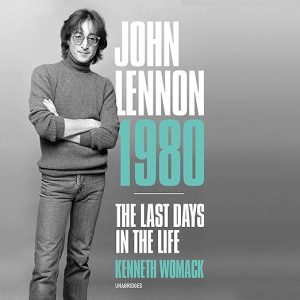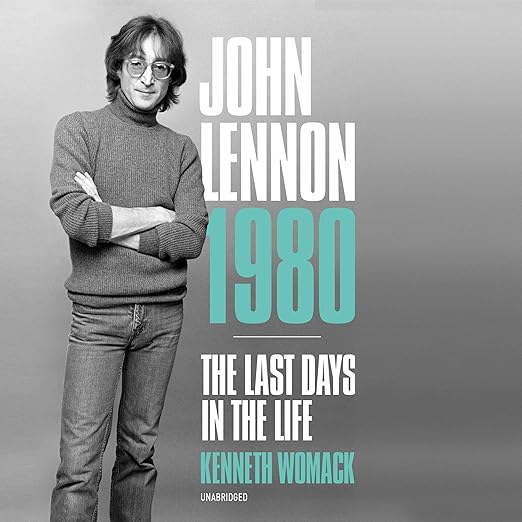
Kenneth Womack's decision to write about the last year of John Lennon's life rather than his entire biography is one of the more interesting structural choices in recent rock biography, and the John Lennon 1980 audiobook - narrated by Paul Woodson and running 10 hours and 32 minutes - earns that constraint. The book does not approach December 1980 as its destination. It approaches 1980 as its subject: specifically, the creative reemergence of a man who had spent five years in deliberate domestic retirement and was returning to music on his own terms, with something specific and personal to say for the first time in years.
Five Quiet Years as the Real Prerequisite
Womack is a serious musicologist and literary scholar who has written extensively about the Beatles - his two-volume biography of George Martin and his study of Abbey Road are reference points in the field. He brings that background to the Lennon project with evident care. The Double Fantasy material is treated not as nostalgia but as an argument: Lennon at forty was making music that reflected who he had become rather than who audiences still wanted him to be. The album's domestic themes, its focus on partnership with Yoko Ono, and its departure from the political anger of the early 1970s work were deliberate statements, and Womack traces the creative decisions behind them with the analytical rigor his musicological training provides.
The five years of retirement between 1975 and 1980 - the period when Lennon stepped back from public life to raise Sean and bake bread and be, by his own account, a house husband in the Dakota - receive sustained and sympathetic treatment. Womack does not frame this as absence or failure of nerve. He frames it as the prerequisite for what 1980 produced: a man who had done the work of becoming someone other than John Lennon the icon, and who was ready to make music from that renewed self rather than from the myth. One reviewer with decades of Beatles reading described the book as allowing him to fully understand, appreciate, and admire Lennon in new ways despite years of prior engagement with the subject. That reframing is one of the audiobook's genuine intellectual contributions to the existing literature.
Woodson's Narration Insists Living Is the Point
Paul Woodson's narration handles Womack's prose with appropriate seriousness. This is not a light music biography but an analytical work with real scholarly weight, and Woodson does not try to make it breezy. His pacing allows Womack's arguments to develop rather than rushing past them in search of narrative incident. The sections analyzing specific Double Fantasy tracks benefit from this approach - Woodson gives the musicological observations space to register in the listener's mind, which is important because the audiobook cannot play the music itself and must rely on description to do work that notation or playback would handle more efficiently in another format.
For listeners who grew up with the Beatles and carry the biographical knowledge as ambient context, this audiobook functions differently than it does for younger listeners encountering Lennon primarily through his posthumous myth. Womack explicitly anchors the book in the knowledge of how the year ends but insists that the ending is not the point - the living is the point. That reorientation is where the book does its most distinctive work, and it lands differently depending on how long you have been carrying the weight of what December 1980 represents in rock history. The insistence on creative vitality over tragic closure is the book's central argument, and it is sustained well across the full ten-hour runtime.
A Single Year Means Some Chapters Go Missing
The audiobook is pitched at readers who already care about Lennon rather than at the uncommitted. Womack assumes familiarity with the major arc of the Beatles' history, the artistic and personal tensions of the early solo period, and the general context of the Dakota years. Listeners coming to Lennon's story for the first time will find the book comprehensible but may miss the significance of certain interpretive moves that Womack makes against the default critical narrative. An introductory Lennon biography first would be the right preparation before arriving at this more focused account.
The book's single-year scope means that certain aspects of Lennon's character and history - his relationship with his son Julian, specific moments of cruelty in earlier relationships, his political period of the early 1970s - are addressed in summary rather than depth. Womack acknowledges the shadow that the assassination casts over everything but keeps his focus on the creative vitality of the year rather than on the biographical reckoning that a fuller account would require.
The Assassination's Investigation Stays Largely Unaddressed
Beatles fans with existing knowledge of Lennon's arc will find Womack's concentrated focus on the comeback year more intellectually satisfying than a general biography would be at this point in the literature. Music listeners who want serious analysis of Double Fantasy as an artistic statement rather than a cultural artifact will find this audiobook supplies exactly that. The 4.6 rating reflects consistent satisfaction among readers who knew the subject before they opened the book and came expecting scholarly rigor rather than a popular retelling.
Casual listeners looking for a biographical narrative of Lennon's full life will find this scope frustrating. And listeners who primarily want the story of the assassination itself - the circumstances, the investigation, the cultural aftermath - will find that Womack's deliberate redirection away from that ending, while artistically justified, leaves that dimension largely unaddressed. The book is called John Lennon 1980 rather than John Lennon for precisely this reason, and respecting that specificity is the right approach to the listening experience.
Before You Listen
Does this audiobook cover Lennon's full life or only the final year?
The book focuses specifically on 1980 - Lennon's return from five years of domestic retirement through the recording of Double Fantasy to the end of the year. Earlier periods of his life are referenced for context but not covered in depth. Readers wanting a comprehensive biography should look at earlier accounts of his full arc first.
Do you need to be a Beatles expert to enjoy this audiobook?
Familiarity with the broad outlines of the Beatles' story and Lennon's solo career is helpful. Womack makes interpretive moves against the default critical narrative that require some prior knowledge to appreciate. Listeners new to Lennon's story will follow the book but may miss some of its analytical texture. A general Lennon biography first is good preparation.
Does the audiobook include or discuss the music from Double Fantasy?
Womack discusses specific tracks from Double Fantasy in considerable analytical detail, covering the creative decisions, lyrical content, and musical choices. The audiobook cannot play the music itself, so Woodson's narration must describe what Womack is analyzing. Listening to Double Fantasy before or during the audiobook significantly enhances the experience.
How does this audiobook compare to Womack's other Beatles books?
One reviewer who had read his George Martin biography and the Abbey Road study describes the same care and thoughtfulness in the Lennon book. Womack's musicological background is consistent across his Beatles work - this volume shows the same rigorous attention to creative decisions and their cultural context that his earlier books brought to Martin and the Abbey Road sessions.