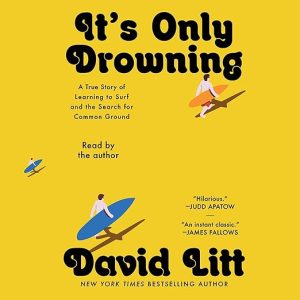
David Litt is chest-deep in the Jersey Shore Atlantic, wiping out on a wave roughly the height of a garden flower, and the audiobook opens with exactly this scene: a Yale-educated former Obama speechwriter being methodically humiliated by beginner surf, narrated by the man himself with the timing of someone who has spent years calibrating exactly how a punchline lands and what it should cost before it arrives. It's Only Drowning is a national bestseller and a 2025 Booklist Editors' Choice, and both distinctions are earned for different reasons - one for the prose, one for the cultural observation buried inside what the cover promises is primarily a surfing memoir.
A Closer Look at It's Only Drowning
Litt's central premise - a politically anxious writer notices that his Joe Rogan-superfan, truck-driving, tattooed brother-in-law Matt is somehow thriving and investigates surfing as the relevant variable - could easily tip into condescension in less careful hands. What saves it is that Litt genuinely does not know who is right. The book is not a liberal intellectual discovering the simple wisdom of a working-class man. It is two people who disagree about almost everything discovering, through the shared discipline of trying to do something genuinely difficult together, a connection that neither expected and neither knows quite what to make of. That dynamic is more interesting than the memoir's marketing fully captures, and it sustains the book through the passages that might otherwise feel like extended surf instruction.
The surf writing is impressive on its own terms. Reviewers with thirty years of surfing experience report that Litt's descriptions of what it actually feels like to paddle into a wave, to wipe out, to suddenly and improbably stand up, are accurate in the way that only someone who went through the physical experience can write. The goal he sets - riding a big wave at Oahu's North Shore, one of surfing's genuinely prestigious and dangerous venues - is ambitious enough that the stakes feel real, and the chapters building toward it develop genuine momentum. Litt narrates his own journey without inflating it into heroism or deflating it into pure comedy, which requires the same kind of precise calibration his speech-writing work would have demanded.
The friendship with Matt deepens through the book in ways that are specific and earned. Matt is not a type or a representative; he is a fully drawn person with his own logic, and Litt's willingness to render him that way rather than as a political emblem is the memoir's most important sustained achievement.
Author narration is the right call here, and it shows throughout every chapter. Litt's timing is impeccable - the self-deprecation that could read as annoying on the page lands exactly right when you can hear the smile in it. Political observation is woven through the surfing narrative rather than delivered in separate editorial passages, which keeps the pacing clean and prevents the book from feeling like two separate projects merged under one title. At just over seven hours, this is a perfectly sized audiobook: complete in its own right, substantial enough to satisfy, and compact enough to carry across a weekend without exhausting its welcome. The Hawaii sequences in the final third carry emotional weight that the earlier chapters carefully prepare through months of Jersey Shore wipeouts, the growing closeness with Matt, and the gradual shift in Litt's relationship with his own anxiety - all converging in the North Shore chapters with the kind of payoff that makes you understand why the project mattered.
Things to Know Before Starting It's Only Drowning
Listeners expecting pure surf content should know that the political and cultural dimensions of the book are substantial and genuinely interwoven rather than incidental. The 2024 election, the cultural gap between Litt and Matt, the question of what the Joe Rogan audience actually wants and values - these run throughout the narrative, and while Litt's handling is notably fair-minded, readers who want surf writing without cultural analysis will find it harder to separate than they might hope. The memoir is also genuinely personal about anxiety and existential dread in ways that some sections carry more emotional weight than the comedic framing might initially suggest. The balance between humor and vulnerability is a strength rather than a liability - this is not a book that performs lightness while actually being heavy, or vice versa - but it is worth knowing that both registers are genuinely present and neither is subordinate.
Who David Litt Is Writing For
Surfers who also read literary nonfiction are the obvious center of the target, but the actual readership has proven considerably broader. Anyone interested in the current cultural divide between coastal professional America and working-class America will find Litt's account of his relationship with Matt one of the more nuanced treatments of that divide currently available in memoir form. Readers who enjoy humor and vulnerability in roughly equal measure will find the tone consistent throughout the full runtime. People considering learning to surf at any age will find both encouragement and unusually honest expectation-setting. Listeners who enjoy books about unexpected friendships and the things physical challenge reveals about character will find this among the better recent entries in a tradition with many worthy examples - and one of the most honestly narrated. Litt earns the surfing metaphor in the title by the end, which not every adventure memoir can say.
Before You Listen
Does David Litt narrate the It's Only Drowning audiobook himself?
Yes. Litt reads his own memoir, and it is one of the stronger author-narrated audiobooks in recent years, his timing and self-deprecating delivery are central to how the book's humor lands.
Is this audiobook mainly about surfing, or does it cover substantial political and cultural territory?
Both, genuinely. Surfing provides the narrative arc and organizing activity, but Litt's friendship with his Joe Rogan-fan brother-in-law and his observations about America's current cultural divisions are substantial and run throughout the book.
How accurate is the surfing content for listeners who actually surf?
Very accurate, according to experienced surfer reviewers. Litt's descriptions of what surfing actually feels like, the wipeouts, the progression, the North Shore experience, are praised as unusually precise for a memoir by a non-professional.