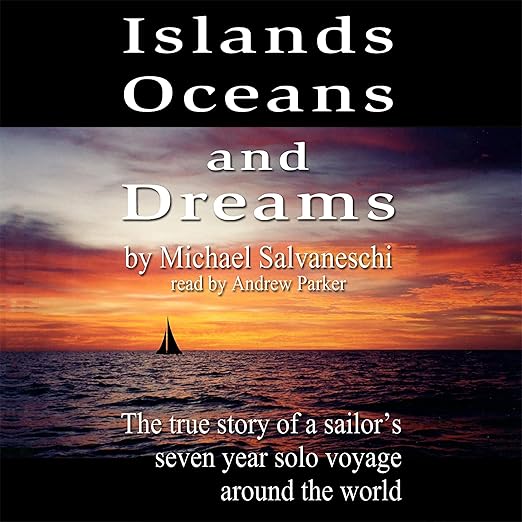
Solo sailing memoirs live or die on a single variable: the degree to which the author can make the ocean feel inhabited rather than merely scenic. Michael Salvaneschi's Islands, Oceans and Dreams manages this because the sea is not the setting of his audiobook so much as the pressure that reveals him. Narrated by Andrew Parker over nearly twenty hours, this is the record of a man who spent decades learning what kind of person he needed to become before he could cross a particular ocean alone. That interiority is what makes it worth nineteen hours of your listening time.
The story's arc is genuinely unusual. Salvaneschi began dreaming of voyaging to the South Pacific at thirty-three, not out of daring but out of desire. He was not, by his own account, an adventurer by nature. He bought a boat, began learning seamanship, and spent twenty years working toward a voyage that the circumstances of his life kept deferring. By the time he finally set off alone for Tahiti, he was a middle-aged divorced man, sailing through pain rather than toward pleasure. That particular emotional context is what distinguishes the book from the genre's more triumphalist iterations.
The craft here is the memoir writer's most difficult task: making the passage of time feel meaningful rather than merely chronological. Salvaneschi's first twenty years with the sea, his commercial swordfishing, his offshore California sailing, his two Mexico voyages, are rendered not as prologue but as education. By the time he reaches French Polynesia and then continues for seven years of solo circumnavigation, you understand precisely what his seamanship cost him to acquire. The turquoise lagoons arrive in context.
One reader reviewer put this precisely: 'Your feelings edged forward and caught me reflecting parts of my own soul, doubts, and feelings.' That kind of response is what distinguishes personal memoir from adventure narrative. Salvaneschi is writing about more than the physical conditions of solo sailing, the pirates, the equipment failures, the weather decisions made without any safety net. He is writing about what it costs to want something for twenty years and what it means to finally be alone in the water with that desire and no more excuses.
What Stands Out
The audiobook format serves this material well. At nearly twenty hours, the runtime matches the scale of the journey being described: a seven-year solo circumnavigation is not a three-hour story. Andrew Parker's narration maintains the reflective register that Salvaneschi's prose requires. The passages describing the Pacific, particularly the French Polynesian islands and the varied conditions of open-ocean passage-making, are read with the kind of attentiveness that gives the physical world its weight without turning the narrative into a catalogue of nautical conditions.
The divorce, which arrives not as backstory but as an active wound in the early sections, is handled with the same plainness as the sailing technical information. Salvaneschi doesn't dramatize the personal failure any more than he dramatizes a difficult anchorage. He reports, he reflects, and he moves forward. That evenness of tone across personal pain and navigational challenge gives the memoir a characteristic texture: stoic without being cold, personal without becoming confessional.
Weak Spots in Islands, Oceans and Dreams
Readers who described initially fearing 'not another of those travelogues' before finding themselves 'identifying' with Salvaneschi are acknowledging something real about the book's early sections: it takes time to establish its emotional register. The first hours are denser with biographical background and sailing education than with the open-ocean drama that the synopsis promises. Listeners who persist past the setup phase will find a memoir that rewards patience. Those looking for an adventure narrative that front-loads its excitement may find the pacing initially demanding.
The piracy section, referenced in the synopsis but not elaborated in the available reviews, is among the book's more gripping passages without being the book's primary subject. Salvaneschi is not writing a danger narrative. He is writing a life narrative that happens to include danger. That distinction matters for calibrating expectations: the adventure elements are embedded in something longer and more quietly ambitious.
Salvaneschi has shared this material as a speaker at yacht clubs and sailing societies, and you can feel that live-storytelling background in the prose's directness and its careful attention to what an audience unfamiliar with seamanship needs to understand. This is not writing that talks down to landlubbers; it assumes curiosity and rewards it.
Salvaneschi's more than thirty years of offshore California sailing experience, his commercial swordfishing, his voyages to Mexico, give the memoir a technical grounding that distinguishes it from adventure accounts written by relative novices. He knows what he is doing on the water, and that competence allows him to describe the moments when things go wrong, the mechanical failures, the weather decisions made without margin for error, with a precision that comes from understanding why they went wrong. The difference between expertise and confidence is one the memoir draws clearly: he is a skilled sailor who remained aware of how much could go wrong.
Best Suited For
This audiobook is ideal for sailors and serious armchair travelers who want the full texture of solo ocean passage-making. It also works for anyone drawn to memoirs about deferred dreams and the particular courage of starting over in middle age. The nineteen-hour runtime is a commitment, but reviewers consistently describe it as one they were glad they made. If you want a short, action-dense sailing adventure, this is not that. If you want to spend time with a man who learned how to cross an ocean by first learning how to live with loss, this delivers something rare.
Frequently Asked Questions
How does the audiobook handle the book's emotional core, the divorce and the deferred dream?
With the same plainness Salvaneschi applies to nautical conditions. He neither dramatizes the personal losses nor treats them as simple backstory. They are present throughout the voyage as context for why this particular crossing mattered so much.
Is the nineteen-hour runtime of this audiobook justified by the content?
For the right listener, yes. The length matches the scope of a seven-year solo circumnavigation. Reviewers describe finding the book increasingly absorbing as the voyage deepens. It is not a book that rushes.