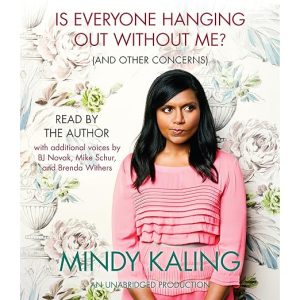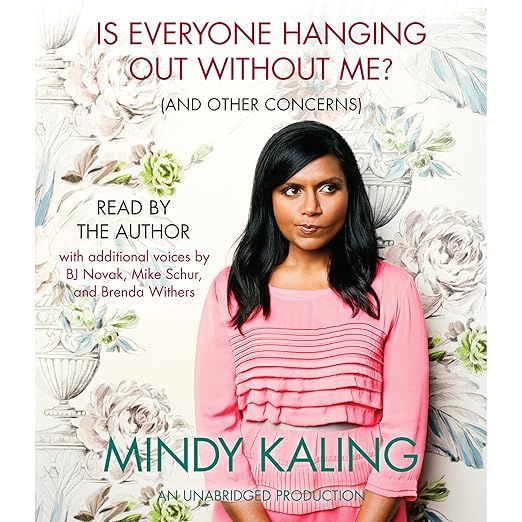
Mindy Kaling's Is Everyone Hanging Out Without Me? (And Other Concerns) audiobook has a particular distinction in the celebrity memoir genre: it is genuinely funny. Not "engaging and warm" or "relatably self-deprecating" in the promotional-copy sense, but actually funny, the kind of funny where one reviewer read the book twice in two weeks because the re-read held up. The New York Times comparison to Tina Fey's cool little sister and a potential successor to Nora Ephron is high praise that the book does not entirely repudiate, which is itself an achievement in a genre where blurb comparisons rarely survive contact with the actual text.
Kaling's life spans a lot of ground before you even get to Hollywood. She opens with childhood as the obedient daughter of immigrant professionals, moves through her description of herself as a "timid chubster afraid of her own bike," through off-Broadway performance and playwriting including her Ben Affleck impersonation show, and eventually into the comedy writing career that led to The Office and then The Mindy Project. At four hours and thirty-seven minutes, the book is short by memoir standards, but Kaling moves efficiently through territory that lesser writers would pad considerably.
The book works because Kaling's comic sensibility is specific rather than general. Her observations about friendship, romance, Hollywood, and fame are not the universalized platitudes that fill most celebrity memoirs. They are eccentric, particular, and occasionally absurd in ways that feel like they came from someone who has actually thought about what she believes rather than assembled conventional wisdom for publication. Her definition of what makes a great best friend (someone who will fill your prescription in the middle of the night) and her precise formulation of "the perfect amount of fame" are examples of the kind of specific, internally consistent logic that makes her comedy writing distinctive and worth returning to.
The Best Parts of Is Everyone Hanging Out Without Me? (And Other Concerns)
Kaling self-narrating is the correct choice and not a close call. Comedy writing on the page relies on timing, word choice, and rhythm. Comedy writing in audio depends on all of those plus the performer's ability to execute the implicit timing that the written version suggests but cannot guarantee. Kaling's actual delivery makes the jokes land at the moment they should rather than the moment the reader constructs for themselves. One guest star on The Mindy Project described her as "frighteningly charismatic," and that quality comes through in the narration. She infuses energy into descriptions of even mundane events, which is a performer's skill that translates directly to audiobook work.
The audiobook also includes what the synopsis describes as "conveniently placed stopping points for you to run errands and make phone calls," a meta-joke about the essay form that lands better in audio than on the page. For listeners new to Kaling's writing, the self-narrated format removes all uncertainty about timing. The jokes work because she performs them correctly, not because you figure out how they should have been delivered.
Before You Commit to Is Everyone Hanging Out Without Me? (And Other Concerns)
The book dates in minor ways. Some of the celebrity name-dropping and industry references have a late-2000s timestamp, and the "Girl Next Door if you live in India or Sri Lanka" joke reflects a particular moment in conversations about South Asian representation in American media that has shifted considerably since publication. None of this damages the book's core pleasures, but it is worth flagging for readers who pick this up expecting contemporaneous cultural commentary rather than a period document of a specific moment in Hollywood.
One reviewer noted being more engaged with the content in the first half and less interested toward the end. That asymmetry is real. The Hollywood and career sections that dominate the later portions have an insider-access quality that is interesting but occasionally narrower in appeal than the earlier chapters about growing up between cultures and trying to figure out who you are when the available categories do not fit.
The immigrant family material deserves more attention than the book's reputation as a comedy memoir sometimes gives it credit for receiving. Kaling writes about being the obedient daughter of professionals who had specific and serious hopes for her future, and her navigation of that background alongside the pull toward comedy writing is one of the book's more substantive threads. The chapter about not peaking in high school, singled out by one reviewer as the funniest in the book, works in part because it carries real feeling about the experience of being perpetually other in social contexts that reward a different kind of performance. The comedy and the identity questions are not separate projects in Kaling's writing. They inform each other in ways that give the book a texture beyond pure entertainment.
Should You Listen to Is Everyone Hanging Out Without Me? (And Other Concerns)?
This audiobook belongs with people who find most celebrity memoirs too earnest and most comedy writing too thin, and want something that manages to be both genuinely funny and occasionally warm without forcing the combination. Fans of Tina Fey's Bossypants, Samantha Irby's essays, or Nora Ephron's self-deprecating precision will find Kaling a natural companion. The self-narration makes the audio version the superior format without question. Skip it if you want a structured career narrative with clear lessons or sustained depth on any single topic. Kaling's mode is observational and comic, not confessional or analytical, and the four-and-a-half-hour runtime does not try to be more than that.
Before You Press Play
- Performance: Mindy Kaling self-narrates, and the performance is the text, the timing, energy, and delivery are inseparable from the humor in ways no hired narrator could replicate.
- What it covers: Comedy writing, friendship and fame, immigrant family identity
- Feel: Genuinely funny and occasionally warm
- Our call: Kaling's voice on audio elevates material that is already sharp on the page, this is one of those rare cases where the audiobook format is the optimal way to experience the book.
Good to Know
Does Mindy Kaling narrate the Is Everyone Hanging Out Without Me? audiobook herself?
Yes, and her self-narration is central to why the audiobook format works so well for this material. Kaling's comic timing in delivery makes the humor land with more precision than the page version, and multiple reviewers who have experienced both formats prefer the audio experience.
Is this audiobook more about Kaling's Hollywood career or her earlier life?
Both, with roughly equal attention. The earlier sections cover her childhood as the daughter of immigrant professionals, her timid adolescence, and her off-Broadway performance work. The later sections move into comedy writing, The Office, and her early Hollywood experience. Some reviewers find the first half slightly stronger in terms of humor and accessibility.
How does this audiobook compare to Kaling's later memoir, Why Not Me?
Is Everyone Hanging Out Without Me? was Kaling's debut memoir and covers more ground on her origin story and pre-Hollywood years. Why Not Me? is a follow-up focusing more on her experience running and starring in her own show. Both are self-narrated; this one is the natural starting point for new readers of her nonfiction.