- Narration: Thomas narrates his own course with mid-century precision; the classroom-recording format with two tracked students remains a distinctive pedagogical device.
- Themes: Spanish grammar at intermediate level, listening and speaking over memorization, sequential language acquisition
- Mood: Focused and methodical, with the satisfying rhythm of a method that trusts the learner to figure things out
- Verdict: For learners already in the Thomas sequence, this audiobook delivers the Intermediate level exactly as designed; those new to the method should begin with Foundation rather than here.
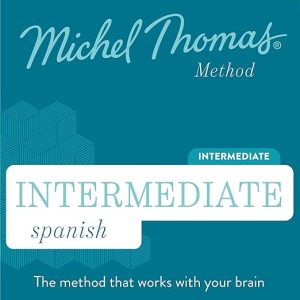
Six hours and twelve minutes into this audiobook course, something clicked that months of app-based Spanish learning had never produced. The Intermediate Spanish Michel Thomas Method audiobook sits at step three of five in the sequence Thomas designed over fifty years of teaching, and arriving here after completing Foundation and Language Builder levels means you no longer feel like you are memorizing isolated facts. You feel like you are starting to think in the language, even at a basic level. That shift is the product Thomas is actually selling, and it is a real one.
Singer's narration of the Intermediate level follows the same architecture as the Foundation course but with considerably greater linguistic complexity already in play. Thomas teaches by building blocks: each component of the language is introduced in a sequence designed to let learners reconstruct sentences rather than recite them. The practical consequence is that by the time you are forty minutes into a session, you are forming sentences you have never heard before rather than reproducing sentences you have been drilled on. The method is older than most language apps, but the pedagogical logic holds up.
Thomas Adds the Subjunctive Without Adding Stress
The core of the Intermediate level is the extension of grammatical structures beyond the foundational patterns the earlier courses establish. At this stage, Thomas introduces the subjunctive, more complex tense constructions, and a wider range of conversational registers. The no-books, no-homework, no-memorizing principle that Stephen Fry described as "a unique and perfectly brilliant way of learning languages" in Rescuing the Spectacled Bear remains intact: you are still learning from listening and thinking, not from drilling vocabulary lists or writing exercises. The method's central argument, that stress and pressure are the enemy of language acquisition, is more visible at the intermediate level than at Foundation, because the material is harder and the temptation to resort to memorization is correspondingly stronger.
Thomas himself narrates the course, and his voice carries a mid-century authority that is distinctive and occasionally strange to contemporary ears. He is not warm in the way that modern language instructors performing for algorithms tend to be. He is precise, patient, and exacting in a way that communicates genuine respect for the learner's intelligence. The classroom recordings that anchor the method include two students whose progress listeners can track as a proxy for their own, a pedagogical device that other course formats have borrowed without fully replicating its effect.
Six Hours of Audio Built for This Method
The audiobook format is native to this course in a way it is not for most language learning products. The Michel Thomas Method was always audio-based: the method predates apps, streaming, and the gamification of language learning by decades, and it was designed for the medium of recorded sound. You do not lose anything by listening rather than sitting in a classroom. The format is the intended delivery mechanism, and the six-hour-and-twelve-minute runtime is designed to be experienced in roughly fifteen to twenty hours of active listening, pausing and responding as Thomas instructs.
A PDF companion is included with the purchase, and while it is not required for the audio content to function, it provides useful reference material for learners who want to review the grammatical structures covered in each session in written form. The course works without it, but having it available for the sessions where Thomas introduces more complex constructions is genuinely helpful.
Grammar Grows, But Vocabulary Still Lags Behind
The Intermediate course assumes you have completed Foundation and Language Builder. Jumping in here without that foundation is not recommended by Thomas's own stated sequence, and the reason is structural rather than arbitrary: the Intermediate level builds directly on patterns established in the earlier courses, and without those patterns in place, the building-block method loses its coherence. If you are arriving at this listing without that background, starting from Foundation will serve you significantly better than beginning here.
The method's consistent weakness, visible at the intermediate level, is vocabulary acquisition. Thomas's approach produces syntactic confidence and grammatical intuition at a rate that other methods do not match. It does not produce broad vocabulary breadth. The Vocabulary Course, which Thomas designed as step four in the sequence specifically to address this gap, is the recommended follow-on for exactly this reason. Learners who finish the Intermediate course and expect to hold extended conversations in Spanish will find they have the grammatical scaffolding for those conversations but need considerably more vocabulary to fill it in.
What the Intermediate course does particularly well is address the gap between knowing individual grammatical rules and being able to deploy them in sequence when constructing an original sentence. At the Foundation level, learners are building relatively simple structures. The Intermediate level asks them to hold more pieces in working memory simultaneously, combining tenses and subjunctive forms in ways that resemble actual conversation rather than textbook exercises. Thomas's sequencing is designed to build that working-memory capacity gradually, and by the end of the six-hour course most learners will find they can generate more complex Spanish than they expected to reach at this stage of study.
Seamless Continuation for Learners Who Stayed the Course
Learners who have already worked through Foundation and Language Builder and want to continue the Thomas sequence will find this audiobook exactly what they need: a direct continuation of the method in a format that integrates seamlessly with the earlier material. The six-hour runtime is manageable, and the progression from the earlier levels is clear and motivating rather than jarring.
Learners seeking a self-contained intermediate Spanish course without prior exposure to the Thomas method, or those who prefer grammar-forward approaches with written exercises and vocabulary lists, will not find that structure here. The Thomas method works by accumulation within its own system, and its full value is available only to those willing to commit to the sequence from the beginning.
Frequently Asked Questions
Can I start with this audiobook if I have some existing Spanish knowledge but no prior experience with the Michel Thomas Method?
It is possible but not optimal. The Intermediate course builds directly on patterns established in the Foundation and Language Builder levels. Experienced Spanish learners with a strong grammatical foundation may be able to adapt, but Thomas's building-block architecture works most effectively when followed in sequence from the beginning.
How long should the audiobook take to complete if I follow the method correctly?
The course contains approximately five hours of main content plus a one-hour review session. Thomas recommends completing it over roughly fifteen to twenty hours of active listening, with regular pauses to think out answers before Thomas provides them. Passive listening significantly reduces the method's effectiveness.
What comes after this audiobook in the Michel Thomas Method Spanish sequence?
Thomas recommends the Vocabulary Course as step four, specifically to address the vocabulary breadth that the method's grammar-focused approach does not prioritize. The Insider's course follows as step five. Completing Intermediate gives you grammatical confidence in Spanish but will require additional vocabulary development before extended conversation becomes comfortable.