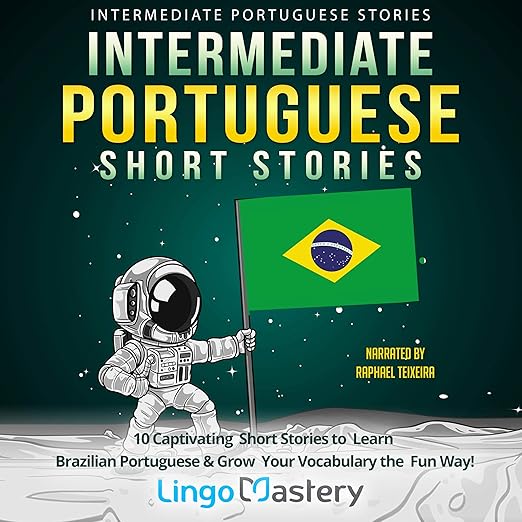
Language learning resources occupy a special and often frustrating category for audiobook listeners. Most of them are either too basic to sustain interest, too dense with grammar instruction to be enjoyable, or so focused on isolated vocabulary that they fail to build the contextual understanding that real conversation requires. Intermediate Portuguese Short Stories, published by Lingo Mastery and narrated by Raphael Teixeira, is a genuine exception to that pattern. This audiobook, designed for B1 and above learners of Brazilian Portuguese, organizes ten short stories around relatable everyday topics and structures the content carefully enough that it functions as immersion practice rather than textbook supplementation. The six-hour-and-ten-minute runtime gives the material room to develop rather than rushing through each story to fit a shorter format.
Lingo Mastery's design philosophy here is explicit: use straightforward grammar and commonly used vocabulary so that the B1 learner is stretching without being overwhelmed, and embed natural dialogue that reflects actual conversational usage rather than textbook construction. Reviewer Anthony Muhye, who had been searching for suitable intermediate material, described finding this audiobook an excellent fit for his level, noting both the difficulty calibration and the vocabulary work at the end of each story. That end-of-chapter structure, available through the companion PDF that accompanies the audiobook, distinguishes this from a pure listening experience and adds a consolidation function that passive listening alone cannot provide. The design treats the audio and the written support material as genuinely complementary rather than redundant.
Raphael Teixeira's narration is the audiobook's most significant asset. Native fluency in Brazilian Portuguese is not just a credentialing note; it means the prosody, the rhythm, the dropped syllables and natural contractions that characterize real speech are present in the delivery rather than the careful enunciation of a non-native reader trying to be maximally clear. For learners working on comprehension, hearing natural speech patterns from a native speaker is considerably more valuable than a technically correct but artificially slowed performance. Teixeira reads at a pace that is accessible to intermediate learners without patronizing them, which is a genuine calibration skill that not all narrators achieve.
Reviewer Jim Peterson, who described himself as a fluent Portuguese speaker using the audiobook for maintenance practice, found it useful for reading aloud alongside the audio, which speaks to the quality of the text as well as the narration. The stories are written by a native Brazilian author, which means the idioms, cultural references, and conversational textures are authentic rather than constructed by a non-native writer who studied the language. That distinction matters at the intermediate level, where learners are beginning to develop an ear for what sounds natural rather than just what is grammatically correct, and where exposure to inauthentic phrasing can build incorrect intuitions that are difficult to correct later.
Bridging the Gap to Authentic Native Content
The practical case for this audiobook is strong for two specific populations: learners who are studying Brazilian Portuguese in an environment where the language is not spoken around them, and learners who have worked through beginner-level material and find the jump to authentic native-speaker content too steep. Intermediate Portuguese Short Stories occupies a productive middle space between those poles. The content is engaging enough to sustain attention across the full six hours, the vocabulary support at the end of each chapter addresses the specific gaps that intermediate learners typically encounter, and the dialogue-heavy structure gives the ear more to work with than narrative description alone would provide.
Reviewer Leisa K. mentioned using this audiobook with an elementary school English as a Second Language program, which indicates the material's range: it is accessible enough for a classroom support context while sophisticated enough to serve genuinely intermediate independent learners. The stories themselves are designed to be relatable across age groups and cultural backgrounds, which widens the potential audience considerably beyond a narrow language-learner demographic. Topics drawn from everyday life mean the vocabulary and structures covered are high-frequency and immediately applicable rather than domain-specific and infrequently used.
Skip the PDF and You Lose Real Value
The audiobook comes with a companion PDF that contains the written text, vocabulary lists, and summaries. That PDF is available through the distribution platform alongside the audio. The audiobook functions without it, but the full learning value requires both components working together. Listeners who are approaching this purely as an audio experience without engaging with the supplementary material are leaving a significant portion of the content value unused. The chapter summaries and vocabulary guides in the PDF serve a different consolidation function from the audio, and active learners will want to use both rather than treating one as sufficient.
This is also explicitly Brazilian Portuguese rather than European Portuguese. The phonological differences between the two varieties are significant, and learners who are studying for a European context should know that the narration reflects Brazilian pronunciation, rhythm, and some vocabulary. For learners of Brazilian Portuguese, this is a strength and a feature of the audiobook's authenticity. For learners targeting Portugal or other European contexts, it is a mismatch worth knowing about before committing to the full listen, because building comprehension around the wrong variety can create more work later.
Teixeira's Natural Speech Suits B1 Listeners Best
This audiobook is well-suited to B1-level learners of Brazilian Portuguese who want engaging, naturally narrated content that serves comprehension and vocabulary building simultaneously. It works particularly well for learners who are living outside a Portuguese-speaking environment and need a reliable source of natural speech input. Skip it if you are studying European Portuguese rather than Brazilian Portuguese, if you are a beginner who needs more scaffolding than this level provides, or if you are an advanced learner for whom the vocabulary and grammar level will feel too comfortable to produce useful stretching. At 4.6 stars across 124 listeners, it has found a consistent and appreciative audience in exactly the demographic it is designed for, and the combination of native narration and structured vocabulary support makes it one of the more useful resources in this specific learning category.
A Few Questions About Intermediate Portuguese Short Stories
Does the Intermediate Portuguese Short Stories audiobook work without the companion PDF?
The audio experience is complete and useful on its own, but the companion PDF adds vocabulary lists, chapter summaries, and written text that significantly increase the learning value. The audiobook format handles listening comprehension and ear training; the PDF handles active vocabulary consolidation. Using both together is the recommended approach.
Is this audiobook suitable for European Portuguese learners, or only Brazilian Portuguese?
The stories were written by a native Brazilian author and narrated by Raphael Teixeira in Brazilian Portuguese. Phonological differences between Brazilian and European Portuguese are significant, including vowel reduction, intonation patterns, and some vocabulary distinctions. Learners targeting European Portuguese should approach this audiobook knowing the accent and some usage will differ from their target variety.
How does the Intermediate Portuguese Short Stories audiobook handle vocabulary that might be above a B1 level?
The writing is deliberately calibrated for intermediate learners, and the end-of-chapter vocabulary sections in the companion PDF address specific words from each story. Reviewer Anthony Muhye specifically cited the vocabulary structure as a strength after searching for suitable intermediate material. The design anticipates that learners will encounter unfamiliar words and provides structured support for building those gaps.