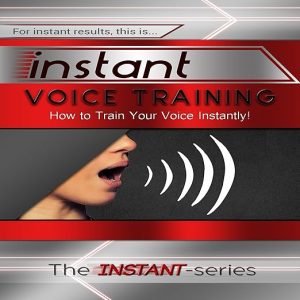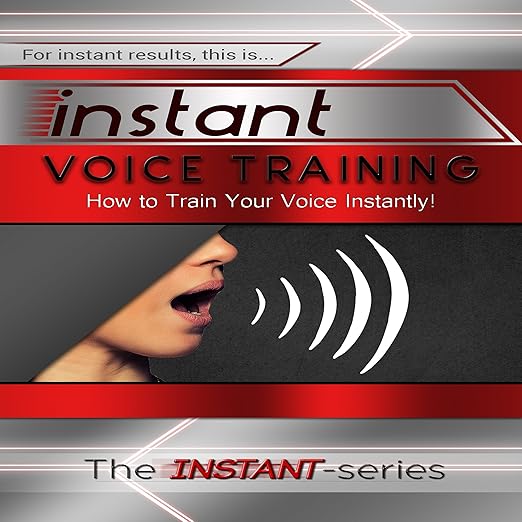
A fifty-four-minute audiobook that asks you to download a separate reference guide before pressing play is an unusual proposition, and Instant Voice Training is upfront about needing that companion document to make full sense of its exercises. The premise is straightforward: your voice, not your appearance or your vocabulary, does most of the work of how you come across to other people, and the program sets out a handful of concrete techniques for changing how yours sounds. It leans on the familiar claim that words make up only a small fraction of communication, with tone and delivery carrying the rest.
The Seven-Percent Statistic, Stretched Too Far
This is part of the INSTANT-Series, a catalog of short, single-topic audio guides, and it behaves exactly like what that format promises: narrow scope, fast pace, no filler chapters building up to the actual technique. One listener with more than twenty-five years in radio said she still learned something new from it, which is a meaningful endorsement given how much voice-technique material already exists for broadcast professionals. Another reviewer specifically praised the breakdown of what the program frames as four basic voice types people react to when someone starts talking, a simple categorization that seems to be the book's organizing idea.
The seven-percent communication statistic the book leans on traces back to Albert Mehrabian's much-cited research, which actually measured how people judge someone's feelings and attitudes, not communication in general. It gets stretched further than its original context supports in a lot of pop self-improvement writing, and this book is not an exception. That does not undermine the practical voice exercises themselves, but it is worth knowing the framing is borrowing more authority from the statistic than the research actually offers.
The INSTANT-Series itself functions as a recognizable house imprint rather than a single author's body of work, publishing short, narrowly scoped audio guides across a range of practical subjects. That model has an obvious tradeoff: a listener gets a fast, focused session on one specific skill rather than the slower-building authority of a single expert's full career perspective, closer in spirit to a workshop handout than a memoir-inflected craft book. Judged against what that format is actually trying to do, a tightly scoped fifty-four-minute session on vocal technique is a reasonable, honest use of the format rather than an underdeveloped one.
A Twenty-Five-Year Veteran Still Learned Something
The pitch covers a wide range of motivations at once: professional speakers and singers wanting more command, people hoping to overcome mumbling or mispronunciation, anyone who wants to walk into a room and be listened to rather than talked over. A working voice actor building a career from the ground up titled his review 'insightful and helpful', a reaction that matters coming from someone who already has professional reasons to be skeptical of a generic guide promising fast results.
At under an hour, the time investment is genuinely low, and the format suits a specific kind of listener: someone who wants a single, focused session of practical technique rather than a multi-hour deep dive into vocal theory. For a working professional trying to sound more confident on client calls or presentations, that briskness is closer to an asset than a limitation, assuming the accompanying reference guide gets downloaded and actually used alongside it.
The claim that voice matters more than appearance in a first impression is not new territory, but the twenty-five-year radio veteran's reaction is a useful data point precisely because her whole career already trained her ear for exactly this material. If someone that deep into professional voice work still found a new angle worth naming, that suggests the exercises are reasonably specific rather than a repackaging of advice most speaking-adjacent professionals have already absorbed elsewhere.
One Series Brand Behind Both Book Credits
The reference guide is not optional. The listing states plainly that listeners need it to go through the audio material, which puts this closer to a workbook than a conventional audiobook; anyone who skips the PDF is very likely missing exercises the narration assumes you have in front of you. This is the single most important practical detail before buying, more important than any question about narration quality.
Both the author credit and the narrator credit here belong to the INSTANT-Series itself rather than a named individual, which is worth flagging directly rather than implying a personal, distinctive voice performance is what a listener is actually evaluating. This reads as house-produced, brand-narrated content rather than a single author or actor's original work, which fits the series' broader model of short, interchangeable technique guides across different topics.
A specific irony is worth naming plainly: a program about improving how your voice sounds and lands with other people is itself delivered by a narration credit with no individual identity attached to it. That is not necessarily a flaw in the content of the exercises themselves, which reviewers describe as genuinely useful, but it does mean listeners looking to this recording as a model of excellent vocal delivery, rather than as a set of instructions to apply to their own voice, will not find that here.
Built for Voice Professionals Who Open the PDF
Working professionals in speaking-heavy roles, singers, actors, and anyone specifically bothered by how their voice comes across on a call or in a meeting are the obvious audience, especially if they are the type to actually open a companion PDF rather than let it sit unused. Someone already comfortable with basic vocal technique from choir, theater, or broadcast training may find less new ground here than the two more experienced reviewers implied, but a true beginner stands to get real, immediately usable value.
Anyone expecting a standalone listening experience with no supplementary material, or a deep theoretical treatment of vocal science, should look elsewhere. This is a fast, practical primer built to be used alongside its guide, not a substitute for one, and the fifty-four-minute runtime only tells half the story of what completing the program actually requires.
Listeners hoping for a slower, more personality-driven audiobook experience, the kind built around a single expert's stories and career anecdotes, should also know this is not that. It moves quickly from premise to technique with almost no narrative padding, which is exactly the point for the audience it is built for, but a mismatch for anyone expecting the more discursive, memoir-adjacent tone common in longer self-improvement audiobooks. Anyone choosing between several INSTANT-Series titles on different topics should expect this same brisk, no-frills approach throughout the line, not a quirk specific to the voice-training entry.
Common Questions
Can I follow this audiobook without downloading the companion reference guide?
Not fully. The listing states you need the accompanying guide to go through the audio material, so this works best treated as a paired workbook rather than a standalone listen.
Who narrates this audiobook if there's no individual name credited?
Both the author and narrator fields are listed as the INSTANT-Series itself, meaning this is produced as branded series content rather than a performance by a single named voice actor.
How long is this audiobook, and is that enough time to cover the material?
It runs fifty-four minutes, which covers the core technique efficiently, but the real learning likely depends on working through the paired reference guide's exercises afterward.