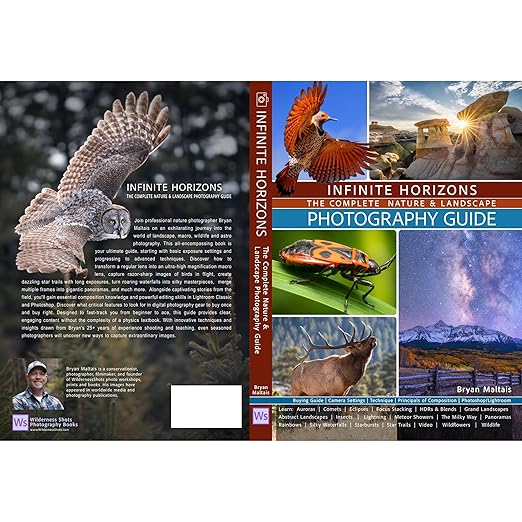
Bryan Maltais opens Infinite Horizons-The complete Nature & Landscape Photography Guide with a premise the audiobook then systematically substantiates: that twenty-five-plus years of field experience can be organized into teachable principles, and that a listener willing to work through those principles carefully will come away with skills that typically require years of costly trial and error to accumulate. This is an ambitious claim for a nine-hour audio guide covering fourteen major topic areas, and the evidence from reviewers - who range from complete beginners to professional photographers - suggests Maltais makes good on it to a remarkable degree.
Turning a Regular Lens Into a Macro One
What distinguishes Infinite Horizons from the crowded field of photography instruction is its breadth combined with specific practical depth. Maltais covers landscape, macro, wildlife, and astro photography, as well as Lightroom and Photoshop editing, but does not treat any discipline superficially. The macro section alone, according to one reviewer, was revelatory because it taught the right technique, prevented unnecessary gear purchases, and demonstrated how to convert a regular lens into an ultra-high magnification macro lens using materials most photographers already own. That kind of specific, counterintuitive knowledge - the sort experienced photographers have accumulated through expensive mistakes - is distributed throughout the book and substantiates the subtitle's claim to comprehensiveness.
Maltais is also unusually strong on the question of gear, which is often handled badly in photography instruction. The book's first chapter, structured around what to know before buying, is oriented toward avoiding the purchases that beginners most commonly regret. One reviewer describes the whole guide as equivalent to a degree in photography in terms of the knowledge it conveys, and the gear chapter alone is credited with preventing unnecessary spending. That practical orientation - buy once, buy right - runs through the book's approach to both equipment and software recommendations throughout all fourteen chapters.
Editing Chapters Ask You to Open the Software
The question of how photography instruction transfers to audio format has an honest answer: better than you might expect, with some limitations. Chapters on composition, light management, depth of field, and the principles governing subject selection all translate well because they are fundamentally about concepts and decision frameworks rather than visual demonstrations. The editing chapters on Lightroom and Photoshop are more challenging in audio, since workflow instruction is inherently visual, and listeners working through those sections will want to cross-reference with the software open in front of them.
Thirty-Eight Minutes a Chapter, Built to Revisit
The Virtual Voice narration delivers the content at a consistent pace without the dramatization that some instructional audio suffers from. For technical material, this even-keeled delivery is a reasonable trade: you are here for the information, and the narration stays out of its own way. At nine hours and five minutes across fourteen chapters, the pacing is appropriate for content that benefits from slow absorption rather than cover-to-cover consumption. Multiple reviewers recommend this as a reference to return to rather than a one-time listen, which is the right framing for audio instruction of this density.
A practical listening note: the fourteen chapters average roughly thirty-eight minutes each, which makes a session-based approach - one chapter per listen, with practice in between - well-suited to the material. Maltais's field stories serve as memory anchors: when you recall a technique later, you often recall the story that illustrated it first, which makes audio an unexpectedly effective format for instruction that might seem inherently visual.
The Chapter on Not Ruining Nature for a Shot
The chapter on protecting nature in the age of social media - one of fourteen, and one that many guides skip entirely - reflects Maltais's investment in the ethical dimensions of the craft. The tension between getting the shot and not damaging the environment or disturbing wildlife is real and underserved in most photography instruction. Maltais addresses it directly, which gives the book a seriousness about consequence that sets it apart from purely technical guides focused only on output quality.
Listeners should also note that the audio edition incorporates field stories alongside the technical instruction - Maltais draws on his decades of experience shooting aurora, meteor showers, lightning, and wildlife to illustrate principles with specific situations from his own practice. These narrative sections provide context for the technical content and make the instruction more memorable than a list of settings and techniques would be on its own. The book covers an unusually wide range of disciplines within nature photography, from star trail photography to insect macro to silky waterfall technique, and each section is detailed enough to function as its own standalone tutorial.
Thirty-One Five-Star Reviews, Unusually Uniform
The guide is designed explicitly to serve beginners through advanced practitioners, and reviewers at both ends of that spectrum confirm it delivers. Complete beginners will find a structured progression from camera basics through advanced technique without the jargon barrier that afflicts many technical guides. Intermediate photographers looking to extend their skills into night sky or macro will find specific, actionable instruction that goes well beyond surface-level tips. Seasoned photographers are likely to find new approaches even in familiar disciplines, as Maltais draws on techniques not standard in mainstream instruction. Those working purely in portrait, street, or event photography will find much of the content outside their primary discipline, though the composition and light management chapters are broadly applicable regardless of genre.
The five-star rating across thirty-one reviews is unusually uniform for a technical guide of this scope, where readers often penalize complexity. That uniformity suggests Maltais has calibrated the technical depth correctly: deep enough to be genuinely useful, accessible enough that the learning curve does not become a barrier. Reviewers ranging from complete beginners to professionals who describe it as equivalent to a photography degree confirm that the guide's multi-level claim is accurate rather than aspirational.
Before You Listen
Does this audiobook work for complete beginners with no photography background?
Yes, by design. Maltais structures the book to progress from foundational concepts - camera settings, exposure, depth of field - through advanced techniques, making it accessible to listeners who are just starting out. The gear chapter is specifically oriented toward preventing beginner mistakes, and reviewers with no prior background report finding it approachable throughout.
Does photography instruction translate well to audiobook format given that it is a visual craft?
Mostly yes, with one important limitation. Conceptual instruction on composition, light, and subject selection transfers well to audio. Editing workflows in Lightroom and Photoshop are harder to follow without visual reference, and listeners may want to have the software open while working through those chapters. Consider supplementing with visual resources specifically for the editing sections.
Does Maltais recommend specific gear brands or is the equipment guidance brand-neutral?
The book focuses on what features and specifications to look for across gear categories rather than specific brand recommendations, which makes the guidance more durable as product lines change over time. The approach teaches you what to evaluate rather than which product to buy, which reviewers describe as preventing the expensive purchasing mistakes that typically accompany early photography learning.
Is this audiobook useful for someone who only wants to learn one type of photography, like macro or night sky?
Each chapter functions as a relatively self-contained tutorial on its subject area. However, the early chapters on camera settings, light management, and composition provide foundational knowledge that the later specialized chapters build on. Starting from the beginning is recommended even if your primary interest is in a specific discipline covered later in the book.