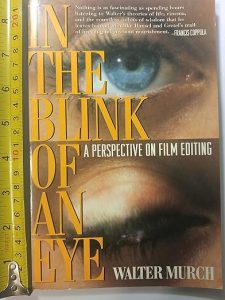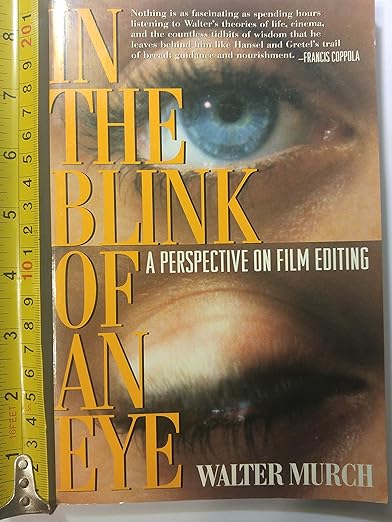
Everything on this listing points backward. The publisher shown is a small film-book press, the release date reads April 1995, a page count of 114 sits where an audiobook description belongs, and the five reviews are dated 1998, 2000, 2002, 2014 and 2015. The synopsis is a single line: "The author reveals his views on the art of film editing". What the record does give you is a runtime of three hours and forty-eight minutes, a 4.6 average from 28 ratings, and Chris Brinkley listed as the reader of Walter Murch's In the Blink of an Eye, and those three facts have to do a lot of work.
Reviewers Call It 'The Bible for Film Editing'
The book itself needs no defending, and on this page neither does its author: a reviewer writing in 1998 names Julia, The Unbearable Lightness of Being, The English Patient and Apocalypse Now among the films Murch worked on. Reviewers here treat this slim volume as canon: one calls it "The bible for film editing", "Taught in most film schools and for good reason", and adds that it is "Easy to read, brief, and unrivaled". Another, writing in 1998, describes Murch as one of the great image and aural montagists working, and credits the book with going "inside the metaphysics of editing film and sound in a most understandable way".
Two specifics from the reviews tell you what the argument actually is. One reader singles out the blink theory itself, the idea the title is built on, and the same review points to the passages on Apocalypse Now as the practical illustrations that make it stick. Another reviewer, addressing anyone planning a career in the industry, promises "some ral insights in the mind of an editor" in their own spelling, and frames the book as something that makes you a more useful member of a crew rather than a theorist.
As I read it, the appeal is that Murch treats a technical craft as a perceptual one. The question is not which frame to cut on but what a viewer's attention is doing at that instant, and that reframing is why a 114-page book from the mid-1990s is still assigned. It also happens to be the reason this recording is a stranger proposition than it looks.
Two Minutes a Page Suggests a Different Edition
Think about what a reader is being asked to carry here. This is a theory of vision delivered without anything to see. Murch reasons about the moment a viewer's eye stops tracking, about the rhythm of attention, about cuts you notice and cuts you do not, and a listener has to hold all of it as description. A recording of this book needs the pacing of a lecture rather than a narration, with enough space after each proposition for a listener to picture the example before the next one arrives. That is the specific craft demand, and it is why I would sample the section on the blink itself rather than the opening pages.
Against that, the format has a real advantage for this particular text. Under four hours is genuinely short, which makes it a single-sitting book, and one reviewer's word for the prose is easy. Craft argument at this length also rewards repeat listening in a way a manual would not, and film people who already have the ideas in their hands may get more from hearing them re-explained than from rereading a book they know.
One arithmetic note worth passing on. That runtime against the 114 pages this record lists works out to roughly two minutes a page, appreciably slower than trade nonfiction usually runs. That difference is large enough to suggest the recording may follow a longer or later edition than the 114-page entry describes. It is an inference rather than a fact, and it is one more reason to check the product page before buying.
A Gift Notice Inflates a Twenty-Eight-Rating Pool
The edition muddle is the headline caveat. Nothing visible on this page describes an audio product: the publisher, the page count, the identifier and the 1995 date all belong to a printed book, and the earliest review predates the year 2000. The tag on the listing reads Photography, which is not what the book is about. A buyer therefore has no way to confirm from here which edition was recorded, whether it is unabridged, or when the recording was made. Verify all of that on the product page before buying, because the review pool cannot help you with any of it.
Dated material is a genuine issue here rather than a quibble. One reviewer praises the comparison between non-linear systems and linear film editing, and in 2002 that was a live professional argument. Today it is a historical one, since the transition it examines finished long ago. The perceptual theory has aged beautifully. The technology discussion has aged into a document about how the industry felt at a hinge moment, which is interesting for different reasons than the ones a working editor is buying for.
Treat the score cautiously as well. Twenty-eight ratings is a slender pool, and one of the five written responses is a gift notice which states outright that its stars represent the recipient's opinion rather than the reviewer's. That leaves four substantive readings, all of them warm, all of them about a printed book, spread across seventeen years. The consensus about Murch is trustworthy. The number attached to this particular recording is close to meaningless.
Confirm the Edition First, Sample the Reading Second
Editors, assistant editors, film students and anyone building a career in post-production are the obvious audience, and the reviews treat it as foundational rather than optional in that world. It will also reward directors and cinematographers who want to understand what happens to their footage, and screenwriters curious about how structure survives the cutting room. Anyone who simply loves film and wants to know why a scene feels the way it does will find the perceptual argument fascinating on its own terms.
Look elsewhere if you want software instruction. Nothing here teaches a timeline, a keyboard shortcut or a workflow, and anyone hoping for that will find a philosophy of attention instead. Readers who need current technical context should treat this as history, and anyone who prefers to study diagrams and frame comparisons will be better served by the printed edition, which is short and cheap.
So the recommendation is conditional, and I would rather be plain about that than pretend otherwise. The book is a landmark and four hours is nothing. The listing, though, is a print record wearing an audio runtime, with no reviewer anywhere on the page who has heard it. Confirm the edition first, sample the reading second, and if both hold up, this is one of the shortest routes into how film actually thinks that anyone has written.
Why does this audiobook page show a page count and a 1995 print publisher?
Because the record appears to merge a printed edition with an audio one. The identifier, publisher, date and 114-page count all describe the book, and every review predates 2016. Only the runtime and narrator credit belong to the recording, so confirm the edition on the product page.
Does Murch's argument survive an audiobook with no images?
Mostly, since his reasoning is about what a viewer's attention does rather than about specific frames. One reviewer calls the writing easy to read and unrivaled. Expect to supply the mental pictures yourself, and expect the passages on Apocalypse Now to work best because you may already know the film.
Is a book from the mid-1990s still useful to a working editor?
The perceptual theory is still taught in film schools, according to one reviewer, and holds up entirely. The section comparing non-linear systems with linear film editing has become a historical document rather than practical guidance, since that transition is long finished.
Is four hours long enough to cover film editing properly?
It is not a comprehensive manual and never claimed to be. A shade under four hours buys a focused argument about how cuts work on an audience, which is exactly what one reviewer means by calling it brief and unrivaled. Pair it with technical training.