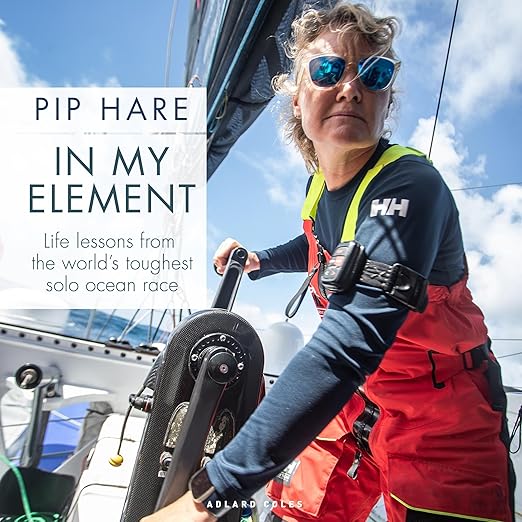
I started In My Element on a gray November morning, headphones in, walking around a park that felt very far from the Southern Ocean. By the time I reached the first storm sequence, I had stopped walking entirely and was standing still on a path, completely absorbed. This is the effect Pip Hare's memoir tends to have.
The Vendee Globe Race is the planet's most demanding solo sailing competition, a non-stop lap of the world with no assistance allowed, through some of the most hostile waters on earth. Hare entered the 2020-2021 edition in a boat that was, by the field's standards, underfunded and technically outclassed. She finished, and in the process discovered something about herself that she spends this book trying to articulate. The bonus audio material from her archives, unique to the audiobook edition, adds documentary texture that print readers miss entirely.
The Review
What separates this from the considerable shelf of solo-sailing memoirs is the intellectual honesty Hare brings to the experience. She is not writing a triumph narrative, though there is triumph in it. She is writing about what it actually means to function alone on 30 minutes of sleep at a time, in darkness, in cold, with a boat that might fail at any moment. The mental management strategies she describes, the way she reframes fear, rations emotional response, and finds what she calls being in flow, are specific and credible rather than generically inspirational.
The comparison one reviewer drew to recovering from spinal fusion surgery is telling. Hare's account functions as a genuine companion text for anyone navigating an extended ordeal, not because the circumstances are similar but because the psychological architecture is the same. You are dealing with a challenge that exceeds what you thought you could handle. You have no choice but to continue. You find ways.
What Makes In My Element Worth Hearing
Pip Hare narrates her own book, and this matters enormously. Her voice has the clipped pragmatism of someone who has spent a lot of time making decisions under pressure. When she describes the boat surfing down a wave at speed in the Southern Ocean, laughing out loud from pure exhilaration, you hear something that no professional narrator could manufacture: the actual person who lived that moment. Pete Goss, quoted on the cover, calls it an entertaining and compelling page turner, and the audiobook specifically rewards that description because Hare's delivery gives the page-turner quality a physical dimension.
The bonus archive audio is a genuine addition. Listeners hear actual recordings from the race, weather reports, radio calls, the grain and static of real ocean communication. It situates the memoir in documented reality rather than retrospective reconstruction, which is a meaningful difference for a book that depends on you believing what it describes.
The Caveats
The book operates on two registers simultaneously. On one level it is a race account, detailed and sequential. On another it is a meditation on living fully in the middle of your life, the sense that discovery and transformation are not the exclusive territory of the young. Hare repeatedly frames her Vendee Globe as something that happened to her as a middle-aged woman, which she treats not as a caveat but as the point. She was not supposed to be there, by conventional expectations, and she was there anyway.
Technical sailing knowledge is not required to follow the narrative. Hare explains what she needs to explain and trusts the listener to stay with her. Where she loses some readers is in the more analytical passages about mental frameworks, which can feel slightly clinical after the visceral immediacy of the race sequences. But these sections are relatively brief and ultimately earn their place.
Who Should Pick Up In My Element
This is an excellent match for listeners who enjoy adventure memoirs with genuine intellectual substance, fans of solo endurance sports at any level, and anyone drawn to books about mental resilience and human capability under extreme conditions. It is one of the few sailing books that works equally well for people who have never been on a boat. Those looking for lighter listening should be aware that the Southern Ocean sequences are intense, though never gratuitously so. Strongly recommended.
The Short Version
- Performance: Pip Hare narrates her own book with exactly the right combination of understatement and intensity; you hear the Southern Ocean in her voice.
- What it covers: Solo ocean racing, mental resilience, finding flow as a middle-aged woman
- Feel: Immersive and quietly electrifying
- Our call: One of the finest sailing memoirs in recent years, elevated by a self-narration that makes the Vendee Globe feel immediate and real.
Common Questions
Do I need to know anything about sailing or the Vendee Globe to appreciate this book?
No prior knowledge is required. Hare explains what is necessary and the psychological and human dimensions of the story work independently of any technical sailing interest.
What is included in the bonus audio material mentioned in the synopsis?
The audiobook edition includes actual recordings from Pip Hare's race archive, including weather reports and radio communications from the Vendee Globe. These are woven into the narration to provide documentary texture.
How does Pip Hare's self-narration compare to a professional audiobook narrator?
Reviewers consistently praise it as a strength rather than a limitation. Her pragmatic, understated delivery matches the book's tone perfectly, and the moments of genuine emotion land harder because you know they are coming from the person who experienced them.
Is this book primarily a sailing adventure or more of a self-help or personal development read?
Both threads run throughout, but neither dominates. The race account grounds everything in specific physical reality, while the reflections on mental resilience and living in flow give the book its wider relevance. The balance is handled well.