Quick Take
- Narration: Nick Dolle reads clearly and efficiently, appropriate for a 32-minute guide, though the brevity leaves no room for the narration to distinguish itself.
- Themes: Natural wonders, Icelandic cuisine, budget travel planning
- Mood: Brisk and functional, a quick briefing rather than an immersive listen
- Verdict: A serviceable introductory snapshot of Iceland that functions as a five-minute conversation starter rather than a comprehensive planning resource.
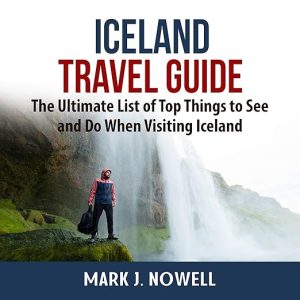
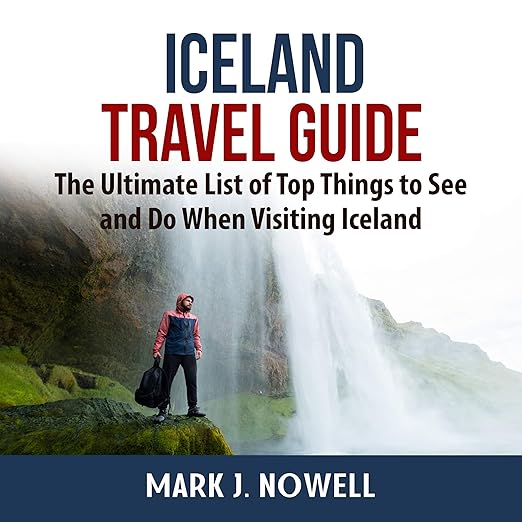
Thirty-two minutes is a specific amount of time. It is roughly the length of a sitcom episode without commercials, or the time it takes to walk from one end of Reykjavik’s Laugavegur shopping street to the other at a relaxed pace. It is also the total running time of this Iceland Travel Guide by Mark J. Nowell, which means we should be precise about what we are evaluating: not a travel guide in the conventional sense, but a brief orientation to Iceland’s key attractions that you can absorb on a single short commute.
Nick Dolle narrates at a confident, businesslike pace that suits the format. There is no pretense of immersive travel writing here, this is closer to a structured briefing than a listening experience. Dolle moves through the material without ornamentation, which is probably the right choice when the entire content must fit inside half an hour.
Our Take on This Iceland Travel Guide
The book delivers what its subtitle promises: a list. Specifically, twelve of Iceland’s best man-made attractions and towns, twelve of its best natural attractions and parks, and a brief section on Icelandic cuisine with restaurant suggestions. For a 32-minute audiobook, that scope is ambitious, and the result is necessarily surface-level. Each attraction gets a paragraph of context at most, enough to identify what it is and why it matters, not enough to tell you how to get there, what it costs, or how to fit it into a realistic itinerary.
The synopsis is refreshingly honest about this: the guide covers budget, accommodation, getting to Iceland, and the major attractions, which is a reasonable outline for a listen this short. The framing around Iceland as a country of natural wonders rather than architectural landmarks is accurate and useful, Iceland’s draw is geological and meteorological, not historical in the European cathedral-and-palace sense, and the guide at least establishes that distinction clearly.
Why Listen to This Iceland Travel Guide
If you are at the earliest possible stage of planning an Iceland trip, still asking whether Iceland belongs on your list at all, this audiobook answers that question efficiently. By the time Dolle finishes, you will know that Iceland has geysers, glaciers, the Northern Lights, black sand beaches, the Golden Circle, and a cuisine built around lamb, skyr, and fresh seafood. You will know the country exists on a geological hot spot that makes its landscape volatile and constantly changing. That is a solid foundation for deciding whether to research further.
The free Audible membership pricing also recalibrates expectations appropriately. At no cost, 32 minutes of reliable orientation to a destination many people know mainly through Instagram is a fair exchange. Listeners who approach it as a brief introduction rather than a planning document will not feel shortchanged.
What to Watch For in This Iceland Travel Guide
The limitations are structural rather than qualitative. A 32-minute audiobook cannot give you the information you need to actually plan an Iceland trip. It cannot tell you that the Blue Lagoon requires advance booking months out, that the Ring Road takes at minimum a week to drive, that highland interior access depends entirely on the season, or that Reykjavik’s restaurant scene has expanded dramatically in the last decade. For that level of detail, you need a full-length guidebook, Rick Steves covers Iceland now, and Lonely Planet’s Iceland edition is thorough.
The 3.6 average rating reflects some listener disappointment on this front, though much of that disappointment reads as misaligned expectations. Reviewers who approached this as a comprehensive guide found it lacking; those who approached it as a quick overview likely found it adequate.
Who Should Listen to This Iceland Travel Guide
Complete Iceland newcomers who want a thirty-minute orientation before diving into deeper research will find this useful. It works particularly well as an introductory listen paired with a longer guidebook or a visit to the Iceland tourist board website. Listeners who already know the basics of Iceland, who have seen the Northern Lights on social media, who know what the Golden Circle is, will learn little here.
Anyone expecting practical logistics, neighborhood recommendations, or the kind of insider knowledge that separates a good guidebook from a bad one should not expect this to deliver. It is a starting point, not a resource, and at 32 minutes it cannot be anything else.
Frequently Asked Questions
Can you actually plan an Iceland trip using this 32-minute audiobook?
Not in any practical sense. The guide identifies major attractions and covers broad categories like budget and accommodation in general terms, but it does not provide the logistical depth needed to plan a real trip. Use it as a starting point and supplement with a full-length guidebook.
Does the guide cover the Ring Road or highland interior routes?
Not in meaningful depth. The guide focuses on the major tourist highlights, natural attractions, man-made sites, food, without getting into specific driving routes, seasonal access restrictions, or itinerary planning. Those topics require a more comprehensive resource.
Is the 3.6 rating a sign of poor quality or misaligned expectations?
Mostly the latter. Reviewers who approached this expecting comprehensive guidance found it disappointingly brief. Listeners who treated it as a brief orientation found it adequate. The content is not inaccurate, it is simply thin by design given the 32-minute runtime.
How current is the information in this 2018 audiobook?
Iceland’s tourism infrastructure has changed significantly since 2018. Specific restaurant recommendations and some logistics details may be outdated. The natural attractions themselves are enduring, but practical planning information should be verified against current sources.