Quick Take
- Narration: Jesse Appell narrates his own memoir, and the self-narration is pitch-perfect, his comic performer’s instincts shape every line reading, making the audiobook format feel like the intended medium.
- Themes: Cross-cultural comedy, American outsider experience in China, the limits and possibilities of humor across language
- Mood: Energetic and warm, with genuine curiosity beneath the comedy
- Verdict: A fresh, engaging memoir about apprenticing in traditional Chinese comedy and eventually writing for a Chinese SNL, Appell’s performer’s voice makes the audiobook the best way to experience this one.
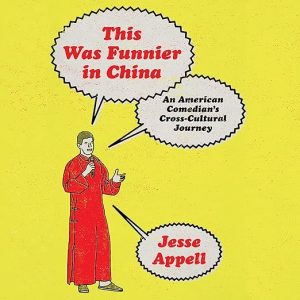
I started listening to This Was Funnier in China on a weeknight when I had a specific question in my mind: what does it actually feel like to be funny in a language that is not your own, in front of an audience that did not invite you? Jesse Appell, who studied Mandarin in high school and ended up apprenticing to a traditional Chinese comedy master, then writing for a Chinese version of Saturday Night Live, has spent years living inside that question. His memoir is the answer.
The book was published in early 2026, which makes it one of the freshest titles in this batch, and it brings with it the energy of a story still close to the person telling it. Appell’s background is in performance, he trained in xiangsheng, a traditional form of Chinese stand-up comedy performed in paired dialogue, and that background shapes not just the content but the structure of the memoir. He understands timing. He understands setup and payoff. And he brings those skills to the prose in ways that make This Was Funnier in China a genuinely pleasurable listen.
Our Take on This Was Funnier in China
The memoir’s central thread is Appell’s apprenticeship under Master Ding Guangquan, a legendary figure in Chinese comedy whose family tree Appell eventually has his name written into. The apprenticeship framework gives the book a clear dramatic arc: a young American arrives in Beijing knowing more about the theory of xiangsheng than about its actual practice, discovers that theory means bombing onstage, and spends years acquiring the cultural fluency that book learning cannot provide.
What he is actually learning, the memoir argues, is not just Chinese comedy but the architecture of cultural understanding itself. The questions he keeps asking, what do people here find funny, how do you handle hecklers, can I say that, are questions about the limits of any outsider’s access to a culture. The fact that they are being asked through the lens of comedy rather than politics or philosophy does not make them less serious.
Why Listen to This Audiobook
Appell narrating his own work is the right call. He is a performer, and he reads with the timing of a comedian who knows where the lines are meant to land. The memoir moves from traditional teahouse performance to a Chinese SNL writers room, and his voice shifts register appropriately across those contexts, deferential in the early apprenticeship chapters, more confident and self-aware as his career in Chinese entertainment develops. Simon and Schuster Audio has produced this well, which matters for a book whose subject is the sound of comedy.
The memoir also has genuine range. Appell’s experience of China spans the teahouse circuit and the television studio, coal mining communities during Chinese New Year and the heart-shaped beds of Shanghai comedy writers. The variety is not superficial, each context is there because it taught him something about what makes people laugh, and he is specific about what he learned.
What to Watch For in This Book
The memoir is focused on Appell’s experience rather than on China as a country, which is the right scope for this kind of book but means listeners wanting a broad portrait of contemporary Chinese culture will find it selective. The world he moves through, traditional comedy circles, television production, the entertainment industry in a rapidly changing country, is one specific slice of Chinese life, and he does not generalize beyond it with much frequency.
The book arrives very close to the present, which means the events it describes are recent enough to feel live. Some of the observations about working in Chinese media and the question of what can and cannot be said will resonate differently depending on when and where a listener encounters them. Appell handles the political dimensions of his experience with care rather than avoidance.
Who Should Listen to This Audiobook
Readers interested in China from an angle that most popular books about the country do not take, through entertainment, traditional performance culture, and the experience of a foreigner earning access to something that does not easily admit outsiders, will find this rewarding. Comedy enthusiasts who want to understand xiangsheng and how it differs from Western stand-up traditions will find Appell an ideal guide. Those who enjoyed books like Peter Hessler’s River Town or Rob Gifford’s China Road, but want something lighter in register, will find Appell occupies a similar territory with more laughs. People looking for political or economic analysis of China should look elsewhere.
Frequently Asked Questions
What is xiangsheng, and does the memoir explain it for listeners who have never encountered it?
Xiangsheng is a traditional form of Chinese stand-up comedy, typically performed by two performers in dialogue and with roots stretching back to the nineteenth century. Appell explains it thoroughly throughout the memoir, and no prior knowledge is required. He is writing for a general audience and takes care to ground each new element of the tradition before exploring it.
Does Jesse Appell speak Mandarin fluently in the memoir, or is the language barrier part of the story?
Both. He studied Mandarin in high school and college and arrived in China with solid foundations, but the memoir covers his development from functional Mandarin speaker to someone fluent enough to perform comedy in front of Chinese audiences. The gap between conversational fluency and comedic fluency, knowing when a joke lands, knowing what cannot be said, is one of the book’s central subjects.
How does the memoir handle the political dimensions of working in Chinese media?
With care and specificity rather than either avoidance or overstatement. Appell’s question ‘Can I say that?’ runs through the memoir as a real professional constraint, not an abstract one. He describes the limits he encountered in the SNL writers room and elsewhere without turning the memoir into a political treatise.
Is this audiobook appropriate for listeners with no background in Chinese culture or language?
Yes, entirely. Appell’s position throughout the book is that of an outsider learning from the inside, and he explains the cultural context he acquires as he acquires it. The memoir functions as its own guide to the world it describes, no prior knowledge of China, Mandarin, or Chinese comedy is required.