Quick Take
- Narration: Mike Hoare reads his own stories with the unhurried confidence of a man who has been telling them at dinner tables for decades, precise, evocative, and occasionally old-world formal.
- Themes: Post-WWII African exploration, physical endurance, colonial-era adventure travel
- Mood: Warm, old-fashioned, and vivid; like receiving letters from a distant correspondent
- Verdict: A time-capsule listen for readers drawn to mid-century adventure writing, narrated by the man who lived it.
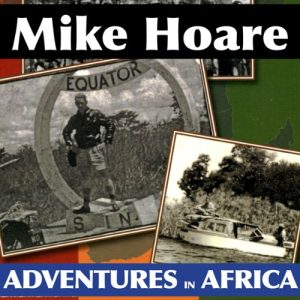
I grew up reading the kind of adventure books where men crossed continents on motorbikes and nobody seemed particularly worried about logistics. Mike Hoare’s Adventures in Africa belongs to that tradition, and listening to Hoare read his own stories, at whatever age he was when the recordings were made, is an experience that is hard to replicate with any amount of professional narration. There is something irreplaceable about the voice of the person who actually did these things.
Hoare is known to history primarily as a mercenary commander in the Congo during the 1960s, but none of that appears here. What you get instead are peacetime adventures spanning the 1950s through the late 1980s: a foot crossing of Basutoland, a motorbike journey from Cape Town to Cairo, sea voyages in a 36-foot ketch, forays into the Kalahari Desert, and eventually a move with his wife to what he describes as an Edenic island in the Okavango delta, where both terrible and wonderful things occur. The geography is vast, the ambitions are personal, and the tone throughout is that of a man who genuinely loved the African continent.
Our Take on Mike Hoare’s Adventures in Africa
The quality of the writing is above what you might expect from an adventurer’s memoir. One reviewer who has read all of Hoare’s books describes his terrific writing making for the most interesting and fun books I’ve ever read, and there is real substance to that claim. Hoare inserts passages of local history at key moments in the journey, grounding the personal narrative in the landscapes and peoples he moves through. The motorbike journey alone, Cape Town to Cairo, is rendered with enough physical and geographic texture to satisfy readers who want more than just a breezy account of having done something difficult.
Why Listen to His Own Narration
At eight hours and 57 minutes, this is the longest book in this batch, and Hoare’s self-narration sustains the runtime with ease. One reviewer calls him wonderfully eloquent and precise, adding that they could listen to him speak all day, and I found myself nodding along to that. There is a calibrated quality to his delivery, WWII veteran, military commander, that gives weight to casual observations. When he describes a particular stretch of African bush or the behavior of the sea in a specific channel, it lands with authority. Another reviewer writing from the UK notes they lost their copy years ago and came back to repurchase it, which is the quiet endorsement of genuine attachment.
What to Watch For in These Adventures
Context matters here. These are colonial-era adventures written and experienced from a specific vantage point, a white, British-educated military man who moved through Africa in the mid-twentieth century. The historical perspective is that of its time, and readers who engage with mid-century travel writing will recognize the conventions. The book does not pretend to be something other than what it is: a personal account of adventures that were remarkable precisely because the Africa Hoare moved through was in the process of enormous political change, even if that context is mostly background noise rather than foreground subject.
What also distinguishes this collection from pure adventure writing is the attention Hoare pays to the people he encounters. The local histories he inserts at key points are not digressions; they are the sign of a traveler who understood that the landscape he was moving through was not an empty stage for his adventures but a place with its own deep time. Whether you agree with his politics or his era’s assumptions, his curiosity about the places he visited is genuine, and it gives the book a texture that distinguishes it from the simpler category of men-doing-hard-things adventure writing.
Who Should Listen to Mike Hoare’s Adventures in Africa
Readers who love mid-century adventure and exploration writing, Hammond Innes, Wilbur Smith, the tradition of the gentleman adventurer, will find Hoare’s company immediately recognizable. Fans of travel memoir in the Robert Byron or Eric Newby mode will appreciate the precision of observation. Anyone drawn to African geography and landscape writing will find reward here. This is not a book for listeners seeking contemporary social or political analysis of the continent, but as a window into a particular kind of post-war physical adventuring, it is vivid and irreplaceable.
Frequently Asked Questions
Does Mike Hoare’s mercenary career feature in Adventures in Africa?
No. One reviewer specifically notes that none of his mercenary work is mentioned. The book covers peacetime exploration and personal adventures only, spanning roughly the 1950s through the late 1980s.
How does Hoare’s self-narration hold up over nearly nine hours?
Remarkably well. Hoare is described by listeners as eloquent and precise, with a voice that sustains the material without fatigue. His military background gives the delivery an authority that suits the adventure content.
Is Adventures in Africa a continuous narrative or a collection of separate stories?
It is a collection of separate adventures, the foot crossing of Basutoland, the Cape Town to Cairo motorbike journey, the sea voyage, the Kalahari expedition, rather than a single through-line narrative. The final chapter covers his and his wife’s time in the Okavango delta.
How does the colonial-era perspective affect the listening experience today?
The book reflects the attitudes and assumptions of a mid-twentieth-century British military man traveling through Africa. Readers who engage with period travel writing will find it consistent with that tradition. Those expecting a contemporary critical lens on African history and colonialism will not find it here.