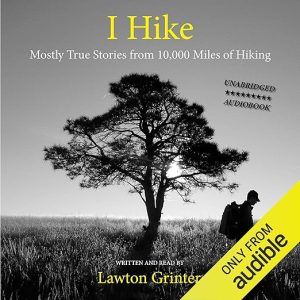
Ten thousand miles over roughly a decade produced twelve stories, and this audiobook is upfront about being a highlight reel rather than a chronicle. Lawton Grinter opens by admitting he never set out to hike that far and that it just sort of happened over the course of ten years. The collection that follows keeps exactly that tone: episodic, unsentimental, and far more interested in the strange middle of a long trail than in any summit photograph.
Twelve pieces cover the range that long-distance hiking actually contains, and the copy makes no attempt to smooth it out. Blissful high ridges appear alongside what the description calls the mental lows of mosquito hell. Things that go bump in the night sit beside the kindness of strangers and a close encounter with hypothermia. The organizing principle is not chronology or geography but simply whichever incident turned out to be worth retelling afterward.
Mosquito hell is the copy's own phrase and its bluntness is representative of the whole. Grinter writes for people who already understand that the misery is the content, and the book earns its laughs by refusing to redeem any of the suffering. The absurd rites of passage that long-distance hikers inflict on themselves get treated as absurd rather than as spiritual, which is rarer in this genre than it ought to be.
Lawton Grinter reads his own work, and on a book like this the decision is close to structural. These are anecdotes carrying trail names, in-group jokes and comic timing that depends on knowing precisely where the punchline sits. The person who lived them controls the pacing of them. You get the teller rather than an interpreter, which is a different proposition from a performed memoir and, for this particular material, the more natural arrangement. Nothing here needs a performance, because the stories were built to be told out loud in the first place.
Why I Hike Works as an Audiobook
Tom Jamrog, five stars, reported reading a few of the twelve mostly true stories on a camping trip in the Maine woods and having both himself and his wife laugh out loud more than once. That detail is the best argument anyone has made for the book. It works when shared in company, which is the exact context a spoken edition recreates, which is also why the humor rather than the scenery is what people quote back.
Self-narration also solves the vocabulary problem neatly. Thru-hiking has a dialect, and trail names, resupply logistics and shorthand for the three long routes all pass through the prose without explanation. An outside reader would have to make a decision about how heavily to lean on each unfamiliar term. Grinter simply says them the way hikers say them, which keeps the book from slowly turning into a glossary with jokes attached.
Jane, five stars, described a collection of vignettes from thru-hikes on the Appalachian, Pacific Crest and Continental Divide trails that swung between hilarious and genuinely informative, and praised its realism about the rigors involved. That mix is the appeal in miniature. Gear choices get discussed with the wisdom or the lack of it made plain, and the practical detail keeps the funny material anchored to the actual walking.
Hypothermia, mosquitoes and situations even seasoned hikers may find unbelievable are the copy's own selling points, and the honesty of that list is disarming. Most trail writing sells transcendence. This one sells the parts that make hikers laugh at each other years afterward, and the promise that the book will make you laugh, cry and cringe is arranged in that order for a reason. Cringing is the dominant register, and the collection is stronger for accepting that than it would be reaching for a larger meaning.
Weak Spots in I Hike
Dates on this page tell a story of their own. Four of the five surfaced responses predate the October 2014 release of this recording, arriving in July 2012, January 2014, March 2014 and August 2014, with only one written afterward. The reception collected beneath this audio edition was earned by the printed book, which is worth knowing before reading that average as a verdict on the listening experience. Two hundred and fifty ratings look substantial until you notice how few of them could possibly have come from anyone who pressed play.
Roadrunner supplied the sharpest dissent at three stars, having read it cover to cover and found the best-of stories neither compelling nor, by that reviewer's standard, worth a book at all. The complaint is specific and fair. Someone who has personally lived through the same situations will recognize them as ordinary rather than remarkable, and familiarity is exactly what makes this collection warm for one listener and thin for another.
Michiele Shaw, four stars, framed a similar reservation more gently, saying the book petered out toward the end while still delivering funny material, and mentioned this was a twentieth title about long trails. That context matters enormously. A reader deep into the subgenre grades this against the best of it, and the recommendation that followed pointed toward Cheryl Strayed's Wild as the stronger book of the two.
The Right Listener for I Hike
Armchair hikers and actual thru-hikers want different things, and this serves the second group considerably better. If you already know the difference between the three long trails and have carried a pack for longer than a weekend, the humor lands immediately and the shorthand costs you nothing. Future Ruins, five stars, arrived through a hiking friend who knows Grinter personally and finished the book wanting substantially more of it.
Anybody hoping for a single sustained narrative should adjust their expectations before starting. This is not a trail journal with an arc, and the copy admits as much by calling it a collection of short stories. The pieces do not build toward anything cumulative, and the recurring complaint across the responses is that it stops rather than concludes. Readers wanting the shape of a journey should look at full-length memoirs.
Trail-name culture gives the game away here. Grinter goes by Disco in these circles, and the responses reach for that name more readily than for the one on the cover. This is a book written from inside a community and read aloud by the person who lived it, making no attempt whatsoever to translate itself for anyone standing outside. Take that as the recommendation and the warning together, because both of them are accurate.
Frequently Asked Questions
How connected are the twelve stories in I Hike?
Barely connected at all, and deliberately so. The pieces are standalone episodes drawn from about a decade of walking, ordered by what proved worth retelling rather than by route or chronology. Nothing accumulates into an arc, which is why several readers describe the ending as simply stopping.
Will this audiobook work for someone who has never hiked long distance?
Partly. The comedy translates, and the copy promises that anyone who has stepped off the pavement will enjoy it. But nicknames, jargon and in-group references go unexplained, and one reader deep in the subject found the incidents ordinary rather than remarkable, so expect a lighter experience without that background.
Does the writer reading his own work change the audiobook?
It matters more here than usual. These are anecdotes with comic timing and a hiker's vocabulary running through them, and having the person who lived them control the pace keeps the jokes landing where intended. The effect resembles stories traded at a campsite rather than a produced performance.