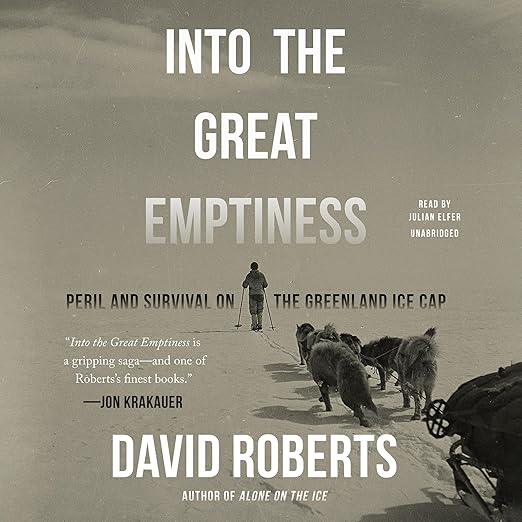
Greenland's east coast in 1930 was the least mapped shoreline on the planet, and this audiobook follows the thirteen scientists and explorers who sailed for it anyway. Their leader, Henry George Watkins, was twenty-three and younger than every man under his command. His plan was to plant a permanent weather station on the ice cap at 8,200 feet so that aircraft might one day cross from Europe to North America on a northern route. What followed is among the stranger survival stories of the last century, and David Roberts assembles it from firsthand accounts and archives.
A Transpolar Air Corridor as the Funding Pretext
Roberts, whom the publisher's copy calls the dean of adventure writing, has produced a life of Watkins as much as a chronicle of an expedition. The polar detail is all present, and so is the peculiar social world that produced the man: an Oxford undergraduate raising serious money and recruiting older, better qualified people to follow him onto an ice sheet nobody had wintered on. The book keeps both registers going, and the second one sets it above the standard endurance narrative.
Spence38a, who withheld the fifth star in January 2025, put a finger on the same thing. That account describes Watkins organizing trips to Labrador and Greenland under the guise of establishing way stations for the emerging air travel industry, and found the most interesting material not in the weather or the route but in his ability to influence and motivate men older and more experienced than himself, and to raise the money that made any of it possible. The word guise is doing real work in that sentence.
Agreement from Roberts is implicit throughout. The commercial pretext, a transpolar air corridor with a meteorological anchor at its center, is what let a young man with no institutional standing turn an adventure into a funded scientific mission. Read the expedition purely as heroism and the achievement shrinks. Read it as a piece of successful salesmanship that then had to be survived, and the whole thing becomes stranger and considerably more interesting than the jacket suggests.
Courtauld Alone Beneath the Snow Through the Winter
Midway through, the book earns everything the opening chapters set up. When a snowstorm strands the autumn resupply and the station cannot be provisioned for another two-man rotation, August Courtauld volunteers to stay alone through the winter so the mission can continue. He is buried under an immovable weight of frozen snow, running short, invisible from the surface. A relief party covers 130 miles in March and finds nothing. Watkins sets out on April 21 with two companions. Chronology carries that sequence, and a recording is at its best when chronology does the work.
Posting six days after this recording appeared in December 2022, ironmanth gave it five stars and called it a well-researched adventure book about a natural explorer and fearless leader. That same note speaks of Roberts in the past tense, which is worth knowing if you come expecting a living author's later corrections or interviews. No explanation for the phrasing appears anywhere on the listing, and the book itself is presented as completed archival work rather than an ongoing project.
Numbers are what stay with you. Temperatures below negative fifty degrees Fahrenheit. Two-month rotations by pairs. Twelve continuous months of observation planned by people who had never wintered anywhere comparable. Heard aloud, the arithmetic of the scheme reveals its own failure long before the narrative admits it, because every figure quietly assumes a resupply the weather was never going to permit. Roberts lets the reader do that subtraction rather than announcing it.
Maps Are the Thing This Format Cannot Hand You
Maps are the thing this format cannot hand you, and the August 15, 2023 account, which awards full marks, lists them among the reasons the story worked, calling them detailed about the routes. A book built on a 130-mile relief march, a coastline nobody had charted, and an inland station at a specific elevation keeps asking you to look at something. Have a map of Greenland open beside you, or accept that most of the geography will remain abstract from the first chapter to the last.
Names arrive densely and cannot be glanced back at. Watkins, Courtauld, the rotating pairs, Labrador, the east coast, the interior, and the Ice Cap Station itself all appear quickly, and a listener does more bookkeeping here than a reader does. Half an hour of inattention costs you the thread of who is where and why it matters. The page files the book under memoir and under sports and outdoors, though the explorers and survival tag is the only accurate one of the three.
A Review That States the Outcome Outright
Dissent here comes from a February 2024 note at three stars, and it carries two warnings. That reader states the outcome of the expedition outright while praising how well the mostly inexperienced party performed, so anyone who reads the pool first will know how the story ends. The same response also renders the leader's first name as Gina rather than Gino, and searching under that version returns nothing useful. Go in cold, and take your spellings from the publisher's description.
A Nine-Hour Account of Endurance and Vision
Polar exploration readers are the obvious audience, along with anyone drawn to the odd institutional world of 1930s British exploration or to the narrower question of how young people talk their elders into catastrophic undertakings. It also suits listeners who prefer their adventure writing researched rather than dramatized. Roberts works from primary material throughout, and the restraint shows in the pacing: the crisis arrives when the documents say it arrived, not when a screenwriter would want it.
Endurance and vision is how a short August 12 entry, unreserved in its praise, sums the book up, and that pairing is exact. The endurance belongs to Courtauld, alone beneath the snow through an Arctic winter with no way of signaling that he was still alive. The vision belongs to Watkins, selling an air route across the top of the world before anyone had proved a plane could survive the crossing. Listeners who care about only one of those threads will find the other occupying more time than expected.
Listeners who need maps in hand should buy the print edition first and treat the recording as a second pass, and anyone hoping for a fast-moving disaster narrative will find the biographical chapters slow going. Everyone else gets a nine-hour account of a scheme that should not have worked, told by a writer who declines to inflate it. The restraint is the point, and it makes the April rescue land harder than any amount of embellishment could.
A Few Questions About Into the Great Emptiness
Does the audiobook include the maps that reviewers praise?
The listing says nothing about a companion PDF, and route detail is exactly what a recording cannot hand over mid-chapter. Since the expedition turns on a 130-mile inland march and a station at a fixed elevation, pull up a map of Greenland's east coast before starting, or expect every distance to stay abstract.
Do I need background in polar history to follow this audiobook?
No. Roberts explains the meteorological purpose of the Ice Cap Station and the logistics of the two-man rotations as he goes. What helps far more than prior reading is a rough sense of Greenland's geography, since the narrative moves constantly between the coast, the interior, and the 130-mile route between them.
How much of this is biography rather than expedition narrative?
A substantial share. Roberts covers Watkins the fundraiser and recruiter alongside Watkins the traveler, and the portrait of how a twenty-three-year-old assembled and then led an older, better qualified party takes up as much room as the ice does. Come for polar hardship and a full life story arrives with it.
Is Gino Watkins a real historical figure, and why do some reviews spell it differently?
He is real, and the publisher's description gives his full name as Henry George Watkins, nicknamed Gino. Spell it that way when searching, since the variants in circulation return nothing useful. Expect August Courtauld's surname to be the harder of the two to catch by ear if you go looking for further reading.