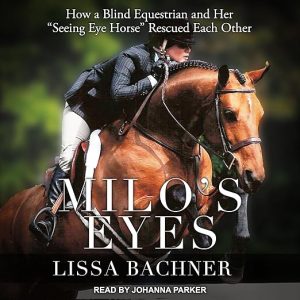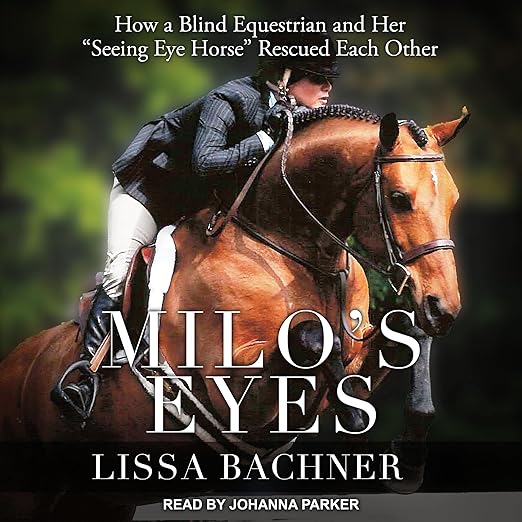
A Better Book Than Its Inspirational Surface Suggests
Lissa Bachner won her first blue ribbon at five years old. By the time she was a teenager, she was training with jumpers, tackling increasingly difficult heights, refining the partnership between rider and horse that competitive show jumping demands at its serious levels. Then blindness arrived and appeared to end it all. Milo's Eyes is the audiobook account of what happened next, narrated by Johanna Parker, and it is a significantly better book than its inspirational-memoir surface suggests. Bachner writes with humor and specificity that keeps the material honest even when the story is, objectively, extraordinary.
The memoir opens with the particular disorientation of losing a sense that had organized your entire athletic identity. How do you jump hurdles when you can barely navigate your own home? That question is not rhetorical. Bachner actually answers it, in practical, physical terms, through the long and technically demanding process of learning to ride competitively without sight. The account of that relearning is where the audiobook separates itself from the standard disability-overcome-through-determination narrative: she is not vague about what the work looked like, how many times she failed, or how dependent the whole enterprise was on other people's expertise and her own willingness to trust a horse she could not see.
Parker Captures Humor Used to Stay Present
Milo himself arrives on New Year's Eve, imported from Germany, frightened and neglected, shaking in a filthy state that would not suggest a future show-jumping partner to most observers. Bachner's promise to him, that he would only know kindness from that point forward, is the emotional foundation of the book, and she earns that moment by showing how it was built rather than simply asserting it. The chapters covering the early months of their partnership document a specific process: the trust had to be constructed from scratch, on both sides, between a blind woman learning to read a horse through feel and sound and a traumatized animal learning that humans were not always a source of fear.
The show jumping sequences are handled with real technical literacy. Bachner explains how the communication between her and Milo worked during competition, what her trainer's voice directions meant, how her body learned to anticipate rhythm and distance through feel rather than sight. These passages are the best in the book, because they make the reader understand that what Bachner and Milo achieved was not miraculous in the sense of being inexplicable. It was miraculous in the sense of being the product of an enormous amount of specific, disciplined, demanding work.
Johanna Parker's narration serves the material well throughout. She captures Bachner's voice as someone who uses humor not to deflect from difficult moments but to stay present in them. The medical passages, which cover multiple eye surgeries in the kind of clinical detail that another narrator might deliver with misplaced drama, Parker handles with the matter-of-fact tone Bachner clearly intended. When the emotional weight does arrive, Parker does not oversell it. The restraint is the right choice for a memoir that earns its feeling through accumulation rather than performance.
Reviewers describe the book as impossible to put down and written with such emotional and technical skill that readers with no prior knowledge of horses or equestrian sport find themselves absorbed. One reviewer mentions starting after seeing Bachner interviewed and immediately ordering the audiobook, which speaks to how transferable the core story is across readerships. This is not a book only for equestrians or disability memoir readers. It is a book about what trust between two living creatures looks like when it is built carefully and tested under real conditions.
An Asset That Comes with Occasional Unevenness
Bachner's decision to tell the story with what she calls effortless humor is both the book's great asset and its occasional unevenness. Some readers accustomed to more solemn disability memoir may find the tonal shifts unexpected, particularly in passages that move quickly from surgical recovery to dry observation about barn politics. This is clearly a deliberate choice, and it reflects Bachner's actual personality as a narrator, but listeners expecting linear emotional escalation should know the book moves differently than that.
The depth of the equestrian world detail is worth flagging for listeners who are not coming from that background. Bachner does not over-explain the sport, which is a stylistic virtue but can occasionally leave newer readers slightly behind when specific competitive formats or training terminology appear without translation. The audiobook rewards patient listeners who let context build.
The final chapters, covering what Bachner and Milo achieved as one of America's most successful blind-rider teams in show jumping, are handled with appropriate restraint. She does not linger on the achievement as validation but as a logical outcome of the relationship she and Milo built. That framing is what gives the book its coherence.
A Story That Never Asks for Your Admiration
This audiobook will resonate most deeply with readers who love memoir that relies on earned specificity, horse enthusiasts who want technical and emotional depth, and anyone interested in disability narratives that are not organized around overcoming in a generic sense but around the genuine complexity of rebuilding a specific life around a specific passion.
Listeners who prefer memoirs with a more uniform emotional register, or who find animal-human bond narratives sentimental by definition, may find the pacing and tonal variety challenging. But for the reader willing to follow Bachner into the technical and emotional details of what she and Milo built together, Milo's Eyes delivers something genuinely uncommon in the genre: a story of perseverance that never once asks for your admiration.
A Few Questions About Milo's Eyes
Do I need to know about horses or equestrian sport to enjoy this audiobook?
No, though the technical detail about show jumping is present throughout. Bachner writes for a general reader and the human and emotional story is fully accessible without specialist knowledge. Some equestrian terminology appears without extensive translation, but context carries most readers through.
Is the audiobook narrated by Lissa Bachner herself or a professional narrator?
Johanna Parker narrates the audiobook. Parker is a professional voice artist who captures Bachner's reported humor and emotional directness well, and several reviewers describe the listening experience as immersive and emotionally impactful throughout.
How does this audiobook handle the medical detail around Bachner's vision loss and eye surgeries?
Bachner writes about multiple eye surgeries with clinical specificity, and Parker narrates those passages with a matter-of-fact tone that reflects Bachner's intent. The medical detail is present and honest but not dramatized in ways that feel exploitative or designed to provoke distress.