Quick Take
- Narration: William Roberts captures Bryson’s deadpan timing with reasonable fidelity, though Bryson’s own self-narrated recordings tend to carry an extra layer of comic precision.
- Themes: Cultural friction, the comedy of misunderstanding, the gap between travel idealism and reality
- Mood: Caustic and warmly funny, with a nostalgic undercurrent
- Verdict: One of Bryson’s most consistently funny books, a European tour conducted entirely by a man determined to be mildly outraged by everything he finds.
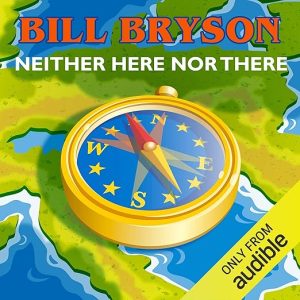
I was halfway through my morning commute when Bill Bryson attempted to order a meal in a German restaurant and wound up in a standoff with a waiter over something he never quite identified, and I laughed hard enough that the woman next to me moved seats. That is the Bryson experience: carefully constructed humiliation, delivered with such precise timing that you feel guilty for laughing and then laugh anyway. Neither Here Nor There, his account of a 1990 backpacking trip across Europe, is among his most reliably funny books, and William Roberts handles the narration with enough comic instinct to preserve most of the timing.
The setup is pleasingly simple. Bryson, middle-aged and mildly domesticated after seventeen years in Britain, decides to retrace a 1970s trip he took with his friend Katz through Europe. He goes alone this time, which means there is no one to blame when things go wrong. From Hammerfest in Norway, the northernmost town on the European continent, he makes his way south through Scandinavia, the Low Countries, Germany, Switzerland, Italy, and on toward Istanbul. He is robbed by pickpockets in Florence. He battles Parisian drivers. He navigates the sex shops of Hamburg’s Reeperbahn with a mixture of anthropological curiosity and performative embarrassment.
Our Take on Neither Here Nor There
What distinguishes Bryson from lesser travel humorists is the quality of observation underneath the jokes. He notices things, architectural details, social rituals, linguistic quirks, with a sharpness that earns his complaints. When he craps on a city, as one reviewer put it, he usually has specific evidence for his dissatisfaction. The joke about the German restaurant is funny because it is built on a real observation about communication across language barriers. The complaint about Parisian drivers is funny because it is accurate.
The nostalgic structure, Bryson 1990 following the path of Bryson and Katz 1970, adds a layer of melancholy to the comedy that elevates the book beyond a simple collection of travel observations. He is not just visiting Europe; he is visiting a younger version of himself, measuring the distance between then and now. That distance turns out to be less amusing than he expected, and the moments when the book acknowledges this are its most resonant.
Why Listen to Neither Here Nor There
The audiobook format suits Bryson particularly well. His prose is constructed like stand-up material, it builds toward punchlines, then subverts them, then subverts the subversion. Roberts is a competent narrator who respects the structure of Bryson’s sentences and does not rush the beats. For listeners who find reading Bryson funny, the audio experience amplifies that, hearing the prose delivered aloud reveals the care with which the sentences are built.
Several reviewers noted laughing out loud, which is not a common experience with audiobooks. One listener from India called Bryson extremely funny and clever, which is accurate on both counts. The cleverness is what sustains the humor across nine hours. Pure slapstick degrades quickly in audio form; Bryson’s literary slapstick holds up because the sentences themselves are doing the work.
What to Watch For in Neither Here Nor There
The critique that Bryson craps on every country he visits is worth taking seriously. He does have a tendency to find the worst in each destination and then generalize from it with comic confidence. Some listeners will find this charming; others will find it grating. By the third or fourth country, the pattern is visible: Bryson arrives, is disappointed by something specific, extrapolates to a grand cultural conclusion, and moves on. If you enjoy that pattern, you will enjoy all nine hours. If it starts to feel repetitive, there is no structural shift that will relieve it.
The book also belongs firmly to its moment. Bryson traveled in 1990, just as the Soviet bloc was dissolving and Europe was rearranging itself. His observations about Eastern Europe feel dated, and some of his generalizations about national character have aged in ways that can occasionally land awkwardly. These are minor notes in a largely durable comic record.
Who Should Listen to Neither Here Nor There
Bryson fans who have not yet reached this one should not hesitate, it sits comfortably among his best work, and the European scope gives it a breadth his single-country books cannot match. Anyone planning a multi-country European trip will find it entertaining pre-departure listening, even if the practical value is approximately zero. Listeners who enjoy comic travel writing in the tradition of P.G. Wodehouse and Evelyn Waugh’s travel essays will find Bryson a natural fit.
Those who prefer their travel writing reverent or informative should look elsewhere. Bryson is not trying to help you appreciate Europe; he is trying to make you laugh at it, and at himself, and at the entire enterprise of the modern tourist. He succeeds reliably enough that the book has stayed in print for thirty-five years.
Frequently Asked Questions
Is the William Roberts narration a good substitute for Bryson’s own self-narrated recordings?
Roberts is competent and preserves Bryson’s comic timing adequately, but listeners who have heard Bryson narrate his own work will notice a difference. Bryson’s self-narrations carry an extra layer of deadpan precision that comes from knowing exactly where the joke lands. Roberts gets most of them, but not all.
Does Neither Here Nor There work as a standalone, or should I read Bryson’s other travel books first?
It works perfectly as a standalone. The 1970 backstory with his friend Katz is explained within the text itself, and no prior Bryson knowledge is required. That said, readers who enjoy this will want to go directly to Notes from a Small Island and In a Sunburned Country afterward.
How does the book hold up given that Bryson traveled in 1990?
The comedy holds up very well; some of the cultural observations feel dated. Eastern European sections in particular reflect a pre-EU, mid-transition moment that no longer exists. Treat those sections as historical texture rather than current characterization.
Is the humor consistent throughout all nine hours, or does it flag in places?
It is remarkably consistent, though a few mid-book chapters covering Switzerland and the Low Countries are slightly less electric than the Norway opening and the Italy sections. The pattern is visible enough that listeners who tire of it early should treat that as a signal to adjust expectations for the remainder.