At a Glance
- Voice: Marcus Jackman is the voice on fourteen and a half hours of advocacy, where the register question is whether a case this confident lands as argument or as verdict.
- Big ideas: Classical apologetics, arguments for a creator, the source of morality, the reliability of the New Testament accounts.
- Atmosphere: Systematic, assured, combative in a friendly register.
- Worth it?: The right purchase for a Christian listener who wants the classical case in full; the undecided will get clarity, the committed skeptic will get a fight.
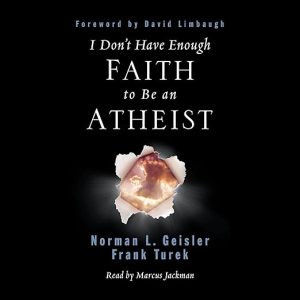
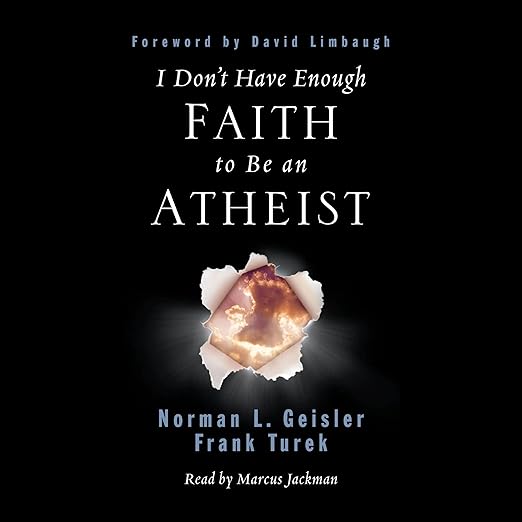
Apologetics has a reputation problem, and the title of this audiobook walks straight into it. Fourteen hours and thirty-three minutes of argument, delivered by two people who think the burden of proof sits on the other side, is either an invitation or a provocation depending on where you start. Norman Geisler and Frank Turek clearly know that, and the confidence is the product.
The Verdict, Briefly
The structure is old-fashioned in a way that works. Geisler and Turek move through the traditional, tested arguments for the existence of a creator God, then turn to the source of morality, then to the reliability of the New Testament accounts concerning Jesus, and only at the end to a detailed investigation of the claims of Christ. Each stage is meant to be load-bearing for the next, which is what classical apologetics means in practice. The claim being defended is not modest: not merely that Christianity is reasonable, but that it is more rational than unbelief, and the whole recording is built to earn that sentence.
The star rating on the listing cannot be earned, though, and it is worth pausing on. The page shows 4.8 from a rating count of five. Five written responses sit beneath that count, and every one of them grades the title at five stars. Five whole votes of five stars average to 5.0. For 4.8 to appear, the five votes would have to total twenty-four, meaning one of them is a four, and no four is visible anywhere. The counter and the written column are the same size here, so no pool of silent voters can rescue the number. One of the two fields is simply wrong.
What Makes I Don't Have Enough Faith to Be an Atheist Worth Hearing
The case for spending an evening or three here comes from an unexpected direction. A five-star response opens by identifying itself as an agnostic looking for something to believe in, tired of lukewarm explanations and radical fundamentalism from both camps, and explicitly unwilling to dismiss atheist or religious arguments because their tone was irritating. That reader stayed. Whatever else the book does, it holds the attention of somebody who came in unconvinced and stayed suspicious, which is a harder test than pleasing the already persuaded.
The second reason is methodological, and another five-star entry names it precisely: this is classical apologetics rather than presuppositional apologetics or evidentialism, and the difference lies in where the arguments begin rather than in what they defend. That distinction is genuinely useful to a listener. It tells you the book will start from reason and general revelation and work toward Scripture, instead of starting from Scripture and working outward. If you have found other apologetics frustrating without knowing why, that sentence is probably the diagnosis.
Marcus Jackman reads it, and the format deserves a warning of its own. A book of numbered arguments is a reference work in disguise: on the page you can turn back three chapters to check a premise before accepting a conclusion, and in fourteen and a half hours of linear audio you cannot. The chain is long, each link is designed to hold the next, and a listener who drifts through the morality section will find the New Testament material resting on something they did not fully receive. Plan for a second pass through at least one section.
Points to Consider
The sharpest objection on the page comes from inside the tent. A five-star entry filed from Australia describes itself as a Catholic reader, calls the treatment of atheistic and materialistic philosophies convincing and the scientific material enthralling, and then flags a single disagreement: the way the book assigns miracles. That is a small note with a large implication. This is a Protestant apologetic, and readers from other traditions will find the shared ground enormous and the last few feet contested.
The written column also travels further than the recording does. Of the five entries, two are not in English at all, one filed from the Netherlands and one from Italy, and the Italian entry opens by noting how fast the parcel arrived. A star average assembled from editions in three languages and several countries tells you something about the book's reach and almost nothing about this recording, which was published in August 2022, years after most of those entries were written.
Then the register. Confidence is what sells this book and confidence is also its limit: the argument is presented as settled at each stage before the next begins, and a listener who wants the strongest counterarguments stated in their strongest form will find them summarized rather than inhabited. That is a fair choice for the genre. It is worth knowing before you commit fourteen and a half hours to it.
The Right Listener for I Don't Have Enough Faith to Be an Atheist
The surest fit is a Christian listener who wants the classical case laid out at full length and in order, either to settle their own thinking or to be able to make it to somebody else. The copy names that audience directly, offering a more sophisticated defense than most people carry around, and the recording delivers it in a form you can revisit section by section. Small groups and study classes get real value here, since the argument breaks cleanly at the joints.
The people who will bounce off it are equally easy to identify. Committed atheists will meet a book that has already decided the question and argues from that position, and the title alone will set the terms of the encounter. Listeners who want dialogue rather than case-building should look for a debate format instead. Anybody in the middle, genuinely undecided and willing to be argued with, is the audience this book was written for, and at least one such reader has already reported that it worked.
Where in the audiobook does the material about Jesus appear?
At the end. The copy describes a final section given over to a detailed investigation of the claims of Christ, arriving after the arguments for a creator God and the section on the source of morality. In a recording this long, that means the part many buyers want most sits in the last stretch.
Is this audiobook aimed at skeptics or at believers?
The copy claims both, and the structure supports that claim unevenly. The arguments for a creator and for the reliability of the New Testament accounts are built to be shown to a skeptic, while the tone assumes somebody who wants the case made rather than stress-tested. Believers wanting a sophisticated defense are the surer fit.
What kind of arguments does the audiobook actually use?
Traditional and tested ones, in the copy's own phrase: the classical arguments for the existence of a creator God, an examination of where morality comes from, and a case for the reliability of the New Testament accounts. Expect philosophy and historical argument rather than testimony or devotional writing.