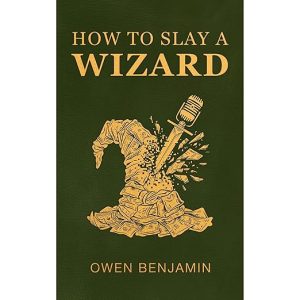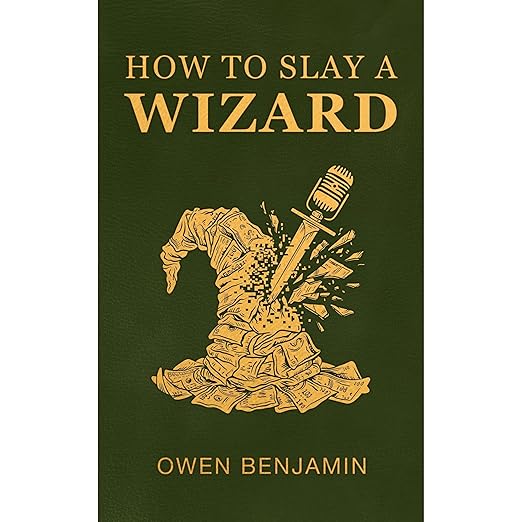
How to Slay a Wizard makes its central claim in the first few pages: spelling is called spelling because words are spells, cursive is called cursive because it flows in curves, and the entire apparatus of modern language is, if Owen Benjamin is right, a mechanism by which a class of manipulators he calls wizards maintains control over the rest of us. This audiobook is five hours of that argument, expanded through memoir, etymology, media criticism, and comedy, delivered in the register that has made Benjamin a cult figure and a polarizing one. The premise is outrageous on purpose, and Benjamin knows it; the joke structure of the book, building toward a punchline that never arrives in the way jokes usually do, is the point rather than an accident.
It Starts With a Dictionary Definition
The book's strongest quality is structural self-awareness. Benjamin is not presenting a series of disconnected grievances; he is building a framework, starting with a dictionary definition of wizard and working outward through what he calls the mechanics of hypnotic language. The progression through fiat currency, propaganda architecture, and what he terms the spiritual sickness of the professional liar is not random. There is a rhetorical logic to the sequence, and for readers who find the opening chapters compelling, the subsequent sections feel earned rather than digressive.
Margarine, Nuclear Drills, and a Magic Trick
What the book is not, and Benjamin says this explicitly, is a political or religious text. That self-framing is worth taking seriously. The analysis of how manipulation works at a structural level, how it requires the participation of the person being manipulated, and how the same architecture repeats across different domains is the core argument, and it is at its sharpest when Benjamin stays closest to it. Reviewer Travis Crosland compares the experience to learning how a magic trick works while still enjoying the performance; the analogy is apt and reflects the book's own self-description of how spells are structured like jokes that never deliver the punchline. Reviewer Shayna Friedman calls it one of the most important books of our time and credits Benjamin as a master of rhetoric applying comedic precision to a serious cultural diagnosis.
The memoir passages, Benjamin's account of growing up eating margarine because the food pyramid said so, hiding under a cardboard desk in nuclear drills, and having his education structured around things he later decided were lies, function as evidence for the book's claims rather than as autobiography in the conventional sense. Your willingness to read them as such will determine how much the overall argument coheres for you. Reviewer Karnok David's minor criticism, that Benjamin hammers his points repetitively, is a fair observation about the book's pacing in its second half, where the accumulation of examples begins to feel redundant for readers who accepted the premise early.
A Pale Shadow of Self-Narration
The honest consideration for audio listeners is the Virtual Voice narration. Benjamin is a comedian and a performer whose rhetorical presence is inseparable from his delivery. The choice of synthetic narration for a book whose central subject is the mechanics of language and persuasion is an irony worth sitting with. The argument about how words carry embedded power arrives in a voice that has no relationship to the person who wrote them, no comedic timing, no inflection that reflects the author's intent. For listeners who are already familiar with Benjamin's voice from his videos and performances, the reading experience will feel like a pale shadow of what a self-narrated version would have provided. That absence is the audiobook's most significant practical limitation.
That said, the material is dense enough that the audio format offers what any audio format offers: the ability to absorb ideas while doing something else. Listeners who want to engage with the argument rather than the performance will find the five hours manageable. The etymology sections in particular reward a listening mode where you can let the connections accumulate without the pressure of a page in front of you, following the thread from spelling to spell to enchantment at an auditory pace that print does not naturally impose.
The One Lie That Makes the Spells Work
The book operates from a set of premises that it states rather than argues from scratch. Benjamin's skepticism toward institutional science, establishment media, and what he frames as the modern ideological consensus is baked into the structure at a level below the explicit argument. Readers who do not share those priors will find the book less like a guide to critical thinking and more like a skilled rhetorician's attempt to move them toward a particular set of conclusions. That is not necessarily a disqualifying observation; Benjamin would likely agree with the description and argue that all books do the same, the difference being whether the author admits it.
The claim at the book's conclusion, the one lie that makes all the other spells work, is handled with a deliberate simplicity that some readers will find revelatory and others will find anticlimactic. The buildup across five hours creates expectations that a payoff this compact either satisfies or doesn't, depending entirely on where you started. The vampire myth explanation and the discussion of the most forbidden word in America, sections that reviewers mention specifically, arrive in the middle of the book and represent the argument at its most creative.
Clarifying Rather Than Converting the Skeptical
Listeners who are already part of Benjamin's audience will find this the most systematic articulation of his worldview outside of his live performances, and the book's structure gives that worldview a more rigorous scaffolding than a podcast format allows. Listeners who are curious about Benjamin as a cultural phenomenon but skeptical of his conclusions will find the read clarifying rather than converting. Those looking for a balanced guide to media literacy and critical thinking that tests its own premises against counter-evidence should look elsewhere. The book is honest about what it is; the question is whether that matches what you're looking for. The Virtual Voice narration is a practical limitation throughout, but the framework itself is more coherent than Benjamin's critics typically allow.
A Few Questions About How to Slay a Wizard
Is the How to Slay a Wizard audiobook narrated by Owen Benjamin himself?
No, the audiobook uses Virtual Voice synthetic narration rather than Benjamin narrating it himself, which is a significant consideration given that his comedic delivery and rhetorical timing are central to how his ideas land in his other media.
Does How to Slay a Wizard work as a standalone audiobook, or does it require familiarity with Owen Benjamin's broader work?
It works as a standalone in the sense that Benjamin lays out his framework from first principles within the text. However, listeners unfamiliar with his background will encounter some premises that the book states rather than argues, so familiarity with his perspective softens that entry point considerably.
How long is the How to Slay a Wizard audiobook and is the pacing consistent throughout?
The audiobook runs five hours and two minutes. Multiple reviewers note that Benjamin's tendency to hammer points repetitively means the second half moves more slowly than the first; listeners who engage most with the book's structural framework will find the early chapters its sharpest section.