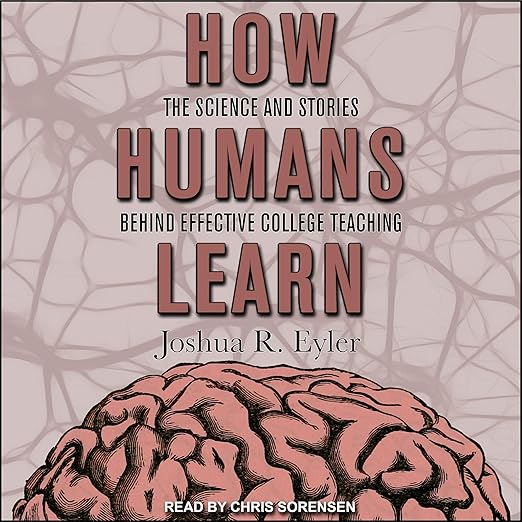
The craft question that How Humans Learn poses is not primarily about pedagogy. It is about what happens when you take the question of learning itself seriously as a scientific inquiry rather than as a set of received teaching practices. Joshua R. Eyler, in this audiobook narrated by Chris Sorensen, approaches that question by doing something that college teaching literature rarely does: he goes back to the biology. He traces the evolutionary roots of learning behavior, follows those roots through developmental psychology, cognitive neuroscience, and anthropology, and arrives at five organizing themes, curiosity, sociality, emotion, authenticity, and failure, that he argues run through the science like structural supports. The result, across eight hours and five minutes of listening, is genuinely illuminating rather than merely useful, which is a harder achievement for educational nonfiction.
Reviewer Evil Overlord captured the audiobook's best quality: the first chapter sends the listener scuttling away on a multitude of excursions following the breadcrumbs Eyler plants. This is the mark of a book that works at a higher level than most educational theory. It does not simply present information. It models the very thing it is describing. A book about curiosity that provokes curiosity is not a trivial achievement. Sorensen's narration supports this quality: his delivery is engaged rather than recitative, and the prose's intelligence comes through in the performance rather than being smoothed over by a neutral read that treats every sentence as equally important.
Treating Failure as a Learning Mechanism
Eyler's structure is worth examining because it is one of the audiobook's consistent strengths. The five themes are not arbitrary categories assembled for organizational convenience. They are derived from the scientific literature and tested against the realities of actual classrooms: Eyler interviews and observes college instructors across the country, and those real conversations are woven through the theoretical material in ways that ground the science in recognizable teaching situations. Reviewer Brittany Avila described the book as taking the onus off of how we teach and redirecting attention to how students learn, which is the central reorientation Eyler is attempting. The distinction matters more than it might appear. Most pedagogical literature starts from the teacher's position. Eyler starts from the learner's evolutionary history and builds forward from there.
The chapter on failure is particularly well constructed and particularly valuable for any listener who has internalized a cultural message that competence means not struggling. Eyler argues that failure is not an obstacle to learning but one of its primary mechanisms, and he marshals evidence from cognitive science and developmental psychology to support that claim with enough specificity that it cannot be dismissed as motivational rhetoric. This is the kind of chapter that reviewer Green was pointing toward when noting the book's biological grounding and its willingness to build from that foundation methodically rather than simply asserting that evolution has something to teach educators.
Sorensen Holds Together Eight Hours of Registers
Sorensen's narration is well-suited to a book of this nature because he maintains consistent intellectual engagement across a wide range of material. The audiobook moves between evolutionary biology, infant development research, brain imaging studies, and practical classroom observation, and it requires a narrator who can hold those different registers together without making the shifts feel jarring or the argument feel discontinuous. Sorensen manages this across the full eight-hour runtime. His ability to vary pace and emphasis in ways that signal when Eyler is building toward a key claim versus illustrating a point he has already established is what keeps the listening from feeling like a lecture even when the content is clearly academic.
The audiobook also works well for listeners who are not college educators but who are interested in learning as a phenomenon in their own lives. The evolutionary framing means the material is not exclusively about classrooms. It is about what human beings are built to do and why standard institutional learning environments so frequently fail to support it. That wider relevance makes How Humans Learn valuable outside the academic context for which it was originally written, and Eyler's clear prose makes the scientific material accessible without sacrificing intellectual substance.
Signposted Summaries Help Track an Eight-Hour Argument
Reviewer Green notes the book's summaries of key ideas from chapters and text-box structures, which are helpfully signaled in Sorensen's narration. These moments are useful anchors for listeners who want to track Eyler's argument across the full eight hours without losing the thread. The chapter on emotion, which examines how fear and psychological safety affect cognitive function, is one of the most practically applicable sections and worth active attention from anyone who teaches, manages, or parents.
The research citations are handled accessibly, which is a minor craft accomplishment in academic audiobook form. Eyler does not drown the narrative in footnotes or make the science feel like a credential-display exercise. He uses the research to build an argument, which is the appropriate ratio. Listeners who want to follow specific citations further will have the tools to do so; those who simply want the conclusions without the apparatus will find Eyler gives them enough to hold onto and enough context to understand why those conclusions matter.
College Instructors First, K-12 Educators Also Benefit
College and university instructors are the primary intended audience, and they will find the most directly applicable material here. That said, the audiobook's evolutionary and developmental framing makes it genuinely valuable for K-12 educators, educational administrators, and parents who want a scientifically grounded account of what conditions support learning rather than inhibit it. Reviewer Evil Overlord's observation that a book achieves something when it does to its reader what the reader hopes to do to students is exactly right, and it describes an audiobook experience that justifies eight hours of committed listening without qualification. This is among the stronger entries in the educational nonfiction audiobook category.
Quick Take
- Voice: Chris Sorensen brings a steady, engaged academic register to How Humans Learn that suits the material without making it feel like a lecture, which is both appropriate and somewhat ironic given the subject.
- Big ideas: Evolutionary basis of learning, curiosity and emotion in education, failure as pedagogy
- Atmosphere: Intellectually energizing and practically grounded
- Worth it?: An audiobook that will change how educators think about their classrooms, and how anyone thinks about why they learn what they learn.
Is this audiobook accessible to listeners without a background in educational research or neuroscience?
Yes. Eyler writes for an educated general audience and explicitly aimed the book at college instructors who are subject-area specialists rather than pedagogy researchers. The science is explained clearly without assuming prior knowledge, and Sorensen's narration keeps the material approachable across the full eight-hour runtime.
How does this audiobook handle the practical application question, or is it primarily theoretical?
It does both. Each thematic chapter includes practical takeaways for educators, and Eyler interweaves interviews with actual college instructors throughout, placing the theoretical claims in dialogue with classroom reality. The balance of theory and practice is one of the book's consistent strengths across its runtime.
Is How Humans Learn available as part of a series, and does that affect what the audiobook covers?
It is part of the Teaching and Learning in Higher Education series from West Virginia University Press, but it stands completely alone. No prior reading in the series is assumed, and the audiobook is self-contained in both its argument and its evidence.