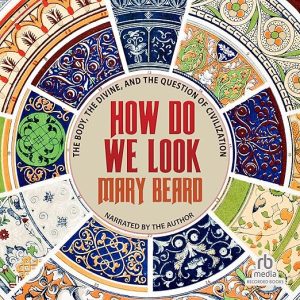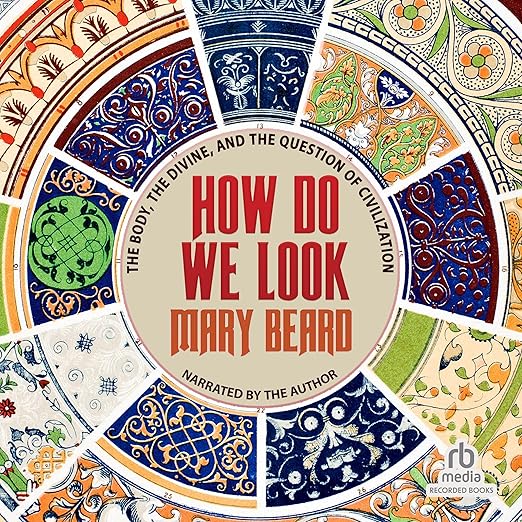
Olmec heads, Amenhotep III's colossal statues, and classical Greek nudes open Mary Beard's tour through how humans have pictured bodies and gods across thousands of years, and at two hours and fifty-one minutes, this audiobook moves through an enormous amount of art history without feeling rushed. Beard narrates her own work here, which matters more than it might for a longer, less idiosyncratic book, since her particular blend of scholarly authority and conversational skepticism is exactly what carries a project this compressed.
A Corrective to Gombrich and Kenneth Clark
The book splits cleanly into two parts. Part one stays in the ancient world, using the Olmec heads of early Mesoamerica, Amenhotep III's colossal statuary, and classical Greek nude sculpture to interrogate power, hierarchy, and gender politics in how ancient societies pictured the human body. Part two moves into religious imagery, from Angkor Wat to Ravenna to Venice to Jewish and Islamic calligraphic traditions, tracing how every religion, ancient and modern alike, has wrestled with the problem of representing the divine at all.
Beard positions the whole project as a corrective to an older, narrower art-historical canon built around Ernst Gombrich and Kenneth Clark, both of whom get named directly in the synopsis as the Western- and male-centric legacy she's writing against. That's an ambitious claim for a book under three hours long, and it mostly earns it by choosing sharp, specific case studies over broad survey coverage.
A Title Doing Careful Double Work
The book was conceived directly alongside Civilizations, the PBS documentary series Beard fronted, and a companion volume called The Eye of Faith, and that dual-media origin explains some of its structure: each chapter reads like a tightly argued television segment translated to prose, moving fast between a specific artifact and a bigger claim about how looking itself is never neutral. Listeners who've seen the series will recognize the pacing immediately; those who haven't lose nothing essential, since the audiobook stands on its own.
The title itself is doing careful double work: 'how do we look' asks both how we appear to others and how we perform the act of looking in the first place, and Beard keeps both meanings active throughout rather than settling on one. A chapter on classical Greek nudes is as much about the ancient viewer's gaze and its assumptions about gender and power as it is about the sculpture itself, which is exactly the kind of doubled reading her scholarly reputation is built on.
The clean split into Part I and Part II functions almost like two connected lectures rather than a single sprawling argument, which suits audio listening well; each half builds its own case before the book pulls back to connect ancient body politics with religious representation as two sides of the same underlying question about power and belief.
Beard's Own Voice Is the Reason to Choose Audio
Beard's own voice is the reason to choose the audiobook over the print edition specifically. She's a Cambridge classicist with a long public-facing career, including the PBS series Civilizations that this book was conceived alongside, and one reviewer credits her directly: 'Her SPQR is her best work, but this new book offers many multi-dimensional observations about world art not often thought or spoken by a single author.' Hearing that voice deliver its own argument, rather than a professional narrator interpreting it secondhand, changes how the skepticism and the authority both land.
Another reviewer, while noting that a book this compact cannot make deep inroads into a subject this vast, still credits Beard with real, specific points to make, arguing that art reveals as much about who's doing the looking as about what's actually being looked at. That's the throughline the whole book pivots on, and it survives the short runtime intact.
Beard's reputation extends well beyond any single book: she's held a professorship in classics at Cambridge for decades, written extensively for a general audience on Roman social history, and built a public voice defined by exactly the qualities this book needs, willingness to argue against consensus, comfort with ambiguity, and a refusal to flatten complicated visual history into a tidy, uncontroversial narrative.
That same public persona carries over online; she's known for engaging directly and often combatively with critics and commentary in a way few academics her stature bother with anymore, and that same willingness to argue rather than retreat into careful neutrality is audible throughout this audiobook's more provocative claims.
Photography That Never Plays Through Your Headphones
This is fundamentally a visual-art book delivered in an audio-only format, and the loss is real. One reviewer specifically credits the accompanying photography as a highlight nearly equal to the prose itself, and that photography simply isn't part of what plays through your headphones. Anyone who wants the full argument, images included, should plan to pair this with the print or ebook edition rather than treating audio as a complete substitute.
Four or Five Pages Per Topic, Built for Chunks
At under three hours, the book covers an enormous geographic and historical range in short, essay-length bursts, four to five pages per topic according to one reviewer. That structure rewards readers after sharp, provocative case studies rather than anyone expecting an exhaustive, chronological survey of world art.
Because the book moves in short, essay-length units rather than one sustained argument, it rewards listening in chunks rather than straight through in one sitting; each case study, an Olmec head, a set of Angkor Wat carvings, a particular Venetian religious painting, works as a nearly self-contained unit, so treating the two-hour-fifty-one-minute runtime as several short listens rather than one long one may suit the material better.
Beard's recurring interest in hierarchy, who gets to look, who gets looked at, whose body counts as ordinary versus symbolic, threads through nearly every chapter here, and listeners familiar with her earlier work will recognize the question as a career-long preoccupation rather than something invented fresh for this project.
Background Details That Turn Out Load-Bearing
Art history enthusiasts who already know Beard's reputation, fans of the Civilizations documentary series looking for a companion piece, and listeners who prefer dense, opinionated nonfiction over exhaustive survey coverage are the clearest audience here.
Listeners who enjoy public intellectuals arguing a specific, contestable thesis rather than delivering neutral survey material will find Beard's voice, on the page and reading it aloud both, exactly suited to that appetite.
It also rewards a second listen more than most short nonfiction does, precisely because each case study is doing more interpretive work per minute than the brisk runtime initially suggests; details that register as background on a first pass often turn out to be load-bearing for the argument once you've heard where Beard is ultimately headed.
Readers hunting for an exhaustive survey of world art will find the scope deliberately narrow; Beard has picked a small number of case studies to make bigger arguments, not attempted anything encyclopedic, and going in expecting comprehensiveness will set you up for disappointment.
In Brief
- Narrator: Mary Beard narrates her own work, and her established public voice, scholarly but conversational, is a genuine reason to pick audio over print here.
- Subjects: representation of the body, religious imagery across cultures, challenging a Western-centric art canon
- Tone: Sharp, opinionated, and compact rather than sprawling
- Bottom line: A smart, short listen for art-history-curious ears, best paired with the print edition for anyone who wants the images too.
Is this audiobook a good introduction to Mary Beard's work, or should I start with SPQR?
Either works as an entry point, but they're different in scope. SPQR is a full Roman history; this audiobook is a short, focused meditation on how art has depicted bodies and gods, better suited to listeners specifically curious about art history rather than Roman history broadly.
Does this audiobook cover a wide range of cultures, or is it mostly Western art?
It deliberately ranges beyond the usual Western canon, covering Olmec Mesoamerica, ancient Egypt, classical Greece, Angkor Wat, Ravenna, Venice, and Jewish and Islamic calligraphic traditions, explicitly positioning itself against a narrower, male- and Western-centric art history.
Is the audiobook missing anything important from the print edition of How Do We Look?
Yes, the photography. Reviewers specifically praise the accompanying images as a highlight of the book, and none of that visual material carries over into the audio-only format.
How long is this audiobook, and does the short runtime limit how deep it goes?
It runs two hours and fifty-one minutes. One reviewer notes candidly that a book this brief can't make deep inroads into a subject this large, but still credits Beard with genuinely sharp, specific points across the material she does cover.